A Different World on Netflix: Is the 2026 Reboot Worth Watching?
TL;DR — Netflix's <em>A Different World</em> (all 10 half-hour episodes, streaming since September 24, 2026) is a sequel, not a remake. It follows Deborah Wayne, the youngest daughter of Dwayne Wayne and Whitley Gilbert, through her freshman year at Hillman College, with Jasmine Guy, Kadeem Hardison, Cree Summer, Darryl M. Bell and a long list of other original cast members dropping in. Critics are mostly positive but not gushing (roughly 80 percent on Rotten Tomatoes and a 72 Metascore when I checked), and the fault line is consistent: reviewers who love it praise its warm new ensemble and honest modern campus stories, while the ones who don't say it leans too hard on nostalgia and has traded the original's comic sparkle for drama. My verdict: yes, it is worth watching if you want a warm, bingeable college dramedy with real emotional stakes, and you will enjoy it more if you stop expecting a laugh-track sitcom. Give it five episodes before you decide.
Get series picks based on this article
Want a warm, character-driven binge in a similar register? Skip the quiz and jump straight to series picks.
Get series picksTell us your mood. We'll do the picking.
8 quick questions. Real series picks from real catalogs — not ads. Free, no sign-up.
Take the quizWhat is the new A Different World actually about?
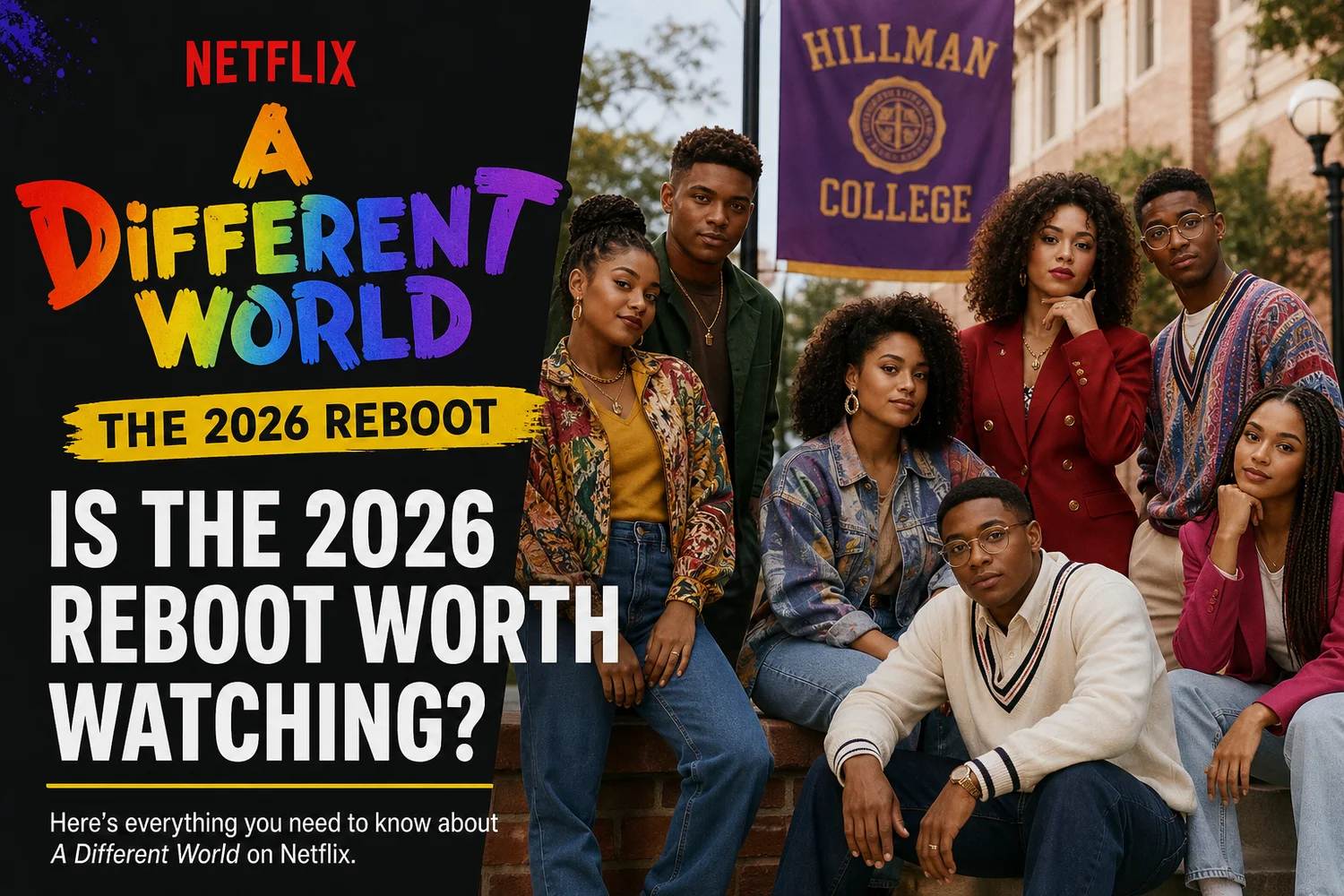
The new A Different World picks up nearly four decades after the original premiered on NBC in 1987. Its lead is Deborah Wayne (Maleah Joi Moon), the free-spirited, somewhat rebellious youngest child of Dwayne Wayne and Whitley Gilbert-Wayne, the couple who became the heart of the original series. Deborah arrives at Hillman College, the fictional historically Black college where her parents met, and her central problem is a familiar one for any child of famous parents: how do you build your own story on a campus where your family name is already on the buildings?
Netflix's official cast guide describes the show in one line as a story about "a freshman and her ride-or-die crew" who "juggle school, romantic drama and family legacy at a historically Black college." That is a fair summary. The show is built around a group of new students, including Deborah's roommate Rashida Duvall (Alijah Kai), a first-generation student from Compton; Shaquille Johnson (Cornell Young IV), a star quarterback; Amir Rodale (Jordan Aaron Hall), a street-smart psychology major from Harlem; Hazel Henry (Kennedi Reece), a small-town girl trying to make her parents proud; and Kojo Achebe (Chibuikem Uche), a fashion merchandising student who wants to design clothes. Around them sits an older layer of Hillman alumni, now adults with careers, marriages, and complications of their own.
What has changed is the format. The original was a network sitcom with a studio-audience feel. The new version is a single-camera, half-hour comedy-drama. Jen Chaney, reviewing for RogerEbert.com, describes the change as a move from a traditional three-camera sitcom to a single-camera dramedy. TheWrap's Diedre Johnson counts the absence of a laugh track as a plus, saying it gives "a more realistic look at the life of a Black student." Time's Judy Berman compares the new look to contemporary dramas such as All American: Homecoming and Bel-Air. That one detail, comedy versus dramedy, explains most of the disagreement in the reviews, so keep it in mind.
Deborah's own backstory matters too. According to Netflix's cast guide, she is an artistic free spirit who ended up at Hillman after a rejection from Tisch. In the reviews I read, she is also described as dealing with an ADHD diagnosis, and What's On Netflix critic Kristen Lopez calls the depiction notably accurate, showing impulsive behavior and procrastination rather than the stereotypical hyperactive kid. Her father, Dwayne, has returned to Hillman as an administrator dealing with a funding scandal, and her mother, Whitley, has built a beauty business called Glitter by Gilbert. Deborah has to keep her grades up while all of that swirls around her.
When did it come out, and where can I watch it?
The series premiered on Netflix on September 24, 2026. That date is deliberate. Wikipedia and Rolling Out both note that it landed exactly 39 years after the original show debuted on NBC on September 24, 1987. All 10 episodes of season 1 were released together, which makes it a natural weekend binge. Netflix's cast guide lists the rating as TV-14, and DVDfever's review puts each episode at roughly 30 minutes, so the whole season is around five hours of viewing.
Where to watch is refreshingly simple: it is a Netflix original, so a Netflix subscription is what you need. I have not verified regional availability outside the United States, so if you live elsewhere, check your local Netflix catalog.
The road to release was not short. Wikipedia reports that Netflix ordered a pilot on March 28, 2025, and that production on the series ran from February 2026 to May 2026 in Atlanta. A November 10, 2025 announcement reported by AOL said the sequel had received a series greenlight, with Felicia Pride attached as showrunner and executive producer and Debbie Allen returning as an executive producer who would direct three episodes, including the premiere. Wikipedia also notes that the production was delayed by the COVID-19 pandemic, so this was not a quick turnaround.
Who is in the cast?
This is the one place where a list is genuinely the clearest format, so here is the cast as Netflix's own Tudum cast guide lays it out, grouped by role in the story.
The new generation at Hillman
- Maleah Joi Moon as Deborah Wayne, the lead and youngest child of Dwayne and Whitley
- Alijah Kai as Rashida Duvall, Deborah's roommate, a criminal justice major from Compton
- Cornell Young IV as Shaquille Johnson, the star quarterback
- Jordan Aaron Hall as Amir Rodale, a psychology major from Harlem
- Kennedi Reece as Hazel Henry, the small-town freshman
- Chibuikem Uche as Kojo Achebe, the fashion merchandising student
- Vincent Jamal Hooper as Ellington, a junior and student assistant to Professor Brooks
- Elijah J. Roberts as Jalen, a junior basketball star from Houston
- Renee Harrison as Candace, a type-A sophomore who is a resident advisor at Gilbert Hall
- Dasan Frazier as Xavier, a student livestreamer who reports campus news
- Joshua Suiter as Andre, the starting quarterback and team captain
The parents
- Jasmine Guy as Whitley Gilbert, now a beauty mogul (Glitter by Gilbert)
- Kadeem Hardison as Dwayne Wayne, a Hillman alumnus and administrator
- Darryl M. Bell as Ron Johnson, Shaquille's father and manager
- Tichina Arnold as Darlene Duvall, Rashida's mother, who runs a store in Compton (Netflix notes she is Alijah Kai's real-life mother)
Other Hillman alumni
- Cree Summer as Freddie Brooks, now a distinguished law professor with her own practice
- Charnele Brown as Dr. Kimberly Reese Boyer, an award-winning heart surgeon
- Dawnn Lewis as Jaleesa Vinson-Taylor, a fundraiser for her alma mater
- Karen Malina White as Charmaine Brown and Ajai Sanders as Gina Deveaux, the campus gossips
- Jada Pinkett Smith as Lena James, now a U.S. Congresswoman
- Joe Morton as Byron Douglas III, a Virginia state senator
Faculty and staff
- Cliff "Method Man" Smith as Coach Bryce Coles, the head football coach and a former NFL player
- Norman Nixon Jr. as Professor Isaiah Baptiste
- Famecia Ward as Nellie Gaines, manager of The Pit
- Aysia Moorer as Officer Boo Boo, the campus security guard
- Raven Goodwin as Dr. Brooklyn Boyer, an adjunct psychology professor
- Debbie Allen as Dr. Langhorne, a longtime academic advisor
- Jenifer Lewis as President Davenport
- Glynn Turman as Colonel Bradford Taylor
Two things stand out in that list. First, the legacy cast is huge, which is a selling point for fans and, as we will see, a complaint for a couple of critics. Second, the returning stars are used in different sizes of role. Time's review says Cree Summer, Kadeem Hardison and Jasmine Guy reprise their roles while Jada Pinkett Smith, Jenifer Lewis and others guest-star, so the balance is roughly this: Guy and Hardison are the returning anchors as Deborah's parents, and the rest of the alumni pop in around the edges.
Who made it?
The showrunner is Felicia Pride, per Wikipedia and the Netflix cast guide. The executive producers listed on Wikipedia are Debbie Allen, Felicia Pride, Reggie Rock Bythewood, Gina Prince-Bythewood, Mandy Summers and Tom Werner, and the production company is The Carsey-Werner Company. Directors named include Debbie Allen, Tiffany Johnson, Angela Barnes, Nefertite Nguvu and Bille Woodruff, and the writers include Felicia Pride, Des Moran and Lisa McQuillan. The theme song is performed by Brandy Norwood, according to Wikipedia.
Debbie Allen's involvement is the most meaningful piece of continuity. She is the person who reshaped the original series after its first season, and she is back both behind the camera and in front of it as Dr. Langhorne. In the November 2025 announcement, Allen is quoted as saying, "There couldn't be a better time than now to reboot A Different World. Our show changed lives, tripled the enrollment of historically Black colleges" and gave voice to young Black America. (That is her own claim; more on the enrollment numbers when we get to the history.) Reggie Rock Bythewood and Gina Prince-Bythewood, both writers and producers on the original series, are back as executive producers as well.
What happens in season 1? (spoiler-free version)
If you have not watched yet, here is the shape of the season without giving away the turns. Deborah arrives at Hillman having to hold a 3.0 GPA, according to The TV Cave's review, and she is quickly thrown together with Shaquille Johnson, the son of Ron Johnson from the original series. Kristen Lopez's review describes the two as having a past, with an ex-boyfriend also attending the school, and it notes that Deborah is dealing with an ADHD diagnosis while her father steps into a bigger role at Hillman and her parents' marriage runs into trouble. Some reviewers describe Dwayne as interim president and others as provost or administrator, so I will just say he is in a senior leadership role and leave it there.
Around Deborah, the show weaves a set of romantic and friendship storylines that mostly play out across the season: a roommate friendship that several critics single out as one of the best parts, a football star working through grief, a student trying to figure out how to be honest about who he is, a small-town freshman with a secret, and a fashion student chasing a career. Alongside the personal stories, the writers keep Hillman itself in the frame. Rolling Out says the season addresses contemporary HBCU challenges including funding pressures, housing shortages, financial aid crises and campus safety. Lopez's review adds that the show touches on social justice, sexuality, religious intolerance and the institution's financial management. In other words, the personal soap opera and the institutional story are meant to run side by side.
The ten episodes are half-hour installments, and the format matters. Because each episode is short and the season is a single continuous story, this is much closer to a serialized dramedy than the episodic, mostly self-contained sitcom of 1987. Chaney's RogerEbert.com review says the show "needs a semester" to figure out its identity, and she defines a semester as five episodes. That is a useful rule of thumb for a viewer deciding whether to stay.
Season 1 recap and ending explained (SPOILER WARNING)
Spoilers ahead for the full season, including the finale. Skip to the next section if you have not finished it.
What follows is drawn from Netflix's own season 1 ending explainer on Tudum, TV Guide's interview with the showrunner, and Men's Journal's list of connections to the original. I have not watched all ten episodes myself, so treat this as a summary of published reporting, and note that some fine details differ between outlets.
Deborah and Shaquille. According to Netflix's explainer, the couple's rift comes from a misunderstanding: Shaquille's phone was confiscated, which is why they lost contact rather than because he lost interest. They reconnect, but Deborah then finds Shaquille's hoodie in Candace's room, which reveals he was unfaithful, and the two break up in the finale. Shaquille is left packing up with a framed photo of his late mother, Jaclyn, and is weighing a move to a college football program in Colorado. Men's Journal adds the detail that Jaclyn was portrayed by Halle Berry in the original series in a Season 4 Valentine's Day episode, which makes the framed photo a quiet callback rather than a new casting.
Amir and Jalen. After Amir admits he slept with Jalen, who is Hazel's boyfriend, the trio eventually repairs things. At the season's closing gala, Netflix says, Jalen tells Amir: "I just never allowed myself to have that kind of bond with another dude before." They kiss and plan to meet privately, but Amir is stopped by his probation officer, and the episode reveals that an ICE warrant has been issued for him. It is a hard cliffhanger and one of the show's clearest efforts to tie personal storylines to real pressures on students.
Hazel and Roger. Hazel confesses that she has been in a long-distance relationship with a childhood church friend named Roger for the whole season. At the gala, Roger texts that he got into Hillman after a gap year, to Hazel's dismay, which sets up a complicated second year for her.
Rashida and Kojo. Rashida and Kojo reconcile and become intimate, but Kojo overhears Andre asking Rashida why she ignored him after they slept together. Kojo leaves the gala with another student, Nneka, and is confronted by an ICE agent asking about his immigration papers. Kristen Lopez's review notes that this storyline is "relegated to the season finale," which she counts among the show's missed opportunities to give a serious topic room to breathe.
Ellington and Denise. The last-minute twist is that Ellington reveals his mother is Denise Huxtable, the character Lisa Bonet played in the original series, tying him directly to Hillman's founding era in the franchise. When Deborah cannot reach Shaquille, she runs to Ellington and they kiss, which is where the season ends. TV Guide's write-up says Dwayne also receives a mysterious late-night call from Denise, hinting at a possible return for Bonet. According to that interview, showrunner Felicia Pride said the team "shot it both ways" for Deborah's ending before Netflix went with the kiss, and that Kadeem Hardison pitched the Denise connection.
Easter eggs for original fans. Men's Journal points to several callbacks. When Byron Douglas leaves Dwayne's office in episode 6, he says "Baby please," a nod to Dwayne's famous wedding plea in the original series. In episode 8, characters discover an Underground Railroad stop beneath Gilbert Hall that Freddie originally found in Season 3 of the original series, which is the kind of deep cut that rewards a rewatch of the classic.
What comes next. Netflix has not, as of Rolling Out's report on September 27, announced a season 2. In the TV Guide interview, Pride poses the guiding question for future stories as "What do we owe the audience?", says she would prefer 15 episodes over the current 10, and imagines the show eventually following characters beyond Hillman, similar to how the original series evolved. That is a wish, not an order.
What did critics actually say about it?
The reviews are not uniform, and the most useful way to read them is by what each critic valued. I read the following directly or through review summaries; I could not access the full Variety and Hollywood Reporter pages, so for those two I will only cite headlines.
The enthusiastic reviews. Variety's headline calls it "a Bold, Fun and Timely Reboot." The Hollywood Reporter's headline describes it as a college comedy that takes "a Beloved Classic Into a Lively New Era, With Charm and Smarts to Spare." TheWrap's headline says the sequel "Gets the A+," and the review, by Diedre Johnson, is positive about the show's identity and its lack of a laugh track. She praises the lead performance in a line I like: "Moon nails Deborah's assertive but insecure nature with no look-at-me acting." What's On Netflix's Kristen Lopez gives it 4 out of 5 stars and says the legacy actors "slip back into" their characters "effortlessly," adding that the new cast is "a lot of fun to watch." Metacritic's summary also shows USA Today giving it an 88 and calling it "the rare series that satisfies the corporate hunger for reboots and the audience thirst for good TV."
The middle reviews. Time's Judy Berman scores it an 80 on Metacritic and describes the sequel as trading the original's comedic spark for something more relevant. She says the new series has "vibrant characters, appealing performances, and a keen sense of how the personal intersects with the political," while noting it lacks the original's energy and wit. The Sunday Guardian's Deepika Pundir gives it 3.5 out of 5 and calls it "a warm and easy to watch comedy drama with a likeable new cast," but says "some of the serious topics are not explored as deeply as they could be." The TV Cave's Lance is positive, saying "it's good to be back," and writes that the show gives "plenty of familiar faces without making the entire show about the past."
The skeptical reviews. RogerEbert.com's Jen Chaney gives the strongest critique among the reviews I could read. She says the series is caught between nostalgia and contemporary storytelling and remains "overly beholden" to its predecessor; Metacritic quotes the show as feeling "too often...beholden to where it came from" to establish its own identity. She also calls the cameos and references "fan service" that feels "dutiful," and Metacritic lists her review at 50. TVLine's Nick Caruso calls Maleah Joi Moon "the best of the new bunch" but says the show's "overly dramatic lean detracts from what could've been a livelier run" and is "too light on the magic and charisma that made the original special." The Guardian shows a 60 on Metacritic. Two smaller outlets also pushed back: MoviesR's Neerja Choudhuri gives it 5 out of 10, citing forced callbacks and missed chances to go deeper, though she calls the Deborah and Rashida friendship "one of the best angles" of the plot; and DVDfever's Dom Robinson found the show "quite bland" with little social commentary.
Put together, the pattern is clear. Nobody says the cast is weak. The praise is nearly always about Maleah Joi Moon's lead performance, the ensemble's chemistry, and the show's decision to treat college life honestly. The criticism clusters around three things: the show is more drama than comedy, it can be too dependent on nostalgia, and a few big storylines (particularly the immigration one) are squeezed toward the end.
What are the scores and the viewership?
Scores on a brand-new series move quickly, so treat these as a snapshot from the days right after the premiere.
- Rotten Tomatoes critics: The season page showed 81 percent from 21 reviews when I checked. Other outlets quoted 82 percent from 17 reviews earlier in the launch window, and PureWow cited 75 percent, so the number has drifted between the low 70s and low 80s while the review pool was small.
- Rotten Tomatoes audience: 68 percent on the Popcornmeter with fewer than 50 ratings.
- Metacritic: a Metascore of 72 ("generally favorable") from 13 critic reviews, with 62 percent positive, 38 percent mixed and 0 percent negative reviews. The user score was 3.8 out of 10 from only 8 ratings, so it tells you almost nothing yet.
- Netflix ranking: Rolling Out reported on September 27 that the show had become Netflix's top show in the United States three days after the September 24 premiere, and PureWow called it Netflix's number one show. I could not find official view-count numbers, so I will not quote any.
The gap between critics and audiences is worth reading carefully. Rotten Tomatoes' audience feedback includes a 10 out of 10 fan who called it "phenomenal" and a viewer who said the drama tilt "loses the heart, humor, and staying power of the classic sitcom." That is the same argument critics are having, just at a smaller scale. Small audience samples are noisy, and I would not lean on them yet.
How does the reboot fit into the history of the original A Different World?
To judge the sequel fairly, it helps to know how unusual the original was. A Different World premiered on NBC on September 24, 1987, as a spinoff of The Cosby Show. As a matter of pure television history, The Cosby Show had aired on NBC from September 20, 1984, to April 30, 1992, and, per Wikipedia, finished number one in the Nielsen ratings for five consecutive seasons, a feat matched among sitcoms only by All in the Family. TV Guide credited it with reviving both the sitcom genre and NBC's fortunes. Spinning a character off to college was a natural move, and the third-season finale of The Cosby Show, titled "Hillman," essentially served as the pilot, introducing the fictional historically Black college in Virginia where the new show would live.
The first season is where the story gets interesting. It centered on Denise Huxtable, played by Lisa Bonet, with Marisa Tomei as her roommate Maggie. It was a ratings hit (Wikipedia says it ranked number two in its debut season with a 25.0 rating) but a critical flop: Rotten Tomatoes' retroactive score for season 1 is 11 percent, with critics calling it "juvenile" and "unrealistic." One journalist described it as drawing "one of the most concentrated doses of critical vituperation ever to greet an instant ratings hit."
Then the show reinvented itself. Bonet left after season 1, the cast was restructured, and Cree Summer and Charnele Brown joined as Freddie Brooks and Kimberly Reese, while Darryl M. Bell was promoted to the principal cast. The most important change happened behind the scenes. Debbie Allen, an alumna of Howard University, became chief creative officer and refocused the series. She began taking writers on yearly research trips to historically Black colleges, and she shifted the spotlight to Jasmine Guy's Whitley Gilbert and Kadeem Hardison's Dwayne Wayne. The Hollywood Reporter later said she transformed the show "from a bland Cosby spin-off into a lively, socially responsible, ensemble situation comedy."
That version of the show took on subjects network sitcoms of the era rarely touched, including race relations, sexual assault, and the Equal Rights Amendment. Wikipedia notes that a 1990 episode was among the first on network television to address HIV/AIDS epidemiology. The guest list was remarkable too: Whoopi Goldberg appeared as a professor in season 4, Jada Pinkett Smith joined as Lena James (recurring in seasons 5 and 6, then main cast in season 6), and En Vogue, Gladys Knight and Jesse Jackson made appearances. Season 6 now holds a 100 percent on Rotten Tomatoes, praised for balancing "comedy and drama that spoke true to the experiences of young Black adults in the early-'90s."
The theme song has its own history: co-written by Stu Gardner and cast member Dawnn Lewis (with a third co-writer credited in Wikipedia), it was sung by Phoebe Snow in season 1, Aretha Franklin in seasons 2 through 5, and Boyz II Men and Terrence Forsythe in season 6. Ratings drifted downward over the run, from that number-two debut to number 71 by season 6 with a 9.6, and the show ended on July 9, 1993, after 144 episodes across six seasons. It aired on Thursday nights, sandwiched between The Cosby Show and Cheers, which helped its early strength, especially among Black audiences.
Its cultural footprint is the big one. Wikipedia reports that during the 1987 to 1993 run, enrollment at historically Black colleges rose 24 percent, and that many Black viewers cited the show as an inspiration for their own college choices. Debbie Allen's 2025 line about "tripled" enrollment is her own, bolder characterization, and I would trust the more conservative Wikipedia figure while acknowledging the show's real influence. The original is currently distributed by FilmRise on Amazon Prime and Netflix, according to Wikipedia, though streaming rights change often, so verify before you plan a rewatch.
The new series is, in essence, a bet that this history is worth continuing. It uses Hillman as a place, Dwayne and Whitley as anchors, and a load of returning faces, but as Tom's Guide's preview pointed out, it has "far less (if any) connective tissue to the Huxtables." The Denise twist at the end changes that a little.
Do I need to watch the original first?
No. Every review I read treats the sequel as approachable for newcomers. Kristen Lopez's review goes further, describing the show as an effective entry point to the 1987 to 1993 series. The show introduces Deborah, Rashida, Shaquille and the others as fresh characters and sets their stakes clearly, so you do not need to have followed Whitley and Dwayne's romance to understand why Deborah is fighting her parents' shadow.
That said, the cameos land with different force depending on your background. Chaney and Choudhuri both say the callbacks can feel dutiful or forced, and that complaint hits harder if you do not recognize the reference. If you want a reasonable middle path, watch the sequel's first two episodes cold, and if the alumni scenes intrigue you, sample a Whitley and Dwayne episode from the original afterward. The reverse order also works: reviews of the original improved from season 2 onward, so you can skip the shaky first season entirely.
How does it compare to grown-ish, Bel-Air, All American: Homecoming and Abbott Elementary?
The new A Different World competes in a crowded lane, and these are the fairest comparisons.
grown-ish is the nearest cousin. Freeform aired it from January 3, 2018, to May 22, 2024, across 6 seasons and 105 episodes, as a spinoff of Black-ish developed by Kenya Barris and Larry Wilmore. Seasons 1 through 4 followed Zoey Johnson (Yara Shahidi) at a fictional California university. It is looser, glossier and more comedic than the new A Different World, which is more grounded and character-driven.
All American: Homecoming is the closest in setting, since it takes place at Bringston University, an HBCU in Atlanta. The CW aired it from February 21, 2022, to September 30, 2024, over 3 seasons and 41 episodes. Its lead, Simone Hicks (Geffri Maya), is a tennis player. It is sportier and more soap-like, and Time's Judy Berman explicitly compares the new A Different World's look to it.
Bel-Air is the tonal comparison for the dramatic reinvention of a classic Black sitcom. Peacock aired it from February 13, 2022, to December 8, 2025, across 4 seasons and 38 episodes. It is more serious than the new A Different World, but the comparison is a useful one because both shows rebuild a comedy legacy as drama. Notably, Bel-Air's first season earned 66 percent on Rotten Tomatoes and its second climbed to 90 percent, which is a reminder that a shaky first season is not a verdict.
Abbott Elementary is the tonal opposite. It is an ABC mockumentary sitcom created by Quinta Brunson, premiering December 7, 2021, with 37 Emmy nominations and four wins in comedy categories according to Wikipedia. If you are missing the joke-a-minute feel of the original A Different World, that show, not the sequel, delivers it.
Living Single is worth adding as the classic-era peer. Created by Yvette Lee Bowser, it aired on Fox from August 22, 1993, to January 1, 1998, following six friends in a Brooklyn brownstone, and Wikipedia lists it on Hulu and HBO Max as of the time of writing.
Who should watch it, and who should skip it?
Watch it if you love college dramedies, want a warm ensemble where a friendship storyline is the emotional center, and you enjoy legacy sequels that hand the spotlight to a new generation. It is also a very good fit if you want a show that treats HBCU life as a full setting rather than a backdrop. Lopez, Berman and Johnson all single out its texture and honesty.
Skip it, or lower your expectations, if you want a laugh-out-loud sitcom. TVLine's Nick Caruso and at least one Rotten Tomatoes viewer say the show has traded comic sparkle for drama, and if that is a deal-breaker, you will feel it within the first few episodes. It is also a poor fit if you dislike nostalgia cameos, because the legacy cast is large. Finally, if you want the show to explore serious themes in depth, note that critics including Pundir, Lopez and Choudhuri say several weighty storylines get thin treatment. The show does touch immigration enforcement and college funding pressures as part of student life, which is worth knowing going in.
What should I watch this if I'm in the mood for...?
- A cozy weekend binge with heart. This is the show. Ten half-hour episodes fit into one afternoon and one evening.
- Nostalgia with a purpose. Watch it, then go back to the original's later seasons to see how the legacy was built.
- A friendship story more than a romance. Deborah and Rashida's dynamic is the part critics most consistently praise.
- Big laughs. Pick Abbott Elementary instead, or revisit the original A Different World in its Whitley and Dwayne era.
- Campus drama with high stakes. Try All American: Homecoming or grown-ish.
- A reinvented classic that goes darker. Bel-Air is the obvious next stop.
- Something you can half-watch. The sequel rewards attention; it is a serialized story, so skip it if you plan to scroll your phone.
If you liked this, what should you watch next?
Start with grown-ish if you want the closest modern college companion, and All American: Homecoming if you want a specific HBCU setting. For a reinvented sitcom, Bel-Air is the pick. For comfort comedy with real heart about people who care about their community, Abbott Elementary is a strong choice, and Living Single is a good period piece. And if the Hillman world hooked you, go back to the original series' Whitley and Dwayne years. If you are not sure which of those matches your mood, that is exactly what our quiz on the site is for, and the link is at the bottom of this piece.
My honest take on the new A Different World
A quick note on how I am framing this. I have read the reviews, the cast guides, Netflix's own ending explainer and the showrunner's interview coverage, and I have not sat through all ten episodes myself. So this is my take based on reviews and reporting, and I would rather say that than pretend otherwise.
With that said, here is what I think. The most interesting thing about this reboot is that it made a choice most nostalgia projects refuse to make: it gave up the format. The original was a sitcom, and the easy, safe move would have been a sitcom again, with a laugh track, catchphrases and a nostalgia payoff every four minutes. Felicia Pride and Debbie Allen chose a single-camera dramedy about an 18-year-old with ADHD, a scholarship roommate, a grieving quarterback and an institution that is struggling for money. That is a braver choice, and it explains why a critic like Judy Berman can call it a respectful reimagining while a critic like Nick Caruso can say it misses the magic.
I think both critics are right, and that is why I lean positive. The original A Different World was not great in season 1 either. Its own history is a lesson: a bland first year (11 percent on Rotten Tomatoes), then Debbie Allen took over and it became one of the most influential shows of its era. A sequel that starts with mixed-to-good reviews and a Chaney-style "needs a semester" warning is on a path the franchise has walked before. The reviewers who say the show finds itself around episode five are, to me, describing a show with a pulse.
What worries me is the legacy cast. A list of returning names this long is a gift and a trap. Every scene spent on a cameo is a scene not spent on Rashida, Amir or Kojo, who are the people Rolling Out says observers predict Gen Z audiences will feel "instantly seen" by. If season 2 happens, I hope Pride follows her own question, "What do we owe the audience?", and leans into the new generation instead of the alumni parade. The finale, with its cliffhangers and the Denise reveal, suggests the writers know they have a strong new ensemble and are trying to keep one foot in the old world. I understand why. I would still bet on the new kids.
My other reservation is structural. Several critics say the heaviest storylines, especially the immigration scare, arrive at the end. A ten-episode season is short for a show trying to juggle a romance web, a funding storyline, ADHD, faith and identity. The original averaged 24 episodes a season (144 across six) to breathe. If Netflix orders a longer season 2, Pride has said she would love 15 episodes, and I think she is right.
So who is this for? If you want a warm, thoughtful show about young people at a real kind of institution, and you are willing to give it a semester, it is worth your time. If you want the fast wit of a great sitcom, you will probably be disappointed, and that is fine. For me, the reviews and reporting say this is a good-not-great debut with an unusually clear path to better. That is exactly the kind of show I like to root for.
Will there be a season 2?
Netflix had not announced a second season as of Rolling Out's report on September 27, 2026. The showrunner has publicly discussed a wish for more episodes and a wider story, and the finale sets up several open threads, but there is no order yet. If a renewal is announced, we will update this guide.
Frequently asked questions
When did the new A Different World come out? September 24, 2026, exactly 39 years after the original premiered on NBC.
Where can I watch it? On Netflix, which is where all 10 episodes of season 1 are streaming.
How many episodes are there? Ten half-hour episodes, released all at once.
Who stars in the new A Different World? Maleah Joi Moon leads as Deborah Wayne, with Jasmine Guy and Kadeem Hardison returning as her parents, plus original cast members including Darryl M. Bell, Cree Summer, Jada Pinkett Smith, Charnele Brown, Dawnn Lewis, Jenifer Lewis and Glynn Turman.
Who created it? Felicia Pride is the showrunner, with Debbie Allen, Reggie Rock Bythewood, Gina Prince-Bythewood, Mandy Summers and Tom Werner among the executive producers.
Do I need to watch the original first? No. It works as a standalone, though the cameos hit harder if you know the 1987 to 1993 series.
Is it a sitcom? Not in the traditional sense. It is a single-camera comedy-drama with no laugh track.
What are the review scores? When I checked, Rotten Tomatoes showed about 81 percent from 21 critic reviews and Metacritic showed a 72 from 13, though early scores shift.
Is there a season 2? Not announced as of September 27, 2026.
What should I watch if I liked it? Try grown-ish, All American: Homecoming, Bel-Air or Abbott Elementary, or go back to the original series.
Looking for your next binge? Take our mood-based quiz at https://www.suggestionlabs.com/quiz/series and let us do the deciding for you.