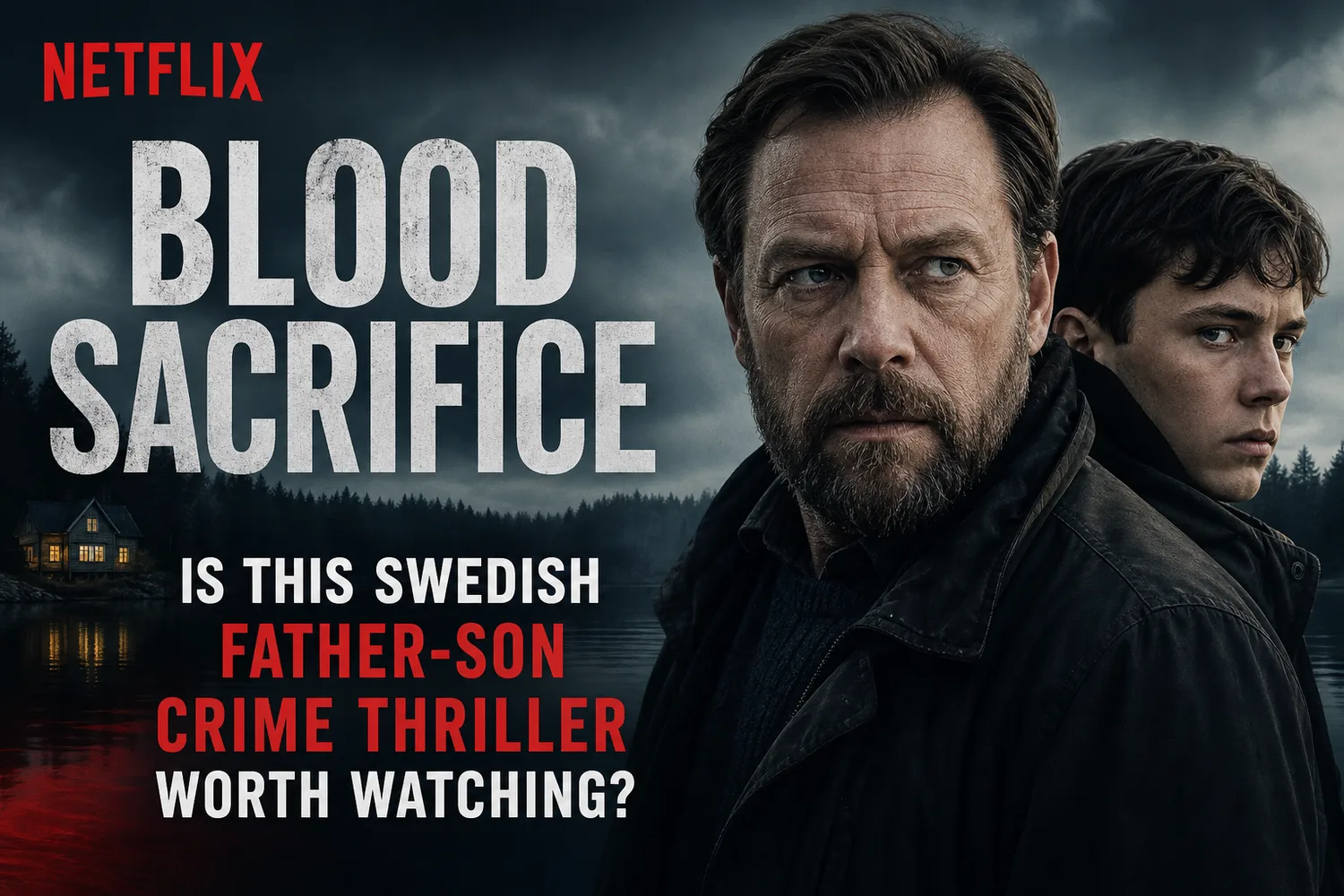
Blood Sacrifice on Netflix: Is This Swedish Father-Son Crime Thriller Worth Watching?
TL;DR — Blood Sacrifice is a five-episode Swedish crime thriller streaming on Netflix, set during a haunting Stockholm summer where a serial killer is systematically targeting police officers. Detective Thomas Berg, played by Jakob Oftebro, is forced to reluctantly team up with his estranged father Alfred, a former investigator played by Peter Andersson, to stop the killings before more officers die. Created by George Kay (of Lupin fame) and directed by Kristoffer Nyholm (The Killing), this is Nordic noir with a personal, emotional core at its center. Here's everything confirmed, plus my honest opinion on whether the father-son dynamic elevates this above a standard procedural.
Get series picks based on this article
Want another atmospheric Nordic noir with real emotional stakes? Skip the search and jump straight to picks built for that.
Get series picksTell us your mood. We'll do the picking.
8 quick questions. Real series picks from real catalogs — not ads. Free, no sign-up.
Take the quizWhat is Blood Sacrifice about?
Blood Sacrifice unfolds across a Stockholm summer, a season the show's creator George Kay has specifically described through "that strange, haunting light of the Nordic summer," where a serial killer begins systematically targeting police officers across the city. As the body count climbs and the department scrambles to understand what's driving the killer's specific targeting of law enforcement, lead investigator Thomas Berg finds himself forced into an uncomfortable, deeply personal partnership: reluctantly working alongside his estranged father Alfred, a former investigator whose own history with the force, and with Thomas himself, has left considerable unresolved tension between them.
That central setup, a case dangerous and urgent enough to force a broken family relationship back into close proximity, gives the show a distinct emotional throughline running underneath its more conventional serial-killer procedural mechanics. According to Kay, the series is fundamentally conceived as "a love story between an estranged father-and-son duo, whose work draws them back together," language that signals the show is at least as interested in Thomas and Alfred's fractured relationship as it is in the specific mechanics of identifying and stopping the killer.
Who's in the cast?
- Jakob Oftebro as Thomas Berg, the lead investigator
- Peter Andersson as Alfred Berg, Thomas's estranged, former-investigator father
- Electra Hallman as Natalie Eklund, an investigator on the team
- Alexander Abdallah as John-Jo Persson, an investigator
- Henrik Norlén as Max Abrahamsson, an investigator
- Lisette T. Pagler as Charlotte Berg, Thomas's wife
- Anders Mossling as Lucas Lind, Thomas's boss
The central father-son dynamic between Jakob Oftebro's Thomas and Peter Andersson's Alfred is clearly positioned as the show's emotional core, and that's a demanding pairing to cast well; both actors need to convincingly sell years of accumulated resentment and unresolved history while also making their gradual, case-forced reconciliation feel earned rather than merely convenient to the plot. Oftebro brings the kind of controlled, internalized intensity that Nordic noir leads tend to specialize in, while Andersson's casting as a former investigator with his own complicated legacy on the force adds real generational weight to the investigation.
Who's behind the show creatively?
George Kay serves as creator, bringing genuine genre credibility given his work creating Lupin, Netflix's hugely successful French heist thriller starring Omar Sy, one of the platform's most significant international breakout hits of recent years. Kristoffer Nyholm directs, carrying his own substantial pedigree from The Killing (Forbrydelsen), the Danish crime drama widely credited with helping launch the entire "Nordic noir" genre's international popularity and influencing a generation of subsequent crime television, both in Scandinavia and internationally.
That combination, a creator known for stylish, internationally successful genre storytelling and a director whose prior work essentially helped define the visual and tonal template for the genre this new show operates within, gives Blood Sacrifice strong creative pedigree heading into its release.
Where is the show set, and why does that matter?
The series is set primarily in Stockholm, Sweden, with Värmdö and Söderhamn also featured as locations within the story, during summer, a deliberate choice given how specifically Nordic noir as a genre has historically leaned into its region's distinctive seasonal extremes, particularly its long, eerie summer daylight and equally long, oppressive winter darkness, as atmospheric tools. Kay's own description of the show's setting, "that strange, haunting light of the Nordic summer," suggests the production is using Stockholm's specific seasonal quality of near-endless daylight as a deliberate tonal choice, using an ostensibly bright, warm setting to generate unease rather than defaulting to the genre's more familiar wintry darkness.
What happens across the five episodes?
As Thomas investigates the growing string of police-officer murders, the specific targeting of law enforcement raises urgent, disturbing questions about motive: is this killer driven by some specific grievance against the police as an institution, a personal vendetta against individual officers, or something else entirely connecting the victims. That investigative uncertainty, combined with the genuine danger every officer on Thomas's own team faces simply by continuing their work while a killer specifically hunts people in their profession, gives the season considerable structural tension independent of the father-son relationship at its core.
Alfred's own history as a former investigator becomes increasingly relevant as the case develops, suggesting his specific expertise, and possibly his own prior cases or professional relationships, hold genuine relevance to understanding and ultimately stopping the current killer, giving Thomas practical reasons beyond simple emotional reconciliation to keep working alongside a father he's evidently been estranged from for some time.
Why do father-son crime dramas keep proving so effective?
This is worth examining, because Blood Sacrifice's central creative choice, building a serial-killer procedural around a fractured father-son relationship rather than a more conventional partnership or solo-investigator structure, taps into a well-established and reliably effective crime-drama tradition. Family estrangement gives a procedural genuine emotional stakes beyond the case-of-the-week mechanics; audiences invest not just in whether the killer gets caught, but in whether these two specific, related characters can work through years of accumulated hurt and disappointment while under the genuine pressure and danger of an active, escalating murder investigation.
That structure also offers considerable dramatic efficiency: the investigation itself becomes a forcing mechanism for emotional confrontation and eventual reconciliation (or further rupture) that wouldn't organically occur otherwise, letting the show explore genuine family drama without needing a separate, disconnected subplot to generate that material.
My honest take on Blood Sacrifice
I think this looks like a well-positioned entry in the Nordic noir genre, and the specific decision to build the show around Thomas and Alfred's fractured relationship, rather than a more conventional ensemble-procedural structure, gives it real potential to distinguish itself within an increasingly crowded field of Scandinavian crime dramas competing for international streaming attention. George Kay's description of the show as fundamentally "a love story between an estranged father-and-son duo" is a bold framing for what's ostensibly a serial-killer thriller, and if the show actually delivers on that specific emotional promise rather than treating the family dynamic as a thin excuse for procedural plotting, this could be an affecting piece of television.
Kristoffer Nyholm's involvement gives me real confidence in the show's atmospheric and visual execution specifically; The Killing remains one of the most influential and well-regarded entries in the entire Nordic noir canon, and a director with that specific pedigree bringing his sensibility to a new story with a distinctive family-drama hook suggests the production understands exactly what's made this genre so internationally successful over the past decade and a half.
The choice to set the show during Stockholm's eerie, extended summer daylight, rather than the genre's more expected wintry darkness, strikes me as a smart, distinctive atmospheric choice too. A lot of Nordic noir leans so heavily on wintry, snow-covered bleakness that it's become something of a genre shorthand; using the region's equally strange, disorienting summer light instead gives Blood Sacrifice a genuine opportunity to feel visually and tonally distinct from a lot of comparable shows, even while still operating within recognizably similar genre conventions.
The specific mystery of why a killer is targeting police officers is also a strong procedural hook; it immediately raises the stakes for every character on Thomas's own team, since they're all plausible potential victims themselves, while also opening up rich investigative territory around institutional grievance, personal vendetta, or some connection to specific past cases that could tie directly back to Alfred's own history on the force. That's exactly the kind of structural choice that can keep a five-episode season feeling tense and forward-moving rather than padded.
Given the show's strong creative pedigree, both in front of and behind the camera, and its distinctive emotional and atmospheric choices, I'm cautiously optimistic this is a Nordic noir worth genuine attention rather than simply another entry in an increasingly saturated genre.
Do you need any specific background to follow the story?
No, the series appears designed to work as a self-contained crime drama, with Thomas and Alfred's estrangement and its specific history established within the show itself rather than requiring any outside context or familiarity with other Scandinavian crime properties.
Frequently asked questions
When did Blood Sacrifice release on Netflix? 2026, as a five-episode TV-MA series.
Who stars in Blood Sacrifice? Jakob Oftebro as Thomas Berg, alongside Peter Andersson as his estranged father Alfred.
Who created the show? George Kay, known for creating Lupin.
Who directs? Kristoffer Nyholm, known for The Killing.
Where is the show set? Stockholm, Sweden, during summer, with Värmdö and Söderhamn also featured as locations within the story.
What is the plot about? A serial killer targeting police officers, forcing an estranged father and son to work together to stop the murders.
How many episodes does the season have? Five episodes.
Is this connected to other Nordic noir shows? Not directly, though it shares genre DNA and a director connection to The Killing.
What is the show's central relationship? The fractured, gradually mending relationship between Thomas Berg and his ex-cop father Alfred.
Is this based on a book or true story? No confirmed source material has been extensively detailed in available reporting; it appears to be an original story.
Looking for your next Nordic noir obsession?
If atmospheric, emotionally grounded crime thrillers are your thing, our series recommendation quiz can help you find your next watch.