Chernobyl: Is HBO's Devastating Nuclear Disaster Miniseries Still Worth Watching?
TL;DR — Chernobyl is HBO's five-episode 2019 miniseries dramatizing the April 1986 nuclear disaster at the Chernobyl Nuclear Power Plant in Soviet Ukraine, and years after its original release it remains one of the highest-rated television productions ever made, currently sitting at a 9.3 rating on IMDb. Jared Harris, Stellan Skarsgård, and Emily Watson lead a devastating, meticulously researched story about scientific truth colliding with institutional denial, culminating in a real-world catastrophe and cover-up that swept a Best Limited Series Emmy in 2019. Here's everything worth knowing about the show and the real history behind it, plus my honest opinion on why it remains essential viewing.
Get series picks based on this article
Want another meticulously crafted, historically grounded drama? Skip the search and jump straight to picks built for that.
Get series picksTell us your mood. We'll do the picking.
8 quick questions. Real series picks from real catalogs — not ads. Free, no sign-up.
Take the quizWhat is Chernobyl about?
Chernobyl dramatizes the events surrounding the April 26, 1986, explosion at Reactor No. 4 of the Chernobyl Nuclear Power Plant in the Soviet Union, widely considered the worst nuclear accident in history. The series follows the disaster from the initial explosion through the chaotic, dangerous early response, the massive, ultimately partial evacuation of the surrounding area, and the subsequent investigation into what actually caused the catastrophe, an investigation that repeatedly collides with Soviet officials more concerned with protecting the state's reputation and avoiding embarrassment than with confronting the full scale of the danger or its true cause.
At the story's center is Valery Legasov, a nuclear physicist tasked with helping manage the disaster response and later leading the official investigation, whose increasingly urgent, dangerous fight to tell the scientific truth about what happened puts him in direct, escalating conflict with a Soviet system fundamentally built around denial, secrecy, and self-preservation. The show is as much about institutional dishonesty and the human cost of prioritizing image over truth as it is about the specific mechanics of the disaster itself.
Who's in the cast?
- Jared Harris as Valery Legasov, the nuclear physicist leading the investigation
- Stellan Skarsgård as Boris Shcherbina, the Soviet official overseeing the disaster response
- Emily Watson as Ulana Khomyuk, a (composite) nuclear physicist investigating the cause
- Paul Ritter as Anatoly Dyatlov, the deputy chief engineer present during the explosion
- Jessie Buckley as Lyudmilla Ignatenko, wife of a firefighter first responding to the disaster
- Adam Nagaitis as Vasily Ignatenko, a firefighter among the first responders
Jared Harris delivers what's widely regarded as a career-defining performance as Legasov, capturing both the character's scientific precision and his mounting, quietly devastating moral horror as he grasps the full scale of both the disaster and the institutional dishonesty surrounding it. Stellan Skarsgård's Shcherbina undergoes one of the series' most compelling arcs, transforming from a loyal party bureaucrat into someone willing to risk everything alongside Legasov to force the truth into the open. Emily Watson's Khomyuk, while a fictional composite character representing the many real scientists involved in the investigation, serves as the audience's entry point into the technical, procedural side of uncovering exactly what went wrong.
Who created the show?
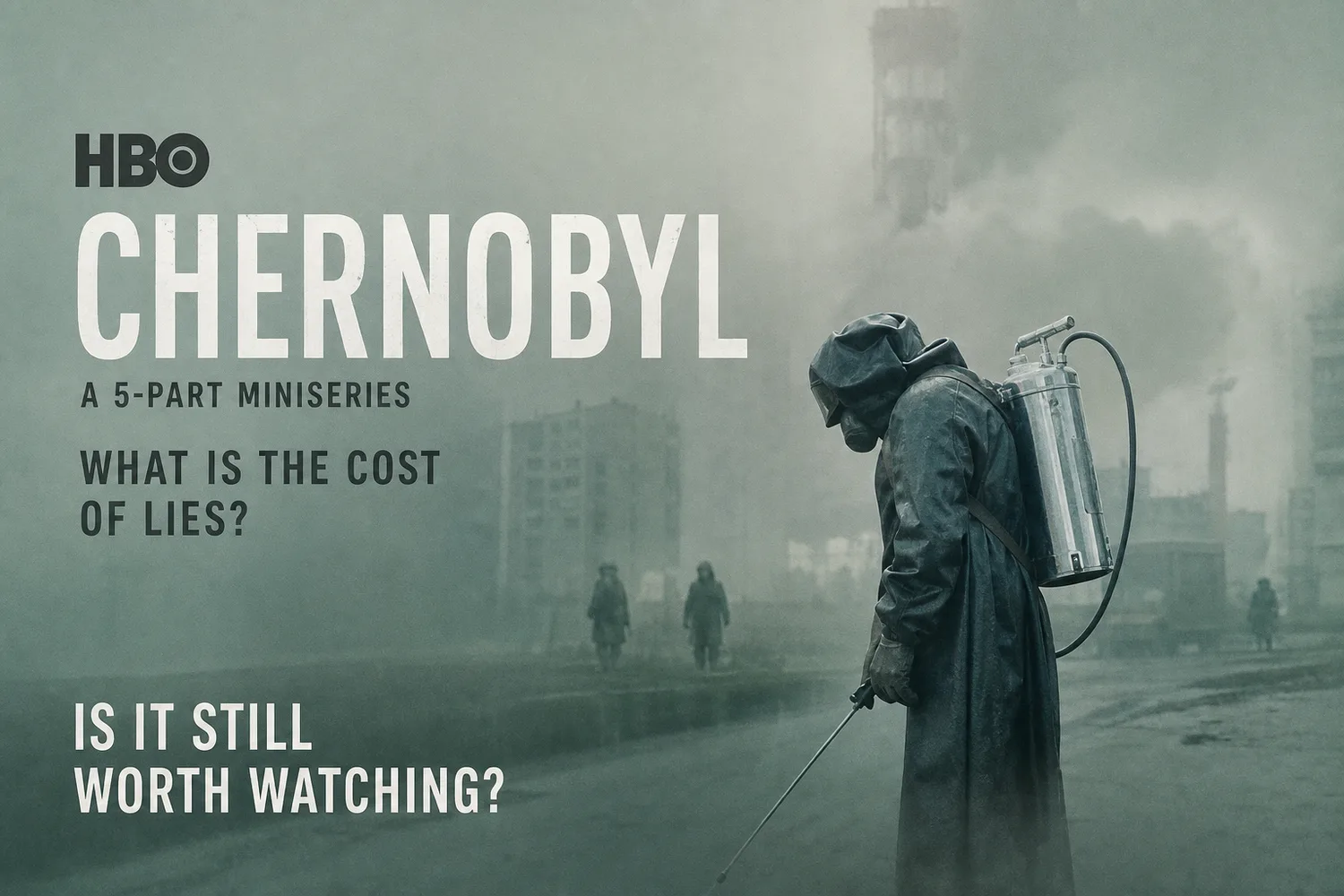
Craig Mazin, previously known primarily for comedy screenwriting, wrote and served as showrunner, a notable creative pivot that surprised many given his prior filmography. Johan Renck directed all five episodes, giving the miniseries a consistent, distinctive visual and tonal identity throughout, a bleak, grimy, meticulously detailed aesthetic that critics widely praised for its commitment to visual and atmospheric authenticity.
How accurate is Chernobyl to real events?
The series is widely regarded as remarkably well-researched and committed to factual accuracy regarding the disaster's broader timeline, causes, and consequences, drawing extensively on real survivor accounts, scientific reports, and historical documentation. That said, the show does take some notable dramatic liberties, most significantly through the character of Ulana Khomyuk, an invented composite figure representing the contributions of numerous real Soviet scientists rather than one specific individual, a choice Mazin has openly discussed as a necessary storytelling simplification given the large number of real people involved in the investigation.
Some of the show's most viscerally disturbing content, particularly its unflinching depiction of acute radiation syndrome and its physical toll on afflicted first responders, has been described by some medical experts as somewhat exaggerated in specific visual details for dramatic impact, though the broader, devastating reality of radiation sickness's toll on those exposed is not in dispute.
How was the show received?
Overwhelmingly positively. Chernobyl won the Emmy for Outstanding Limited Series in 2019, part of a broader awards sweep that included wins for Craig Mazin's writing and Johan Renck's directing among 10 total Emmy wins, out of 19 total nominations that year. It remains one of the highest-rated television productions on IMDb, with a 9.3 rating placing it among the platform's very top-rated shows across any genre or era.
Why does a show about a 1986 nuclear disaster still resonate so strongly?
This is worth examining, because Chernobyl's continued cultural relevance years after its release speaks to something considerably deeper than simple historical curiosity about a specific nuclear accident. At its core, the show is fundamentally about the catastrophic human cost of institutions prioritizing image, denial, and self-preservation over uncomfortable scientific truth, a theme with obvious, unsettling relevance well beyond the specific historical and political context of the late Soviet Union.
Legasov's central struggle, forcing an entrenched, defensive institutional system to confront an inconvenient truth it would strongly prefer to suppress or minimize, resonates with countless other real-world contexts involving institutional denial in the face of scientific or factual reality, giving the show's specific historical subject matter genuine, ongoing thematic relevance that extends well beyond a straightforward historical dramatization.
My honest take on Chernobyl
I think this remains one of the most essential pieces of television ever produced, and its continued high standing years after release is entirely earned rather than simply a product of initial hype. What makes Chernobyl so remarkable isn't just its meticulous visual and historical authenticity, though that commitment to grim, detailed realism is impressive throughout, but its clear-eyed, sustained focus on institutional dishonesty as the story's true central antagonist, arguably more so than the reactor disaster itself.
Jared Harris's performance as Legasov deserves every bit of the acclaim it received; there's a specific, quiet devastation in watching a rigorous, precise scientist forced to navigate a system that has no genuine interest in scientific truth, only in managing appearances, and Harris captures that mounting horror and moral resolve with remarkable restraint rather than melodrama. The finale's extended courtroom sequence, where Legasov finally lays out the full, damning technical truth about both the disaster's specific cause and the systemic dishonesty that made it possible, remains one of the most quietly powerful sequences in recent television, built almost entirely on Harris methodically explaining technical, procedural detail rather than conventional dramatic confrontation.
The show's unflinching willingness to depict the disaster's full human cost, particularly through Jessie Buckley's devastating performance as Lyudmilla Ignatenko watching her husband suffer the effects of acute radiation exposure, gives Chernobyl real emotional weight beyond its more procedural, investigative sequences, ensuring the show never loses sight of the disaster's genuine human toll amid its broader examination of institutional and scientific failure.
What ultimately elevates Chernobyl beyond simply being a well-made historical dramatization is its genuine, sustained thematic ambition: this is a show fundamentally interested in what happens when truth becomes inconvenient to power, and that theme's continued, unfortunate relevance across countless other contexts is exactly why the show has maintained such remarkable staying power in the years since its original release. For anyone who hasn't seen it, or who's due for a rewatch, this remains as devastating and essential as ever.
Do you need any specific historical background to follow the story?
No, the show is structured to work for viewers with no prior specific knowledge of the Chernobyl disaster, methodically building out the necessary scientific and historical context as the investigation unfolds across its five episodes.
Frequently asked questions
When did Chernobyl originally air? 2019, on HBO, as a five-episode miniseries.
Who stars in Chernobyl? Jared Harris as Valery Legasov, alongside Stellan Skarsgård and Emily Watson.
Who created the show? Craig Mazin, who wrote and served as showrunner; Johan Renck directed all five episodes.
How accurate is the show? Widely regarded as remarkably well-researched, though it includes some dramatic liberties, most notably the composite character Ulana Khomyuk.
What awards did Chernobyl win? The Emmy for Outstanding Limited Series in 2019, along with wins for writing and directing, out of 19 total nominations.
Is Chernobyl based on a book? It draws on extensive real historical research, survivor accounts, and scientific reporting rather than a single source book.
How many episodes does the series have? Five episodes.
Is Chernobyl difficult to watch? Yes, it's an unflinching, emotionally intense depiction of a real disaster's human cost; viewers sensitive to medical or disaster content should be aware going in.
Is there a season 2? No, it's a self-contained miniseries with no continuation planned.
Where can I watch Chernobyl? HBO and HBO Max.
Looking for your next unforgettable drama?
If meticulously crafted, historically grounded dramas with real emotional weight are your thing, our series recommendation quiz can help you find your next watch.