Gremlins 3: Release Date, Teaser, Delay and Everything to Know Before October 2028
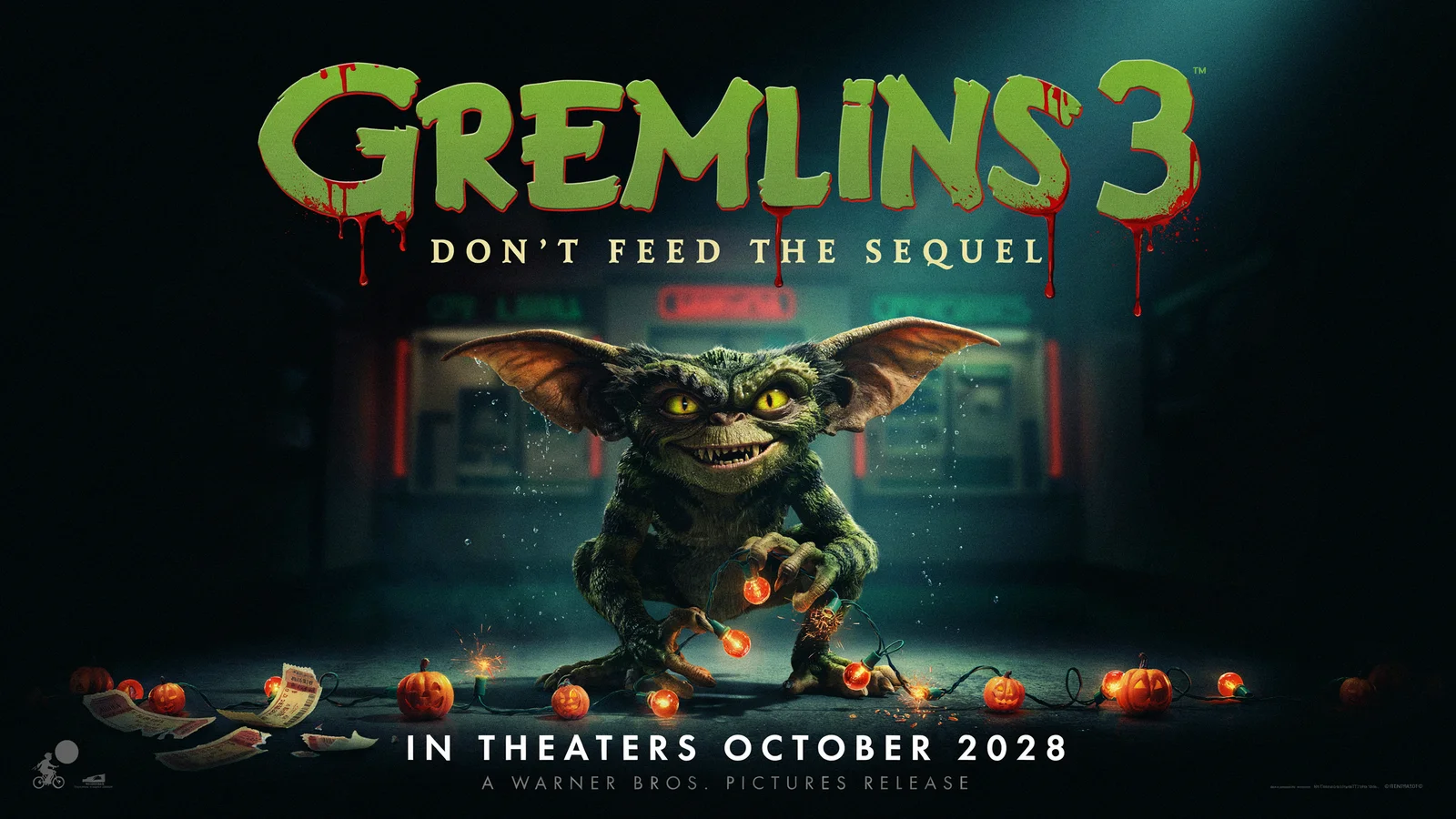
TL;DR — Gremlins 3 is now set to open in theaters on October 6, 2028, nearly a full year later than its original November 19, 2027 date. Warner Bros. announced the move on September 23, 2026 with an 11-second teaser in which a Mogwai (widely identified as Gizmo) peeks out of a backpack, lets out a small "Uh-oh," and gives way to a red date card reading "10.6.28. Only In Theaters." One outlet, World of Reel, ran the date as October 28, 2028 in its headline, but its own article text and every major trade report say October 6, which is also how the "10.6.28" card reads. Chris Columbus, who wrote the 1984 original, is directing and producing; Steven Spielberg is executive producing through Amblin; Hannah Marks is writing the current screenplay from an earlier draft by Columbus, Zach Lipovsky and Adam Stein. There is no official title, no announced cast, and no plot synopsis yet, filming is reported to begin in early 2027, and original director Joe Dante is not returning. It will be the first live-action Gremlins film in 38 years, following Gremlins (1984), Gremlins 2: The New Batch (1990) and the animated prequel series Gremlins: Secrets of the Mogwai and Gremlins: The Wild Batch.
Get movie picks based on this article
2028 is a long wait for Gremlins 3. Get a pick made for your mood while you wait.
Get movie picksTell us your mood. We'll do the picking.
8 quick questions. Real movie picks from real catalogs — not ads. Free, no sign-up.
Take the quizWhen is Gremlins 3 coming out now?
The confirmed release date is Friday, October 6, 2028, in theaters. That's the date reported by The Hollywood Reporter, TheWrap, The A.V. Club, Dark Horizons, ComingSoon, SuperHeroHype, Geek Culture, ComicBook.com and The Statesman, and it matches the date card at the end of Warner Bros.' own teaser, which reads "10.6.28. Only In Theaters." Written the American way, that is month 10, day 6, year 28.
The film had previously been dated for November 19, 2027, a slot Warner Bros. set when it officially announced the project in November 2025. The new date moves it back by roughly eleven months, which is why most outlets are describing it as "nearly a year" or "a year" delay.
If you've seen October 28, 2028 floating around, here's where that came from. World of Reel published its story under the headline "Gremlins 3 Teaser Arrives as Release Delayed to October 28, 2028," and the same date appears in its URL. But the body of that very article says Warner Bros. moved the film "from its original November 19, 2027 release date to October 6, 2028." In other words, the headline and the article disagree with each other, and the article agrees with everyone else. My read is that "10.6.28" was misread somewhere along the way, with the "28" taken as a day of the month rather than the year. Unless Warner Bros. says otherwise, October 6, 2028 is the date to put in your calendar.
It's worth adding the obvious caveat that release dates set two years out are not carved in stone, and this particular date has already moved once. Still, as of today, October 6, 2028 is the official, studio-announced date.
Why was Gremlins 3 delayed, and what does the move to October mean?
Warner Bros. has not given an official reason for the delay. Several outlets, including The Statesman, Trevor Decker's report and TheWrap's coverage, note that no explanation accompanied the announcement. The A.V. Club floated possible budget or scheduling factors, but that was explicitly the outlet speculating, not reporting, so treat it that way.
What we can say with more confidence is that the production timeline has been sliding. Multiple reports this week say filming has not started and is now expected to begin in early 2027. If you're shooting a creature feature that leans on puppetry and practical effects in early 2027, a November 2027 release starts to look very tight, because that kind of film typically needs a long post-production runway for editing, effects clean-up and sound. Pushing into late 2028 gives the production breathing room. That's my inference from the reported timeline, not a studio statement, but it's the most practical explanation on the table.
The more interesting part is where the film landed. November 2027 would have made Gremlins 3 a Thanksgiving and holiday-season movie, which suits the original's snowy Christmas Eve setting. October 2028 turns it into a Halloween movie. Several outlets pointed out that an early October release has worked for Warner Bros. before, most famously with Joker, which opened in October and earned roughly $1.078 billion worldwide according to The Statesman's report. ComicBook.com also framed the October slot as a better fit for Halloween-season marketing.
I actually think the October move suits the franchise's identity better than people expect. Yes, the first film is a Christmas movie, and people love arguing about whether it counts as one. But the franchise's real flavor is horror-comedy: mischievous, gooey, a little mean, and funny. That's a Halloween mood as much as a holiday one. A Gremlins film sitting on screens across the last three weekends of October, surrounded by costume parties and seasonal horror marathons, is an easy marketing story to tell.
The same schedule shuffle also moved DC Studios' animated film Dynamic Duo to September 22, 2028, meaning Warner Bros. now has two family-leaning, puppetry-adjacent releases sitting a couple of weeks apart in early fall 2028. Dynamic Duo, per Geek Culture's report, is directed by Arthur Mintz and uses a mix of "stop-motion, CGI, and puppetry," so it's an interesting neighbor for a film that has also promised to go tactile.
What does the first Gremlins 3 teaser actually show?
Very little, on purpose. The teaser runs about 11 seconds (one fan site measured it at 10, but ComicBook.com, The Statesman, Fiction Horizon, Comic Basics and Trevor Decker all describe it as 11). In that time, a Mogwai peeks out from inside a backpack and quietly says "Uh-oh." Then a red date card appears: "10.6.28. Only In Theaters."
Most coverage identifies the creature as Gizmo, and that's how Fiction Horizon and Trevor Decker describe it. Geek Culture and Comic Basics were more cautious, calling it "one of the adorable creatures" and "one of the iconic creatures." Warner Bros. did not name the character in its post, so I'll say it plainly: it looks like Gizmo, most outlets are calling it Gizmo, but the studio hasn't formally confirmed which Mogwai it is.
That's the entire teaser. There's no footage of human characters, no location, no voice beyond that "Uh-oh," and no title card beyond "Gremlins"-style branding and the date. Comic Basics reported that the clip, reposted by DiscussingFilm, reached 1.8 million views and 38,000 likes within hours, which tells you something about how much goodwill is still attached to this furry little face.
So what can you reasonably read into it? ComicBook.com suggested the teaser implies the classic setup: "an irresponsible youth will get their hands on a Mogwai and will fail to follow the all-important rules of caring for the animal." The backpack is a nice detail there. It suggests a Mogwai being smuggled somewhere it shouldn't be, carried by someone young enough to carry a backpack, which is precisely the kind of situation where rules get broken. But that's interpretation. Nothing about the story has been confirmed.
What I noticed most is the tone. It's cute first and ominous second. The "Uh-oh" is the whole joke: it's the sound of something about to go very wrong, delivered by the one creature in the franchise who never means any harm. That's a smart choice for a first tease, because it sells the brand's most marketable face while promising the mayhem that follows. The red date text also does a lot of work. It reads a little like a warning label.
Who is making Gremlins 3?
The creative team is the most solid information we have, and it's genuinely interesting.
Chris Columbus is directing and producing. This matters more than a typical director hire, because Columbus wrote the original Gremlins. He conceived it around 1981 as a spec script, and Spielberg bought it. Columbus went on to write The Goonies and Young Sherlock Holmes (both 1985) before becoming one of the most commercially reliable family filmmakers in Hollywood, directing Adventures in Babysitting (1987), Home Alone (1990), Mrs. Doubtfire (1993), and the first two Harry Potter films, Harry Potter and the Sorcerer's Stone (2001) and Harry Potter and the Chamber of Secrets (2002). His more recent directing credits include Percy Jackson & the Olympians: The Lightning Thief (2010), Pixels (2015) and The Thursday Murder Club (2025). He has never directed a Gremlins film before. Joe Dante directed both of the originals.
Steven Spielberg is executive producing through Amblin Entertainment. Spielberg was the executive producer on the 1984 film, and the franchise has been an Amblin property from the start. Amblin's Kristie Macosko Krieger and Holly Bario are producers.
The screenplay has passed through several hands. When Warner Bros. announced the film in November 2025, the script was credited to Columbus alongside Zach Lipovsky and Adam B. Stein, the directing duo behind Final Destination Bloodlines, which Warner Bros. released in May 2025 and which grossed about $317.9 million worldwide with a 92 percent Rotten Tomatoes score. Per this week's reports from ComingSoon, SuperHeroHype, The Statesman, TheWrap and The A.V. Club, Hannah Marks is now writing the current screenplay, working from that earlier draft. Marks is an actor turned filmmaker whose credits include writing and directing Mark, Mary & Some Other People (2021) and directing Don't Make Me Go (2022) and the John Green adaptation Turtles All the Way Down (2024). Geek Culture's report credits Marks with the screenplay and Columbus, Lipovsky and Stein with the story, though that's how one outlet phrased it rather than an official Writers Guild credit, which won't exist until the film is finished.
Other producers include Eleanor Columbus of Maiden Voyage Pictures, the production company Chris Columbus co-founded with his daughter in 2014, and Michael Barnathan and Mark Radcliffe of 26th Street Pictures.
There's an elegant logic to this team. The Final Destination Bloodlines duo know how to stage inventive, darkly funny carnage that audiences cheer rather than wince at, which is a big part of the Gremlins formula. Marks has a strong track record with character-driven stories about young people, which could matter if the teaser's backpack really does signal a younger lead. And Columbus is the person who invented these creatures in the first place.
Is Joe Dante involved in Gremlins 3?
No, Dante is not returning as director, and none of this week's reports list him in any role on the new film. SlashFilm noted at the time of the November 2025 announcement that it was "unclear whether Dante will be involved at all with this new installment."
This is the single biggest point of concern among longtime fans, and I understand why. Dante directed both Gremlins films, and his fingerprints are everywhere in them: the affection for old B-movies and Looney Tunes, the character-actor cameos, the refusal to let the film be merely cute. Spielberg hired him for the first film precisely because of his horror-comedy sensibility. Dante himself told The Ringer's 2024 oral history that Spielberg, looking at his first Amblin production as a horror movie, figured, "Let's get this guy who made these two horror movies," meaning Piranha and The Howling.
Dante hasn't stepped away from the franchise entirely in recent years, though. He served as a consulting producer on the animated prequel series Gremlins: Secrets of the Mogwai, so the franchise has been in contact with him more recently than 1990.
Who is in the Gremlins 3 cast, and what is the story?
Here I need to be direct, because this is where a lot of articles blur the line between fact and wishful thinking. As of September 24, 2026, Warner Bros. has not announced any cast members, any plot synopsis, or an official title. The Statesman's headline summed it up neatly: "No title, no cast, no plot, and now a new date."
What we do have are statements people have made over the years, and they're worth knowing as long as you treat them as history rather than confirmation.
Zach Galligan, who played Billy Peltzer in both original films, told Syfy Wire in December 2015 that the planned film would not be a remake: "It's not going to be a reboot. It will not be a remake in any way, shape, or form." He described a Jurassic World-style approach set 30 years after the original, and about his own involvement, he said: "I swear on my life, I don't know if I'm in it or not, but I think there is probably a decent chance since I'm one of the few people left standing from the first movie." That interview was about an earlier version of the project, written at the time by Carl Ellsworth, so it doesn't describe the current script. Galligan has stayed close to the franchise since, including a guest voice role in the animated prequel series.
Chris Columbus has also talked about his vision for years. In 2017, speaking to SlashFilm (as reported by ComingSoon), he said of his script: "I'm really proud of the script. It is as twisted and dark as anything, so we'll see." Asked about the idea of the story considering whether Gizmo himself should be gotten rid of, given how much destruction his offspring cause, he said: "I think it probably is a good idea to be honest with you. Too many people are dying." Again, that was about the script as it stood nearly a decade ago. Hannah Marks is now working on the screenplay, so there's no way to know how much of that "twisted and dark" draft survives.
What is confirmed about the story is only this: it's a third installment in the existing franchise. Every report on the announcement and the delay refers to it as a sequel, Gremlins 3, rather than a reboot. Anything beyond that, including which original characters come back, whether the story returns to Kingston Falls, or whether a new generation takes center stage, is speculation until Warner Bros. says more.
I'll add one practical note. Several beloved members of the original casts are no longer with us, so a Gremlins 3 that tries to reunite the full 1984 ensemble simply isn't possible. That's one more reason a "new generation plus a familiar face or two" structure seems like the most likely shape, but I'm flagging that as my guess, not a report.
Will the gremlins be puppets or CGI?
This is the question fans care about most after "is Joe Dante back," and it's one where Columbus has been consistent for a long time. In 2017 he said: "Oh, without a doubt, minimal CGI. CGI will enable us to remove wires and make the puppeteers' lives a little easier." In 2020, as quoted by Fiction Horizon and TheWrap this week, he said he "would do it as tangible puppets, not CGI," adding, "I don't think I'd use much CGI in 'Gremlins 3.'"
World of Reel's report on the teaser says the gremlins "will not be CGI but will return to the practical puppetry that defined the original films," and Wikipedia's current franchise summary reflects the same plan. I'd frame it this way: practical puppetry is the stated intention of the director, repeated over many years, but we won't truly know the balance until we see finished footage. Modern creature films almost always use some digital work, even if only for wire removal, which is exactly what Columbus described.
Why does this matter so much? Because the puppets are the soul of the franchise. The 1984 creatures were built by effects artist Chris Walas, who told The Ringer, "I took the approach that there's not going to be an easy way to do this, right up front." The production reportedly tested dressing a monkey in a gremlin costume before abandoning that idea when the animals panicked, and instead built a huge number of rubber puppets. Walas said he couldn't "estimate an accurate number since we cannibalized a lot of them to create new puppets along the way." Joe Dante insisted on keeping the Mogwai small to preserve their cuteness, which made the puppets harder to operate and more prone to breaking down. The crew grew so frustrated that they kept a list titled "Horrible Things to do to Gizmo," which found its way into the film in the scene where the gremlins hang Gizmo on a wall and throw darts at him.
For the 1990 sequel, makeup legend Rick Baker took over the creature work and gave the new batch of Mogwai distinct personalities, redesigning Gizmo as a larger but simpler puppet capable of more expression. The result is one of the most varied practical-creature showcases of its era.
That physical, slightly unpredictable texture is a huge part of why these films still look charming. If Gremlins 3 really does commit to puppets, the teaser's single shot of a Mogwai in a backpack is a nice early sign. It reads as a creature that's physically there.
What are the three rules of owning a Mogwai?
If you're new to the franchise, these are the rules everything hinges on. They're given to Randall Peltzer when he acquires Gizmo from Mr. Wing's Chinatown antique shop in the first film:
- Keep them out of bright light. Sunlight in particular is lethal to Mogwai.
- Don't get them wet. Water makes a Mogwai multiply, with new Mogwai popping off its back.
- Never, ever feed them after midnight. Food after midnight triggers a transformation into a gremlin, a scaly, reptilian, destructive creature.
The genius of the rules is that they're simple enough for a child to repeat and vague enough to invite argument forever. Fans have spent four decades debating what "after midnight" means once you cross time zones, or when midnight ends. The films mostly shrug at those questions, which is correct: the rules exist to be broken, and the entire plot of a Gremlins movie is watching the consequences cascade.
I'd bet good money the rules are central to Gremlins 3 as well, because they're the franchise's most quotable idea. That "Uh-oh" in the teaser sounds a lot like the moment right after someone ignores one of them.
How did the original Gremlins come together in 1984?
Gremlins opened on June 8, 1984, the same day as Ghostbusters, which is one of the most remarkable coincidences in blockbuster history. Ghostbusters won that opening weekend, but Gremlins came in second with about $12.5 million and kept going. Made on a budget of about $11 million, it earned roughly $150 million domestically and more than $212 million worldwide, and it remained Warner Bros.' most successful film until Batman in 1989.
The story is set in the snowy small town of Kingston Falls at Christmas. Randall Peltzer (Hoyt Axton), a struggling inventor, buys a Mogwai from Mr. Wing's shop in Chinatown as a present for his son Billy (Zach Galligan). The creature, whom they name Gizmo, comes with the three rules. Of course the rules get broken, Gizmo's offspring become gremlins, and Kingston Falls endures a Christmas Eve of escalating chaos, ending with a showdown in a local movie theater. Phoebe Cates plays Kate Beringer, Billy's girlfriend, and the cast includes Polly Holliday as Ruby Deagle, Frances Lee McCain as Billy's mother Lynn, Corey Feldman, Dick Miller and Keye Luke as Mr. Wing. Howie Mandel voiced Gizmo and Frank Welker voiced Stripe, the leader of the gremlins.
The origin of the idea is wonderfully humble. According to producer Michael Finnell in The Ringer's oral history, Columbus was living in a rough apartment as an NYU film student and could hear mice running around at night. Columbus himself described the image that stuck with him: "what sounded like a platoon of mice would come out and to hear them skittering around in the blackness was really creepy." That's the core of Gremlins: not a giant monster, but lots of small ones you can hear before you can see.
Spielberg found the script in early 1982 and was blunt about why he bought it: "It's one of the most original things I've come across in many years, which is why I bought it." But the film we got was considerably softer than Columbus's early drafts. In those versions, Gizmo himself was meant to transform into Stripe, and there were far nastier moments, including the death of Billy's mother and gremlins eating the family dog. Spielberg pushed back on the Gizmo change because he felt audiences would want the cute Mogwai around for the whole film. Gizmo went from a character who disappears early to the hero of the franchise, which, commercially speaking, may have been one of the best notes a producer ever gave.
This is precisely why Columbus's 2017 comments about a "twisted and dark" Gremlins 3 are so interesting. The writer who originally wanted Gizmo to turn evil is now the director, with more authority over the finished film than he had in 1984. Whether he uses it to go darker is one of the real open questions about the new movie.
A few more pieces of the original deserve mention because they explain why people still love it. Jerry Goldsmith's score, including that jaunty, slightly unhinged main theme, won a Saturn Award. Gizmo's famous singing voice actually belonged to Ilene Keys, uncredited, rather than Mandel. Mandel told The Ringer he built Gizmo's speaking voice around the idea of stretching the neck of a balloon and pushing the air out.
Critics were split in a revealing way. Roger Ebert gave it three stars out of four and enjoyed it as a sly collection of send-ups. Gene Siskel went further, calling it "a wickedly funny and slightly sick ride." Leonard Maltin disliked it, calling it "icky" and "gross," a review that would come back to haunt him in the sequel. Today, the film holds an 86 percent Rotten Tomatoes score, with a consensus that calls it "a minor classic" whether you read it "as a statement on consumer culture or simply a special effects-heavy popcorn flick."
How did Gremlins change the movie rating system?
This is the piece of Gremlins trivia that surprises people most, and it's genuinely true: Gremlins is one of the two films that led directly to the creation of the PG-13 rating.
In 1984, the Motion Picture Association's ratings jumped from PG straight to R, with nothing in between. That summer, two Spielberg-connected films, Indiana Jones and the Temple of Doom (which Spielberg directed) and Gremlins (which he executive produced), both arrived with PG ratings and both drew complaints from parents about their violence and intensity. In Gremlins, the most-cited example is the kitchen sequence in which Billy's mother fights off gremlins with household appliances, including the notorious microwave moment.
Spielberg suggested an intermediate rating between PG and R. The MPA introduced PG-13 on July 1, 1984, just weeks after Gremlins opened, and Red Dawn became the first film released with the new rating. Gremlins itself remained a PG release in its original run. Producer Michael Finnell summed it up to The Ringer: "Actually, because of Gremlins and Indiana Jones and the Temple of Doom, which also had some kind of gnarly things in it," the new rating came about.
Why does this matter for Gremlins 3? Because the franchise's DNA is literally the boundary between a family film and something scarier. The new movie will have to decide where on that line it sits. Columbus's family-friendly track record points one way, his "twisted and dark" comments point another, and the Final Destination Bloodlines writers on the earlier draft point a third. No rating has been announced, but a PG-13 Gremlins 3 would be a fitting full-circle moment for the franchise that helped invent the category.
What makes Gremlins 2: The New Batch so different?
If the first Gremlins is a small-town horror-comedy with a mean streak, Gremlins 2: The New Batch is a cartoon that escaped into live action, and I mean that as the highest compliment.
The sequel opened June 15, 1990, and it had a rough time commercially. It opened against Dick Tracy, and its total domestic gross was about $41.5 million, a far cry from the original. But it has since grown into a cult favorite, and some critics now argue it's wittier and more subversive than the first film.
The story moves Billy and Kate to Manhattan, where they work in the Clamp Center, a gleaming "smart" skyscraper owned by eccentric media mogul Daniel Clamp (John Glover). Gizmo ends up captured by the building's Splice O' Life genetics lab, run by Christopher Lee's Doctor Catheter, and once he gets wet, a new batch of Mogwai is born. Those gremlins then raid the lab's serums and mutate into wild variations: an intelligent Brain Gremlin (voiced by Tony Randall), a bat-like gremlin, and Greta, the female gremlin, among others. Robert Prosky plays a horror host modeled on Grandpa Munster, Robert Picardo plays the building's security chief, Haviland Morris plays a ruthless executive, and Dick Miller's Murray Futterman gets an expanded role.
What makes The New Batch special is how much it mocks itself and the idea of sequels in general. Dante initially said no. He told The Ringer, "When they offered me the sequel right away when the movie was a big hit, I said, 'No, I can't stand any more puppets.'" He eventually agreed after Warner Bros. offered him complete creative control, and he used it. The film opens with a Looney Tunes segment directed by Chuck Jones featuring Bugs Bunny, Daffy Duck and Porky Pig. Leonard Maltin, the critic who panned the first film, appears as himself, holding the home video of the original and repeating his criticism until the gremlins attack him. In the most famous gag, the gremlins appear to break the actual film in the theater you're watching, until wrestler Hulk Hogan appears on screen to threaten them into restarting it. For the home video version, Dante replaced that bit with a scene in which the gremlins seem to sabotage your VCR.
The screenplay was written by Charles S. Haas, who came up with the idea of confining the chaos to a single smart building after executives worried about the cost of city-wide destruction. Rick Baker's creature designs gave the new Mogwai individual personalities, with names like George, Lenny, Daffy and Mohawk.
Reviews at the time were mixed but fair. Ebert gave it two and a half stars. Maltin, of all people, gave it three out of four. Today it sits in the low 70s percent on Rotten Tomatoes with a B+ CinemaScore, and its critics consensus says it "trades the spiky thrills of its predecessor for looney satire."
Here's my view: Gremlins 2 is the key to understanding what a good Gremlins 3 needs. The franchise can stretch into wildly different tones as long as the creatures stay anarchic and the filmmaking has a point of view. The first film has dread. The second has satire. A third film that only has nostalgia would be the weakest of the three.
What are Gremlins: Secrets of the Mogwai and The Wild Batch?
If you've been away from the franchise since the VHS era, you may have missed that Gremlins came back in animated form, and it came back well.
Gremlins: Secrets of the Mogwai premiered on Max on May 23, 2023, with ten episodes. Developed by Tze Chun, it's a prequel to the 1984 film, set in 1920s Shanghai, and it tells the story of how a 10-year-old Sam Wing first meets a young Gizmo. Yes, that Sam Wing: the boy who will grow up to be Mr. Wing, the old shopkeeper who sells Gizmo to Randall Peltzer in the original. Sam teams up with a street thief named Elle, and the two travel across the Chinese countryside encountering creatures from Chinese mythology while being pursued by an industrialist named Riley Greene. The series also gives the Mogwai an origin, tying their creation to the goddess Nuwa and her brother Fuxi.
The voice cast is strong: Izaac Wang as Sam, A.J. LoCascio as Gizmo (taking over from Howie Mandel), plus Ming-Na Wen, B.D. Wong, James Hong and Matthew Rhys, with guest voices including George Takei, Sandra Oh, Timothy Olyphant and Zach Galligan. Steven Spielberg, Darryl Frank and Justin Falvey executive produced, and Joe Dante consulted. The first season scored 100 percent on Rotten Tomatoes.
Gremlins: The Wild Batch is the second season, released in two parts on October 3, 2024 and April 10, 2025. It moves Sam and Gizmo from Shanghai to America, covering events that happen before Randall Peltzer ever walks into the shop. It also earned a 100 percent Rotten Tomatoes score.
I'd genuinely recommend these series to anyone who thinks of them as a kids' side project. They're warm, beautifully designed, and they take the franchise's mythology more seriously than either film did. They also prove something useful for Gremlins 3: Gizmo still works as a lead character in 2020s storytelling, and there's appetite for new Gremlins material. Nothing has been announced to connect the animated series and the new film, so don't expect Sam Wing to show up, but the series kept the franchise alive for a new generation right up to this teaser.
Why did a third Gremlins movie take 38 years?
When Gremlins 3 opens in October 2028, it will have been 38 years since Gremlins 2 and 44 years since the original. That's a long gap even by the standards of the current revival era, and it happened for a mix of reasons.
The first is the commercial performance of Gremlins 2. A sequel that earns around $41.5 million domestically on a much bigger budget than the original doesn't exactly send a studio racing toward part three. Gremlins 2 found its cult audience later, on home video and cable, long after the decisions about sequels had been made.
The second is that the project changed shape several times. According to the franchise's development history, Warner Bros. negotiated with Amblin in 2013 about rebooting the franchise, with Seth Grahame-Smith and David Katzenberg attached as producers, and the project was put on hold. By 2015, Galligan was publicly insisting it would be a sequel, not a reboot. Around 2016 and 2017, Columbus was working on it with writer Carl Ellsworth, and in 2017 he said the script was finished. In 2020, Columbus again talked about the puppets-over-CGI approach. Then things went quiet again until 2025, when Warner Bros. confirmed development, and the film was officially dated on November 6, 2025 during a Warner Bros. Discovery investors call, according to Gizmodo.
The third reason is simpler: Columbus has had no reason to rush. In a franchise built on one of his own original ideas, he has had the standing to hold out for a version he believed in, and the long, quiet stretch between announcements over the better part of a decade reads to me like a writer protecting the thing he made rather than a studio squeezing out a product.
The fourth reason is the craft challenge itself. A practical-puppetry creature film is expensive, slow and technically demanding in a way that a CGI film isn't. If you're committed to doing it the hard way, you need a studio that's willing to pay for the hard way.
Put those together and the long wait makes more sense. It wasn't one missed opportunity. It was a string of decisions by people who apparently cared enough about the property to not rush it, followed, as of this week, by one more year of waiting.
What order should I watch the Gremlins franchise in before 2028?
You have two good options, and the right one depends on whether you're a first-timer or a returning fan.
Release order (my recommendation for first-timers):
- Gremlins (1984)
- Gremlins 2: The New Batch (1990)
- Gremlins: Secrets of the Mogwai (2023)
- Gremlins: The Wild Batch (2024 to 2025)
This is how audiences experienced the franchise, and it preserves every surprise. You meet Gizmo the way Billy meets him, with no idea what he's capable of. You then see Dante blow up his own movie in the sequel, which works best when the original is fresh. And the animated prequels land more powerfully once you know who Mr. Wing becomes, because the whole emotional hook of Secrets of the Mogwai is watching the kid who will one day warn Randall Peltzer about the rules.
Chronological order (best for returning fans):
- Gremlins: Secrets of the Mogwai (1920s Shanghai)
- Gremlins: The Wild Batch (Sam and Gizmo's journey to America)
- Gremlins (1984)
- Gremlins 2: The New Batch (1990)
Watching in story order turns the franchise into a kind of generational saga. You follow Gizmo from his early adventures with young Sam, across an ocean, into the antique shop, and eventually into the Peltzer household and a Manhattan skyscraper. It's a lovely way to rewatch the films with fresh eyes, especially the scene where Mr. Wing insists Gizmo is not for sale.
If you're short on time before Gremlins 3, the two films are the essentials. Together they run a little over three and a half hours, since each is about 106 minutes. The animated series are optional but rewarding, and they're the best way to introduce younger kids to the franchise before the films, which are scarier than their reputation. Streaming availability varies by country and changes frequently, so check your local services before you plan a marathon. The animated series originally premiered on Max.
Viewing tip for parents: the 1984 film was rated PG under the old system, but it's the very film that helped create PG-13. The kitchen scene and some of the gremlin deaths are genuinely intense for young children. Gremlins 2 is sillier and more cartoonish, though still messy. Preview before you hit play with a six-year-old.
What should Gremlins 3 learn from the first two films?
This is analysis rather than reporting, but I think it's the most important conversation to have now that the film has a date and a team.
Keep the creatures small and the danger real. The best idea in Columbus's original concept is that little things in the dark are scarier than big things in daylight. The skittering-mice feeling is the franchise's horror engine. A Gremlins 3 that turns into a sprawling action movie with hundreds of digital gremlins would lose that intimacy.
Let the gremlins have personality. Both films understood that gremlins are funny because they act like the worst version of a rowdy crowd: drunk, destructive, delighted with themselves. Stripe in the first film and the mutant variety in the second are memorable because they're characters, not swarms.
Have a target. The first film pokes at small-town greed and holiday consumerism. The second satirizes corporate media, sequels and even film critics. The best version of Gremlins 3 will be about something in our world, whether that's our obsession with gadgets, the way we buy cute things without reading the instructions, or the viral culture that would turn a Mogwai into content within minutes. The teaser's 1.8 million views in hours is almost a joke that writes itself.
Respect Gizmo without flattening him. Columbus's old idea about the story asking whether Gizmo should be sacrificed is the kind of real stake that could make this film more than a nostalgia exercise. I'm not saying the film should kill off its mascot. I'm saying it should make you worry about him.
Honor Dante's spirit even without Dante. You can't copy another director's sensibility, and Columbus shouldn't try. But Dante's gift was treating a studio film as a playground for movie-loving mischief. Gremlins 3 will be strongest if it's willing to be a little weird.
My honest take on Gremlins 3
I'm cautiously excited, and I want to explain both halves of that phrase.
The excitement comes mostly from the fact that the person who invented these creatures is finally the one steering them. Chris Columbus wrote a darker Gremlins than the one we got in 1984, and he's spent roughly a decade telling interviewers that his sequel script is "twisted and dark" and that he wants tangible puppets instead of CGI. Those are not the talking points of a filmmaker trying to cash in. They're the talking points of someone who remembers what made the original feel dangerous. I also like the writing lineage. Lipovsky and Stein have just proven with Final Destination Bloodlines that there's a big modern audience for gleefully inventive, darkly comic mayhem, and Hannah Marks brings a sensitivity to younger characters that could give the human side of the film real heart. That's a smart combination for a franchise that has always been part creature feature and part coming-of-age story.
The caution comes from three places. First, Joe Dante. I don't think Gremlins 3 needs Dante to be good, but I do think the franchise's anarchic, cinephile personality came from him, and Columbus's own directing career leans warmer and more family-focused. Home Alone is, in a sense, a Gremlins movie where the kid is the gremlin, so I know he can do slapstick cruelty with charm. But the question is whether he'll lean into the edge he wrote in the early 1980s, or sand it down the way Spielberg's notes did back then. Second, the delay itself. A year's slip isn't a red flag by itself, especially with filming pushed to early 2027, but a creature film that keeps moving always makes me a little nervous about how settled the script and the effects approach really are. Third, the complete absence of a story announcement. Two years out, that's normal. It also means everything fans are excited about, including returning characters, a darker tone and puppets, is still promise rather than evidence.
Here's what tips me toward optimism: that teaser. It's 11 seconds long and it does one thing, which is remind you that a small furry creature saying "Uh-oh" is still one of the most effective pieces of mischief in movie history. It doesn't overpromise. It doesn't show a single frame of spectacle. It trusts the character. That's exactly the instinct I want from this production, and it's also exactly the instinct that a studio in a hurry usually doesn't have.
I also genuinely prefer the October release date. Gremlins as a Halloween movie makes a lot of sense to me, and the franchise's horror roots deserve a season built around scares. If the finished film earns it, October 2028 could see Gremlins return to a permanent place on seasonal watchlists alongside the original's Christmas rewatch tradition.
My bottom line: I'd rather wait until October 2028 for a Gremlins 3 made with puppets, patience and a point of view than get a rushed one in 2027. If Columbus delivers even a portion of that "twisted and dark" script with the tactile creature work he keeps promising, this could be one of the rare legacy sequels that feels like it belongs to its franchise rather than feeding off it. For now, the best thing you can do is rewatch the originals, catch the animated series if you haven't, and keep an eye out for the next teaser. Just don't get anything wet.
Frequently asked questions
When does Gremlins 3 come out? Gremlins 3 is scheduled for theatrical release on October 6, 2028.
Is the Gremlins 3 release date October 6 or October 28, 2028? October 6, 2028. World of Reel's headline says October 28, but its own article text, the studio's "10.6.28" date card and major trade outlets all say October 6.
Why was Gremlins 3 delayed? Warner Bros. hasn't given an official reason. Reports say filming has moved to early 2027, and the new October slot places the film in the Halloween season.
What was the original Gremlins 3 release date? November 19, 2027, set when Warner Bros. announced the film in November 2025.
Who is directing Gremlins 3? Chris Columbus, who wrote the original 1984 Gremlins and directed Home Alone and the first two Harry Potter films.
Is Steven Spielberg involved in Gremlins 3? Yes. Spielberg is executive producing through Amblin Entertainment, as he did on the original films.
Is Joe Dante directing Gremlins 3? No. Dante directed Gremlins and Gremlins 2 but is not returning to direct the third film.
Who is in the Gremlins 3 cast? No cast has been announced yet. Zach Galligan has expressed interest in the past, but nothing is confirmed.
What does the Gremlins 3 teaser show? An 11-second clip of a Mogwai, widely identified as Gizmo, peeking out of a backpack and saying "Uh-oh," followed by the date card "10.6.28. Only In Theaters."
Will Gremlins 3 use puppets or CGI? Chris Columbus has repeatedly said he wants tangible puppets with minimal CGI, mostly for tasks like removing wires.
What are the three rules for a Mogwai? Keep it away from bright light, don't get it wet, and never feed it after midnight.
What order should I watch the Gremlins movies in? In release order: Gremlins (1984), Gremlins 2: The New Batch (1990), then the animated Secrets of the Mogwai and The Wild Batch. For story order, start with the two animated seasons.
Looking for your next movie night pick?
Take our mood based movie quiz at https://www.suggestionlabs.com/quiz/movies and find your next horror-comedy pick in minutes.