Lanterns: Everything to Know About the DCU's Green Lantern Detective Series
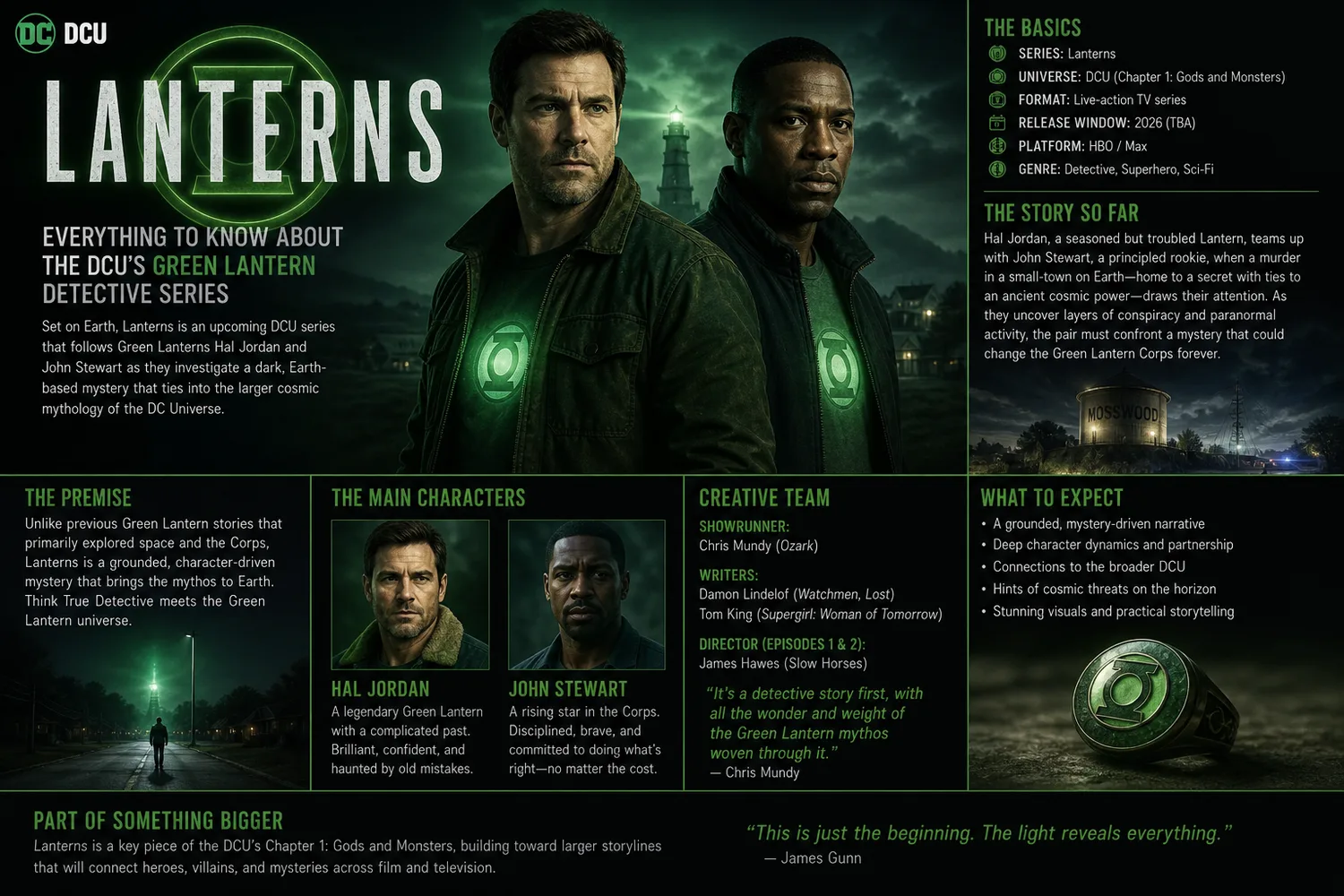
TL;DR — Lanterns premiered on HBO Max August 16, 2026, bringing Green Lantern into James Gunn's rebooted DC Universe not as a big-budget space-opera spectacle, but as an eight-episode "prestige pulp detective show" built around a Nebraska-set murder mystery. Kyle Chandler plays a seasoned Hal Jordan training his eventual replacement, Aaron Pierre's John Stewart, while Ulrich Thomsen's Sinestro looms as a corrupting mentor figure. Created by Chris Mundy (Ozark), Tom King (DC Comics), and Damon Lindelof (The Leftovers), this is one of the most tonally distinctive superhero projects to reach screens in years. Here's everything confirmed, plus my honest opinion on why grounding Green Lantern in small-town crime drama might be exactly the right call.
Get series picks based on this article
Want a grounded, character-driven take on larger-than-life mythology? Skip the search and jump straight to picks built for that.
Get series picksTell us your mood. We'll do the picking.
8 quick questions. Real series picks from real catalogs — not ads. Free, no sign-up.
Take the quizWhat is Lanterns actually about?
Set primarily in Nebraska, the series is framed explicitly as a murder mystery and detective story first, with its cosmic Green Lantern Corps mythology serving as backdrop and eventual escalation rather than the immediate focus. The core dynamic follows Hal Jordan, a Green Lantern approaching the end of his active service, training John Stewart, a veteran US Marine, to become his eventual successor. As the two investigate a series of increasingly disturbing local mysteries, the show digs into what's been described as "darker mysteries and reckonings," grounding cosmic superhero mythology within a specifically American, small-town crime-drama register.
That structural choice, using a genre-savvy detective-show format to introduce cosmic superhero concepts gradually rather than front-loading spectacle, represents a distinctive approach within the increasingly crowded superhero-television landscape, and it's a big part of why Lanterns has generated such specific, sustained curiosity ahead of its release.
Who's in the cast?
This is a prestige-television-caliber cast, and the casting logic reveals a lot about the show's intended tone. Kyle Chandler has built his career on exactly the kind of grounded, weathered, morally serious authority figures this version of Hal Jordan clearly needs, and casting him rather than a more conventionally "superhero movie" leading man signals real commitment to the detective-drama framing over pure spectacle. Aaron Pierre, meanwhile, has been building real momentum as a rising dramatic talent, and John Stewart's arc as Hal's chosen successor gives him a substantial character journey to anchor across a full season.
Ulrich Thomsen as Sinestro is a particularly interesting casting choice given the character's importance to Green Lantern mythology; Sinestro's fall from trusted mentor to one of the character's most significant villains is one of the most consequential relationship arcs in the entire Green Lantern comic book history, and having that dynamic play out across a full prestige television season, rather than compressed into a single film's runtime, gives it real room to develop with appropriate weight.
- Kyle Chandler as Hal Jordan
- Aaron Pierre as John Stewart
- Kelly Macdonald as Kerry, a small-town sheriff central to the mystery
- Nathan Fillion as Guy Gardner (also appearing in the DCU's Superman film)
- Ulrich Thomsen as Sinestro, Hal's former mentor turned rogue Green Lantern
- Garret Dillahunt as William Macon
- Poorna Jagannathan as Zoe
- Nicole Ari Parker as Bernadette, John Stewart's mother
- Jason Ritter as Billy Macon
- Sherman Augustus as John Stewart Sr.
Who's behind the show creatively?
The creative team here is stacked with serious dramatic television pedigree. Chris Mundy, known for his work on Ozark, one of the more acclaimed prestige crime dramas of recent years, brings direct genre expertise in exactly the kind of grounded, morally complex crime storytelling the show is aiming for. Tom King, a highly respected DC Comics writer known for psychologically rich, deconstructive takes on major superhero characters, brings deep comic-book mythology credibility. And Damon Lindelof, of Lost and The Leftovers fame, brings a proven track record of blending genre concepts with ambitious, often melancholy emotional and philosophical territory.
James Hawes, known for directing Slow Horses (itself a recent trending topic in this same general period, having just premiered its own new season), directs the season's first two episodes, with Stephen Williams (Watchmen), Geeta Vasant Patel (Ahsoka), and Alik Sakharov (Dark Matter) handling additional episodes. That's an impressive slate of directors with deep experience across both prestige drama and elevated genre television specifically.
James Gunn and Peter Safran, as the heads of the newly rebooted DC Studios, serve as executive producers, reflecting how directly this project connects to Gunn's broader vision for reshaping the DC Universe across film and television.
How does Lanterns fit into James Gunn's broader DCU plans?
Since taking over as DC Studios co-head, James Gunn has been explicit about wanting the new DC Universe to embrace varied tone and genre across its different film and television properties, rather than forcing every project into the same house style. That's a notable departure from a lot of prior shared-universe strategy across the broader superhero genre, which has often prioritized tonal consistency across properties specifically to make the overall universe feel cohesive.
Lanterns leaning this heavily into prestige detective-drama territory, rather than more conventional cosmic superhero spectacle, is probably the clearest evidence yet of that stated strategy actually playing out in practice. Guy Gardner's connection to Gunn's Superman film also signals genuine connective tissue between Lanterns and the DCU's flagship film properties, suggesting this isn't a fully isolated, disconnected side project but a meaningfully integrated part of the larger universe Gunn is building.
Why tell a Green Lantern story as a murder mystery instead of a space epic?
This is one of the more interesting creative gambles in recent superhero adaptation history, and it's worth examining why it might actually work. Green Lantern as a concept has always had a fundamental tonal tension built into it: the core mythology (an intergalactic police force powered by willpower-fueled rings, an entire cosmic universe of alien Lanterns) is about as maximalist and cosmic as superhero concepts get, but the character's best-received comic runs (including much of Tom King's own celebrated work across DC properties) have often found their most compelling material by grounding that cosmic mythology in specific, intimate, human-scale stories rather than pure spectacle.
The 2011 Green Lantern film starring Ryan Reynolds is frequently cited as a cautionary tale specifically for leaning too heavily into CGI-heavy cosmic spectacle without a strong enough grounded emotional or narrative core to anchor audience investment. A murder-mystery, detective-drama approach represents almost the exact opposite strategy: start intimate, character-focused, and grounded, and let the cosmic mythology expand outward gradually as the story earns it, rather than front-loading audiences with alien planets and CGI energy constructs before they have any real emotional stake in the characters wielding them.
My honest take on Lanterns
I think this is one of the smartest and most exciting creative swings in the current superhero television landscape, precisely because it's willing to actively subvert what audiences typically expect from this specific character and concept. Green Lantern has a difficult adaptation history, the 2011 film's poor critical and commercial reception cast a long shadow over the character's screen prospects for well over a decade, and rather than trying to simply execute a bigger-budget, more polished version of that same cosmic-spectacle approach, this creative team appears to have made the considerably bolder choice to reimagine the entire tonal register the story operates in.
The specific creative pedigree here excites me. Chris Mundy's Ozark experience means the show has direct access to someone who deeply understands how to build sustained, morally complex crime drama tension across a full season, not just a two-hour film. Tom King's involvement means the show has someone intimately familiar with Green Lantern mythology specifically, and known across his broader comics work for finding moving, psychologically rich character material within even the most cosmic, larger-than-life superhero concepts. And Damon Lindelof's track record suggests the show won't shy away from ambiguity, moral complexity, and unresolved emotional and philosophical questions, exactly the kind of texture that elevates genre television from disposable spectacle into something more lasting.
The Hal Jordan-to-John Stewart mentorship structure is also a smart way to handle generational transition within an ensemble mythology this large; rather than picking a single definitive "the" Green Lantern and building the entire show around them, framing the season explicitly around a passing-of-the-torch dynamic gives the show a clear emotional throughline while still leaving room to explore both characters' distinct perspectives and historical significance within the broader Green Lantern Corps mythology.
I do have some genuine curiosity about how the show balances its stated detective-drama, murder-mystery framing with the inevitable need to eventually deliver real cosmic-scale Green Lantern spectacle, ring constructs, alien mythology, the broader Corps, that longtime fans of the source material will rightfully expect to see explored in meaningful depth at some point. Shows that commit hard to a grounded, small-scale tone in their early episodes sometimes struggle to expand outward convincingly when the larger mythology eventually needs to take center stage (a tension that's affected several prior prestige genre-television adaptations attempting a similar slow-build strategy). Given the strength of the creative team assembled here, though, I'm optimistic they've thought carefully about how and when to make that expansion feel earned rather than tonally jarring.
Overall, this looks like one of the most creatively ambitious and genre-savvy superhero television projects currently in development, anchored by a stacked cast and creative team that seem committed to finding something new and distinctive to say with a character whose screen legacy has, until now, been defined mostly by disappointment.
Do you need any prior DCU or Green Lantern comic knowledge to watch?
No, the show appears designed to work as a relatively accessible entry point, grounding its cosmic mythology in an intimate, character-focused murder-mystery structure specifically so new viewers aren't required to have deep pre-existing knowledge of Green Lantern Corps lore. That said, longtime comic readers familiar with Hal Jordan, John Stewart, and Sinestro's significant, complicated shared history will likely catch additional layers of meaning and foreshadowing that newer viewers might miss.
Frequently asked questions
When did Lanterns premiere? August 16, 2026, on HBO Max.
Who stars in Lanterns? Kyle Chandler as Hal Jordan and Aaron Pierre as John Stewart, with Kelly Macdonald, Nathan Fillion, and Ulrich Thomsen as Sinestro.
How many episodes does the first season have? Eight episodes.
Who created the show? Chris Mundy (Ozark), Tom King (DC Comics), and Damon Lindelof (The Leftovers).
Is this part of James Gunn's DC Universe? Yes, with James Gunn and Peter Safran serving as executive producers, and Guy Gardner connecting directly to Gunn's Superman film.
What is the show's tone? A grounded, prestige murder-mystery detective drama, rather than a conventional cosmic superhero spectacle.
Where is the show set? Primarily Nebraska.
Is this connected to the 2011 Green Lantern film? No, this is a complete reimagining within Gunn's rebooted DC Universe continuity, unrelated to the earlier film.
Who plays Sinestro? Ulrich Thomsen, portraying Hal Jordan's former mentor turned rogue Green Lantern.
Do I need to have read Green Lantern comics first? No, the show is designed to be accessible to newcomers, though longtime fans will likely catch additional layers of reference and foreshadowing.
Looking for your next prestige genre pick?
If grounded, character-driven takes on larger-than-life mythology are your thing, our series recommendation quiz can help you find your next watch.