Monster: The Lizzie Borden Story: Cast, Premise, and Is It Worth Watching?
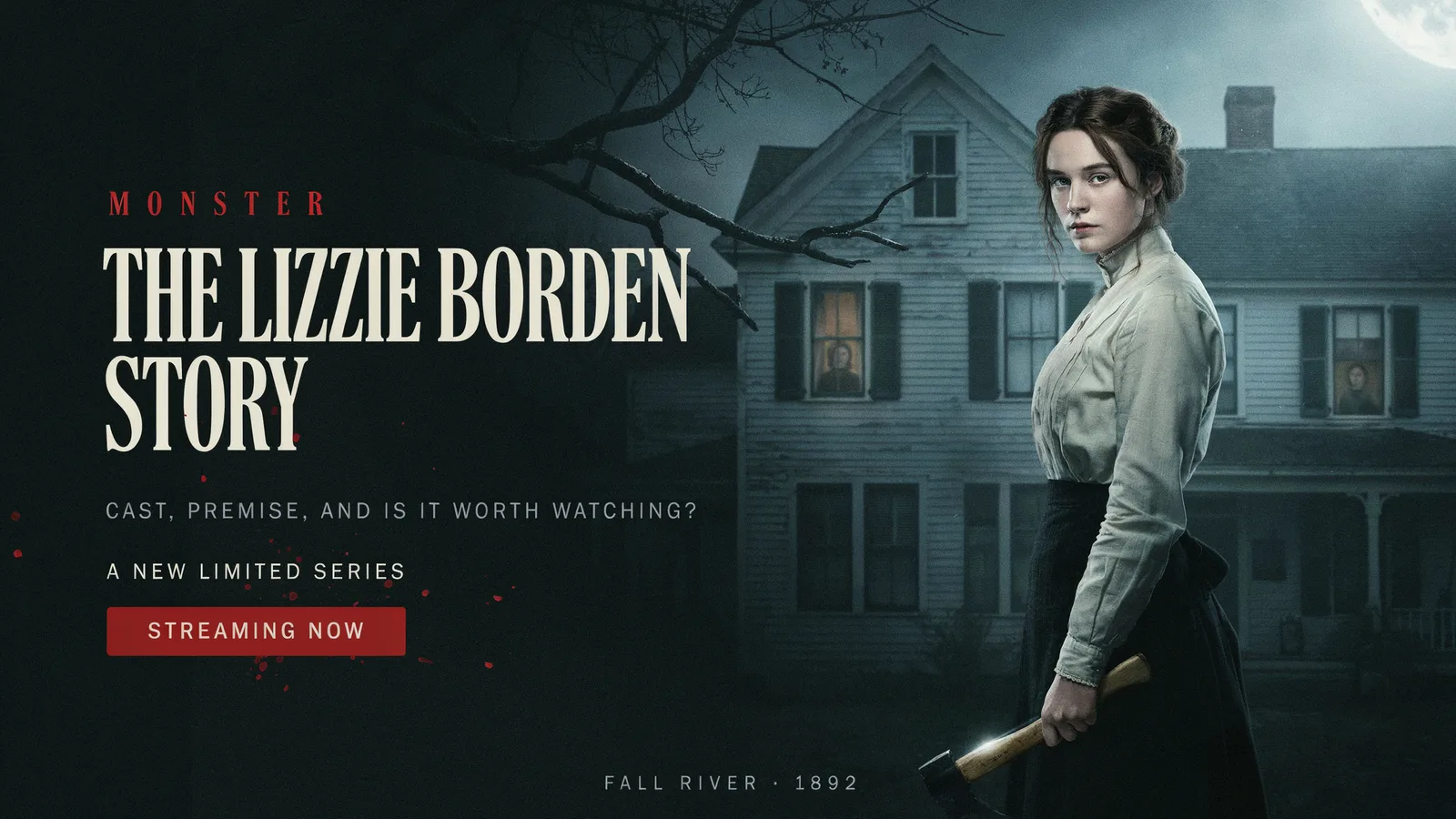
TL;DR — Monster: The Lizzie Borden Story, the fourth season of Ryan Murphy's true-crime anthology, premiered on Netflix September 17, 2026, with eight episodes. Ella Beatty leads as Lizzie Borden, accused of the infamous 1892 axe murders of her father and stepmother, in a season that spans Lizzie's Victorian childhood through the 1990s and connects her story to Aileen Wuornos, played by Sarah Paulson. This is the first Monster season centered on an alleged female perpetrator.
Get series picks based on this article
Want a historical mystery with genuine psychological depth? Skip the search and jump straight to picks built for that.
Get series picksTell us your mood. We'll do the picking.
8 quick questions. Real series picks from real catalogs — not ads. Free, no sign-up.
Take the quizWhat is Monster: The Lizzie Borden Story about?
The season centers on the 1892 axe murders of Andrew and Abby Borden in Fall River, Massachusetts, one of the most famous unsolved crimes in American history (Lizzie Borden was tried and acquitted, and the case has never been officially solved, despite the enduring cultural assumption of her guilt immortalized in the old schoolyard rhyme). The show examines, in the words of the source material summary, "misogyny, gender roles, and societal expectations placed on women in the Victorian era," alongside themes of class and sexuality. Structurally, the season is ambitious: it spans from Lizzie's childhood in the mid-19th century all the way through the 1990s, explicitly connecting her story to a modern-day killer within the same eight episodes. That's a significant departure from a straightforward historical retelling, and it suggests creator Ian Brennan is interested in using the Borden case as a lens for something bigger about how society constructs and mythologizes female violence across different eras.
Who's in the cast, and who do they play?
Ella Beatty plays Lizzie Borden. Vicky Krieps plays a dual role: Bridget "Maggie" Sullivan, the family's housekeeper, and Countess Elizabeth Báthory, the historical Hungarian figure sometimes called the "Blood Countess," a choice that signals the show is playing with symbolic framing across eras rather than a strict single-timeline structure. Charlie Hunnam plays Andrew Borden, Lizzie's father and one of the murder victims. Rebecca Hall plays Abby Borden, Lizzie's stepmother and the other murder victim. Sarah Paulson plays Aileen Wuornos, the real-life serial killer executed in 2002, whose presence in the cast directly supports the season's stated ambition of linking Lizzie's story to a more modern killer. Billie Lourd plays Emma Borden, Lizzie's older sister. Jessica Barden plays Nance O'Neill, an actress historically linked to a romantic relationship with Lizzie in the years after her acquittal. Joey Pollari plays John Morse, Andrew Borden's brother-in-law. Ella Beatty, daughter of Annette Bening and Warren Beatty, takes the lead role in what's a significant, high-visibility showcase part. According to her own comments on the project, the creative approach follows the anthology's established method: "Every season of Monster has been an exercise in understanding the person's psychology. Are they born or are they made?"
Why does this season pair Lizzie Borden with Aileen Wuornos?
This is the detail that most sets this season apart from a conventional historical drama, and it's worth sitting with. Sarah Paulson's casting as Aileen Wuornos (a case Ryan Murphy has engaged with before in other projects, and a figure who's become a fixture of true-crime pop culture in her own right, largely through Charlize Theron's Oscar-winning performance in 2003's Monster) suggests the season is building an explicit throughline between two of America's most famous cases of women accused of violent crime, separated by roughly a century. That's an interesting curatorial choice for a season subtitled around Lizzie Borden specifically. It positions the Borden case not as an isolated historical curiosity but as part of a longer cultural pattern: how society processes, sensationalizes, and mythologizes women who are accused of extreme violence.
Is Lizzie Borden's guilt something the show takes a firm stance on?
Based on what's been reported, the show appears interested in psychological interiority rather than a simple prosecutorial case-for-guilt narrative, following the same approach the Monster anthology has taken with its previous subjects (Jeffrey Dahmer, the Menendez brothers, Ed Gein). Beatty's quote about the franchise's guiding question, "are they born or are they made," suggests the season is more interested in exploring what could have driven Lizzie to violence than in delivering a definitive true-crime verdict. This is worth flagging clearly for anyone sensitive to how the show handles a case that, unlike Dahmer or the Menendez brothers, was never actually proven in court. Any dramatization that leans into her guilt as a narrative assumption is making a creative and interpretive choice about a historically contested question, not dramatizing settled fact.
How does this compare to previous Monster seasons?
The Monster anthology has built its reputation, for better and worse, on tackling real, often deeply disturbing crimes with a specific visual and tonal style: prestige-drama production values applied to upsetting subject matter, frequently drawing both audience numbers and significant criticism in the same breath. Monster: The Jeffrey Dahmer Story became one of Netflix's biggest hits ever while simultaneously drawing sharp criticism from victims' families over how their stories were used without consultation. This is the first season centered on a woman, and specifically on a case where the guilt of the accused was never legally established, which is a different ethical terrain than the franchise's previous, more settled subjects. It's also, notably, further removed in time, which changes the calculus somewhat: there are no living victims' families to consult or potentially retraumatize in the same immediate way.
My honest take on Monster: The Lizzie Borden Story
I have mixed feelings about the Monster anthology as a franchise, and I think that mixed reaction is actually the correct response to what Ryan Murphy and his collaborators have built here. The production values are consistently excellent, the casting is frequently inspired, and the shows do generate real conversation about how we as a culture process violence and the people accused of committing it. But the franchise also has a real pattern of prioritizing shock value over the more careful, victim-conscious storytelling this kind of material arguably demands, and the Dahmer season's ethical controversies were, in my view, a legitimate reckoning rather than an unfair pile-on. That context makes me approach this Lizzie Borden season with a specific, cautious optimism. The 1892 setting changes the ethical stakes in the show's favor: this is a case so old, so thoroughly mythologized in American pop culture already, that it sits in a meaningfully different category than dramatizing a killing spree from the 1990s with living relatives who can watch the show and see their trauma reenacted. What excites me is the choice to make this the franchise's first season centered on a woman, and to lean into the specific gendered dimension of the case, pairing it with Aileen Wuornos, another woman whose violence became a cultural spectacle largely filtered through misogynistic and sensationalized media coverage at the time. My reservation is the same one I'd bring to any Monster season: whether the execution matches the ambition. Given that Lizzie Borden's guilt was never proven, I'll be watching closely for whether the show treats that ambiguity with real narrative respect, or whether it quietly resolves the mystery in favor of the more dramatically satisfying "she did it" version of events that pop culture has already decided on. Overall, I'm interested, in a way I wasn't for some of the franchise's more recent, more ethically fraught installments. The distance of history, the ambitious cross-era structure, and the specific choice to foreground gender as a central theme give this season more room to be thoughtful than shocking. Whether it uses that room well is the real test.
Do you need to have watched previous Monster seasons first?
No, each season is a fully self-contained story with a new cast and subject, so there's no ongoing plot to catch up on. If you're new to the anthology, this Lizzie Borden season is actually a reasonable entry point precisely because of its historical distance from the present day, which softens some of the more uncomfortable ethical questions that have followed the franchise's more recent-history seasons.
Frequently asked questions
When did Monster: The Lizzie Borden Story release? September 17, 2026, on Netflix, with eight episodes.
Who plays Lizzie Borden? Ella Beatty.
Is this based on a true story? Yes, the 1892 murders of Andrew and Abby Borden in Fall River, Massachusetts, a real and historically famous case.
Was Lizzie Borden actually convicted? No, she was tried and acquitted. The case has never been officially solved.
Who created the Monster anthology? Ryan Murphy and Ian Brennan, with Brennan credited as creator and showrunner for this specific season.
How many seasons of Monster are there? This is the fourth season, following seasons on Jeffrey Dahmer, the Menendez brothers, and Ed Gein.
Why does Sarah Paulson play Aileen Wuornos in a Lizzie Borden season? The season explicitly connects Lizzie's story to Wuornos's, spanning Lizzie's Victorian childhood through the 1990s within the same eight episodes, not a separate season.
Is this the first Monster season about a woman? Yes, marking the franchise's first season centered on an alleged female perpetrator.
Does the show take a stance on whether Lizzie Borden was guilty? The show appears more focused on psychological exploration than a definitive verdict, though viewers should approach any dramatization of an unproven case with that context in mind.
Do I need to watch the earlier Monster seasons first? No, each season stands alone with a new cast and subject.
Looking for your next true-crime watch?
Our series recommendation quiz can help you find your next watch based on your actual mood.