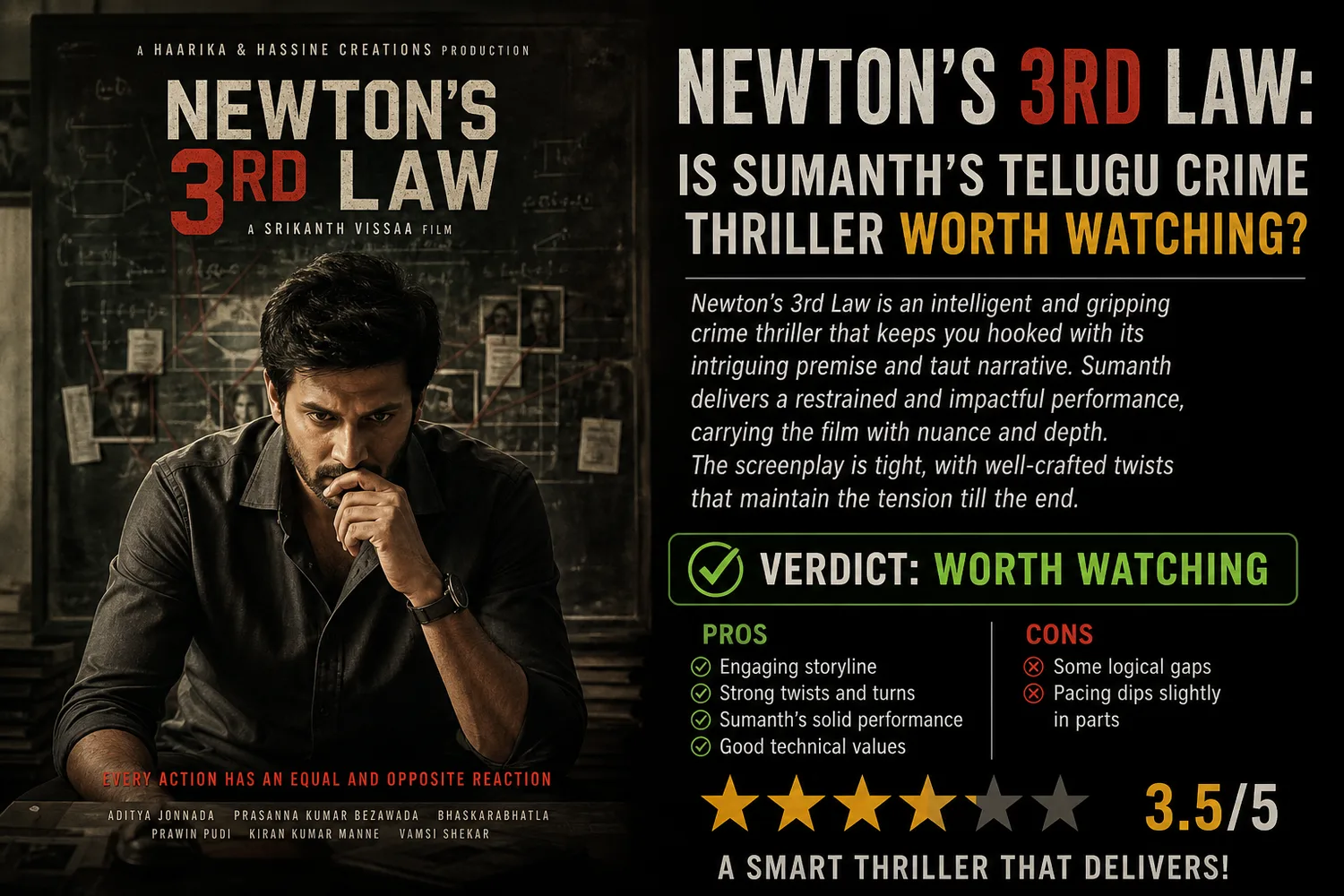
Newton's 3rd Law: Is Sumanth's Telugu Crime Thriller Worth Watching?
TL;DR — Newton's 3rd Law released theatrically July 31, 2026, before landing on Netflix with Telugu, Hindi, Tamil, Kannada, and Malayalam audio tracks. Sumanth stars as investigator Vasudev, digging into a young man's suspicious death that leads back to events from 1999 and a mysterious book that gives the film its title. Directed by Rajesh Karna, the film uses Newton's famous physics principle as a metaphor for karma and inescapable consequence. Reception has been notably split, a strong IMDb user rating against a more measured 2.5-out-of-5 critical consensus from reviewers. Here's everything confirmed, plus my honest opinion on a film whose ambition seems to have outpaced its pacing.
Get movie picks based on this article
Want a slow-burn investigative thriller with real thematic ambition? Skip the search and jump straight to picks built for that.
Get movie picksTell us your mood. We'll do the picking.
8 quick questions. Real movie picks from real catalogs — not ads. Free, no sign-up.
Take the quizWhat is Newton's 3rd Law about?
The story follows Vasudev, a police investigator examining the suspicious death of a young man named Vinay. As Vasudev's inquiry deepens, the trail leads backward through time to events from 1999, and to a mysterious book titled "Newton's 3rd Law," which becomes both a literal plot object and the film's central organizing metaphor. Isaac Newton's third law of motion, that every action produces an equal and opposite reaction, is used throughout the film as a framework for exploring karma, cause and effect, and the way past violence and moral compromise inevitably generate consequences that ripple forward, often landing on people who had nothing to do with the original transgression.
That structural choice, using a real scientific principle as a narrative and thematic scaffold for a crime story about buried secrets and delayed consequences, is an ambitious conceptual hook, giving the film's investigation-driven plot a clear philosophical throughline beyond a standard whodunit structure.
Who's in the cast?
Sumanth has built a long, respected career in Telugu cinema across a wide range of roles, and reviewers specifically singled out his performance here as one of the film's stronger elements, describing it as "restrained," a notable and deliberate choice for a crime-thriller investigator lead, where a lot of similar genre films lean toward more overtly intense or theatrical performances. Jagapathi Babu, playing the criminal figure whose past actions set the entire plot in motion, brings substantial genre credibility from decades of prior work across Telugu film.
- Sumanth as Vasudev, the investigating police officer
- Jagapathi Babu as Stephen Mercury, a criminal figure central to the story's past events
- Srinivas Avasarala
- Trinadh Varma
- Shelley N. Kumar
- Ravi Varma
- Neha Pathan
- Goutham Pandit
Who directs, and what's the film's central thematic approach?
Rajesh Karna both writes and directs, building the film's structure around the specific, deliberate use of Newton's third law of motion as a metaphor for moral consequence and karmic reckoning. That's a thoughtful conceptual foundation for a crime thriller, using established scientific language to frame the story's exploration of how past actions, buried for decades in this case, inevitably generate consequences that eventually surface, whether or not the people involved are prepared to face them.
Where and when did the film release?
Newton's 3rd Law released theatrically in Telugu on July 31, 2026, with a runtime reported as approximately 135 to 138 minutes depending on the source, before making its way to Netflix with multiple regional-language audio tracks (Telugu, Hindi, Tamil, Kannada, and Malayalam), a distribution strategy aimed at reaching audiences well beyond the film's original Telugu-language theatrical release.
How was the film received?
Split, in a way that's worth examining closely. The film built a notably strong audience rating on IMDb, reflecting real enthusiasm among viewers, but a more measured 2.5 out of 5 editorial rating from critical reviews (independently confirmed by multiple Telugu outlets, including NTV Telugu and 123telugu). Reviewers specifically praised Sumanth's restrained lead performance and the film's intriguing central premise, while criticizing slow pacing and uneven execution, particularly flagging the first half of the film as a structural weak point.
That gap, between strong grassroots audience enthusiasm reflected in the IMDb score and more measured critical assessment, often points to a film whose core concept and central performances connect with viewers even when its pacing and structural execution don't fully satisfy more critically rigorous standards, a pattern that's actually fairly common for ambitious genre films built around a strong central idea that the screenplay doesn't always fully capitalize on.
Why might a film with such a strong central premise struggle with pacing specifically?
This is worth unpacking, because it's a recurring challenge for crime thrillers built around a dual timeline structure, connecting a present-day investigation to buried past events. Balancing two separate narrative timelines (the 1999 events and the present-day investigation into Vinay's death) requires careful pacing discipline to keep both threads compelling without either one dragging or feeling rushed relative to the other. When critics specifically flag the first half as the weaker section, that often suggests the film may have spent too much time on setup and scene-setting before its central mysteries and dual-timeline connections started generating real narrative momentum, a common structural pitfall for ambitious, thematically rich crime dramas that prioritize atmosphere and thematic groundwork over more immediate plot propulsion in their opening stretches.
My honest take on Newton's 3rd Law
I think this is an interesting example of a film whose conceptual ambition clearly exceeded its screenplay's ability to fully execute that ambition within a satisfying pacing structure, and the specific gap between its strong IMDb rating and more measured critical reception tells an instructive story about where exactly the film succeeds and where it falls short. Using Newton's third law as an organizing metaphor for karmic consequence is a smart, distinctive hook that elevates the film's thematic ambitions well beyond a standard crime-procedural structure, and that's exactly the kind of conceptual sophistication that engaged audiences, reflected in that strong user rating, clearly responded to and appreciated.
Where the film seems to have stumbled, based on the specific critical feedback, is in the harder craft challenge of translating that strong thematic concept into consistently well-paced, engaging screenwriting, particularly in a first half that critics found dragged relative to the stronger, more compelling back half once the dual-timeline connections presumably started paying off more directly. That's a common issue for ambitious genre films: a strong central idea and clear thematic vision don't automatically guarantee the scene-by-scene pacing discipline needed to keep an audience fully engaged for the full runtime, especially in a structure this reliant on slowly, deliberately revealing connections between two separate time periods.
Sumanth's specifically praised restrained performance also suggests the film found real success on the craft level that matters most for a story like this: making an investigator protagonist who has to carry a lot of quiet, internalized processing (piecing together how the past connects to the present) compelling to watch even in scenes without a lot of external action or dramatic incident. That's a difficult kind of performance to pull off well, and reviewers singling it out as a strength suggests the film's core acting foundation was solid even where its screenplay pacing wasn't.
Given the strong grassroots audience response and a clearly ambitious, thoughtfully constructed central premise, I think this is worth watching for genre fans specifically interested in crime thrillers that aim for genuine thematic depth rather than pure plot mechanics, provided you go in with realistic expectations about some pacing unevenness, particularly in the film's opening stretch, based on the consistent critical feedback on that specific point.
Do you need any specific background to follow the story?
No specialized knowledge of physics or Newton's actual scientific principles is required; the film uses the third law purely as an accessible metaphorical framework rather than requiring any genuine scientific literacy to follow its narrative and thematic threads.
Frequently asked questions
When did Newton's 3rd Law release? July 31, 2026, theatrically, later available on Netflix.
Who stars in the film? Sumanth as Vasudev, alongside Jagapathi Babu as Stephen Mercury.
Who directs the film? Rajesh Karna, who also wrote the screenplay.
What is the film's IMDb rating? Strong with audiences on IMDb, though critical reviews were more measured at around 2.5 out of 5.
What language is the film in? Originally Telugu, with Hindi, Kannada, and Malayalam audio available on Netflix.
What is the central metaphor of the film? Newton's third law of motion (every action has an equal and opposite reaction) used as a framework for exploring karma and consequence.
What is the plot about? An investigator's inquiry into a young man's suspicious death uncovers connections to buried events from 1999.
What was the main criticism of the film? Slow pacing and uneven execution, particularly in the first half.
How long is the film? Approximately 135 to 138 minutes, depending on the source.
Is this connected to any other film with a similar title? No, it's an original Telugu production, unrelated to any other films that may share similar or overlapping titles.
Looking for your next crime thriller pick?
If thematically ambitious crime dramas with a strong central hook are your thing, our movie recommendation quiz can help you find your next watch tonight.