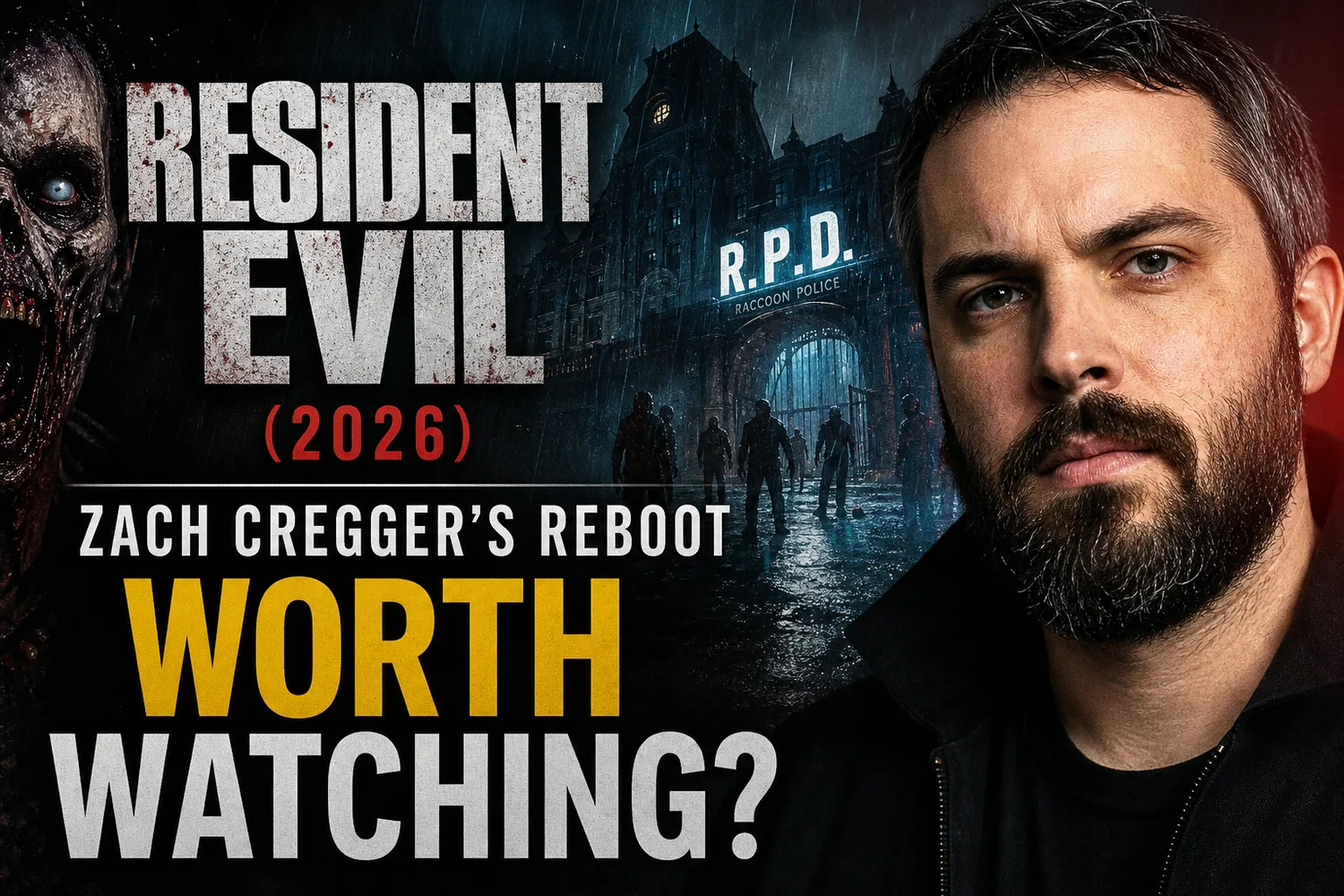
Resident Evil (2026): Is Zach Cregger's Reboot Worth Watching?
TL;DR — Zach Cregger's Resident Evil reboot premiered at Fantastic Fest on September 17, 2026, and opens wide on September 18 via Sony Pictures Releasing. It's an $80 million original story set during a viral outbreak in Raccoon City, starring Austin Abrams as a medical courier caught in the chaos, with an entirely new cast of characters rather than adapting Leon, Jill, or Claire's stories from the games. This is the franchise's second full reboot and eighth overall film.
Get movie picks based on this article
Want real, sustained horror dread instead of jump scares? Skip the search and jump straight to picks built for that.
Get movie picksTell us your mood. We'll do the picking.
8 quick questions. Real movie picks from real catalogs — not ads. Free, no sign-up.
Take the quizWhat is the new Resident Evil movie actually about?
Cregger and co-writer Shay Hatten built an original story that unfolds during a viral outbreak of infected creatures in Raccoon City, the fictional Midwestern American city that's been the series' spiritual home since the first game. The lead character is Bryan, a medical courier played by Austin Abrams, who gets caught trying to complete a hospital delivery as the outbreak spirals into full chaos around him. Crucially, this is not an adaptation of any specific Resident Evil game's plot. Cregger has been explicit about this choice, saying: "I'm not going to tell Leon's story, because Leon's story is told in the games." Instead, the film is designed as an alternate-timeline story that runs parallel to the events of Resident Evil 2, the beloved 1998 game about Raccoon City's initial outbreak, without directly retelling it.
Who's in the cast?
Austin Abrams plays Bryan, the medical courier at the center of the story. Zach Cherry plays Dave, an Umbrella Corporation scientist. Paul Walter Hauser plays Carl, another Umbrella-linked figure. Kali Reis plays Maxine, an armed Umbrella escort tasked with enforcement rather than lab work. Johnno Wilson plays Max, an Arklay County sheriff caught up in the outbreak on the law-enforcement side rather than Umbrella's. That's an interesting ensemble on paper. Austin Abrams has spent the last several years building a resume of specific, off-kilter performances (Euphoria, The Walking Dead, Dash & Lily), and casting him as an ordinary courier rather than a trained soldier or scientist fits Cregger's stated approach of keeping the story grounded in a person who doesn't have combat training walking into a nightmare. Paul Walter Hauser, meanwhile, has become one of the most reliably compelling character actors working right now (I, Tonya, Richard Jewell, Cruella), and his presence suggests the film is interested in giving its corporate-villain side actual human texture rather than faceless evil-corporation shorthand.
Who is Zach Cregger, and why does his involvement matter?
If horror isn't your regular genre, you might not immediately recognize the name, but Cregger has become one of the most talked-about directors in the space over the past few years, largely off the strength of Barbarian, a film that became a genuine word-of-mouth phenomenon for how expertly it subverted audience expectations and built dread out of what seemed, on the surface, like a fairly simple premise. He followed that with Weapons, another critically acclaimed original horror film that further established him as a director with a distinctive point of view rather than a studio hired gun. That matters enormously for a Resident Evil movie specifically, because this franchise has a rough track record when it comes to matching the right creative voice to the material. The original Paul W.S. Anderson-helmed film series (2002 through 2016, six films starring Milla Jovovich) leaned hard into action spectacle over horror, which made for entertaining B-movie fun but drifted further and further from what actually made the games scary. The 2021 reboot, Welcome to Raccoon City, tried to swing back toward faithful horror-game adaptation and mostly got tepid reviews for feeling more like a checklist of game references than a movie that worked on its own terms. Handing the keys to a filmmaker whose entire recent reputation is built on generating real, sustained dread through careful craft feels like the first time this franchise has actually been treated as horror source material deserving a horror filmmaker's full attention.
How does this fit into the Resident Evil movie history?
This is the second full reboot and the eighth Resident Evil film overall, which is worth sitting with for a second. The original six-film Anderson series grossed well over a billion dollars combined worldwide despite a Rotten Tomatoes track record that's charitably described as "not good," which tells you everything about the gap between critical and commercial reception this IP has historically had. Welcome to Raccoon City in 2021 was meant to be a course correction, a more faithful, more horror-focused take closer to the games, and it underperformed both critically and commercially, which arguably created the opening for this second reboot to try a different approach: instead of adapting an existing game's story more faithfully, tell an original story in the same world with a director known for original horror filmmaking rather than franchise management.
Why does an original story (rather than adapting Leon or Jill's arc) make sense here?
I think this is actually the smartest structural decision in the whole project. Every prior live-action Resident Evil adaptation has struggled with the same basic problem: the games' plots, while beloved, are built around video game logic that doesn't translate cleanly into a two-hour film without feeling either slavishly literal or badly compressed. Welcome to Raccoon City ran directly into this problem, trying to cram huge chunks of both Resident Evil and Resident Evil 2's game plots into one film and ending up with something that felt like a highlight reel rather than a story. By building an original character, someone with zero connection to Umbrella Corporation, zero combat training, and no prior knowledge of what's about to happen to his city, Cregger sidesteps the adaptation trap entirely. The audience experiences the outbreak the way an ordinary person actually would: with confusion, panic, and no meta-knowledge of zombie rules from having played the games.
My honest take on the 2026 Resident Evil reboot
I'll be upfront that I went into researching this movie assuming it would be more of the same: another attempt to squeeze box office out of a beloved game franchise with diminishing critical returns. What changed my mind is the Cregger factor specifically. Barbarian is one of the smartest pieces of modern horror filmmaking precisely because of its structural audacity, and Weapons doubled down on that same instinct. A director with that specific skill set, applied to a franchise built on outbreak paranoia and corporate malevolence, feels like an exciting combination rather than just another IP cash-in. My honest reservation is about scale. Cregger's best work so far has been comparatively contained, and Resident Evil, as a franchise, has audience expectations baked in around action and scale that a more intimate horror filmmaker hasn't necessarily had to deliver before. The casting gives me real confidence, though. Putting Paul Walter Hauser in an Umbrella role, rather than stunt-casting recognizable action stars, suggests the film is invested in the corporate-conspiracy side of the story having real human stakes. My overall read: this is the most legitimately excited I've been for a video game movie adaptation in a while. The combination of a genuine horror auteur, a cast built around character actors rather than pure spectacle, and a smart structural decision to tell an original story gives this the best foundation any live-action Resident Evil project has had. Whether it delivers is still an open question until reviews land, but the pieces are in the right place.
Do you need to have played the games to understand this movie?
No, and this appears to be deliberate. Because the story follows an original character with no prior knowledge of Umbrella Corporation or the T-virus, the film is structurally built to work as an entry point for newcomers, the same way a well-made horror movie about any outbreak scenario would. Longtime fans will likely pick up on Easter eggs and parallel-timeline details connecting it to Resident Evil 2 specifically, but the plot itself doesn't require that context to follow.
Frequently asked questions
When does Resident Evil (2026) release? It premiered at Fantastic Fest on September 17, 2026, and opens wide theatrically on September 18, 2026, via Sony Pictures Releasing.
Who directs the new Resident Evil movie? Zach Cregger, known for Barbarian and Weapons.
Is this a reboot or a sequel to the earlier films? It's a reboot, the second in the franchise's film history, and the eighth Resident Evil film overall.
Does the movie adapt a specific game's story? No, it tells an original story that runs parallel to the events of Resident Evil 2 rather than adapting it directly.
Who stars in the movie? Austin Abrams leads as Bryan, alongside Zach Cherry, Kali Reis, Paul Walter Hauser, and Johnno Wilson.
What was the budget? Approximately $80 million.
Where was it filmed? Prague, with production beginning in October 2025.
Is the film in IMAX? Yes, it will receive IMAX distribution.
Do I need to have seen the earlier Resident Evil movies first? No, this reboot is designed as a fresh entry point.
Is this the same continuity as the Milla Jovovich films? No, it's a separate reboot continuity, distinct from both the original Paul W.S. Anderson series and 2021's Welcome to Raccoon City.
Looking for your next horror watch?
Our movie recommendation quiz can help you find your next pick based on exactly what kind of scared you're in the mood for.