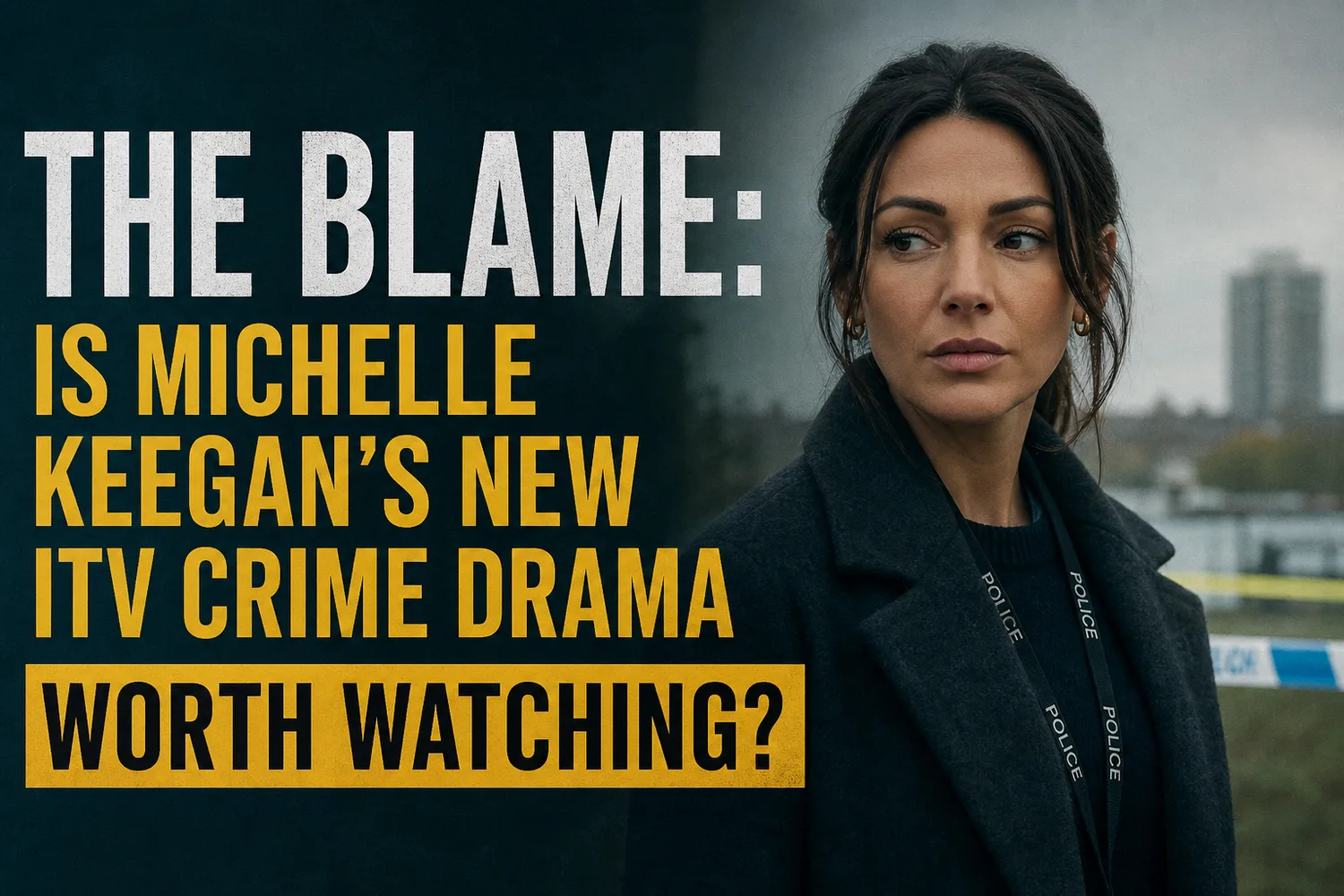
The Blame: Is Michelle Keegan's New ITV Crime Drama Worth Watching?
TL;DR — The Blame is a new six-part ITV crime drama that premiered September 20, 2026, starring Michelle Keegan as DI Emma Crane and Douglas Booth as DI Tom Radley, investigating the murder of a teenage figure skater in the fictional town of Wakestead. It's adapted from Charlotte Langley's 2023 novel by Megan Gallagher, and its defining feature is that it weaves in genuine leaked text messages, uncovered through real whistleblowing, that expose casual, systemic misogyny inside a police force. It's currently streaming in full on ITVX. This isn't a cozy Sunday-night procedural. It's a deliberately uncomfortable show that wants you to sit with how normalized sexism can get inside an institution meant to protect people, and it mostly earns that discomfort. Worth watching if you want a crime drama with genuine teeth and something real to say, less so if you want an easy watch.
Get series picks based on this article
Want another crime drama with real teeth and something to say? Skip the search and jump straight to picks built for that.
Get series picksTell us your mood. We'll do the picking.
8 quick questions. Real series picks from real catalogs — not ads. Free, no sign-up.
Take the quizWhat is The Blame actually about?
The Blame opens with the discovery of a teenage figure skater's body in a quiet town, and from there it becomes a fairly standard murder investigation on the surface. A body, a coach, a tight community with secrets, a detective team racing against time. What separates it from the dozens of other British crime dramas following that exact structural template is what it does with the investigation itself, and specifically with the culture inside the police unit conducting it.
Michelle Keegan plays DI Emma Crane, and the show positions her as essentially the one person inside the fictional Wakestead force willing to actually confront the institutional rot around her, rather than quietly absorb it the way everyone else has learned to. That rot isn't abstract or vaguely implied. The series draws directly on real text messages, uncovered through actual whistleblowing investigations into UK policing, that expose the kind of casual, ugly misogyny that circulates inside institutions when nobody's watching. One report on the show described these texts bluntly as "hideous, and it's tough to watch," which is not a phrase you usually see attached to a primetime ITV drama, and it tells you exactly what register the show is operating in.
The murder mystery itself functions as the engine, but the real subject of The Blame is what it's like to be a woman trying to do serious, high stakes work inside a system that treats her competence as conditional and her presence as tolerated rather than valued. That's a heavier ambition than most six part ITV crime dramas set for themselves, and it shows in how the show is constructed.
Who's in the cast?
- Michelle Keegan as DI Emma Crane, the lead, and the character positioned as the moral center willing to push back against the culture around her.
- Douglas Booth as DI Tom Radley, Emma's colleague, caught somewhere between complicity and genuine self examination as the investigation unfolds.
- Nathan Mensah as DC Lewis Brimah
- Nigel Boyle as Neil Shergill
- Joe Armstrong as Coach Kyle Frasier, the skating coach at the center of the initial suspicion.
- Matilda Freeman as Sophie Madsen
- Gavin Spokes as DC Joel Stevens
- Josh Bolt as DC Douglas James
- Ian Hart as DCI Kenneth Walker
- Ceallach Spellman as PC Callum Drummond
- Tiahna Krenek as Mila Brimah
That's a deep, character actor heavy ensemble rather than a stunt cast lineup, which fits a show that's more interested in a slow burn portrait of an institution than in flashy twist a minute plotting.
Who made The Blame, and what's it based on?
The Blame is adapted by Megan Gallagher from Charlotte Langley's 2023 novel, with Ashley Sanders and Namsi Khan co-writing. It's directed by Bex Rycroft and Claire Tailyour, produced by Matt Strevens, with Gallagher, Polly Hill, Nicola Shindler, and Richard Fee serving as executive producers. It comes from Quay Street Productions and Fifth Season, filmed across London and Hertfordshire in the summer of 2025, and runs six episodes at roughly 47 minutes each.
The real world texture isn't incidental set dressing. Both Keegan and Booth have talked about consulting directly with retired detective Lisa Farrand, who previously advised on Happy Valley, throughout production, and Keegan has specifically noted that Farrand would flag anything in the script that didn't ring true to actual police procedure, right down to interrogation scene dialogue. Booth has also said he drew on the BBC's Panorama investigation into misconduct at Charing Cross police station while building his character, which grounds the show's fictional misogyny in a very real, well documented recent scandal rather than an invented worst case scenario.
There's also a detail worth knowing before you press play. Booth has confirmed that the series' original opening episode was more explicit than what actually aired, and the creative team pulled back from that version before broadcast. He didn't specify exactly what was cut, but the fact that this show's first instinct was even more unflinching than the finished product tells you something about how seriously the creative team wanted to treat the subject matter, even after they dialed it back.
Why did Keegan and Booth actually want to make this?
Keegan has said plainly that she was drawn to the script because of how shocked she was by the end of it, calling that reaction "a really good sign" that a drama was worth doing. She's also spoken about wanting to play strong female characters specifically, describing Emma Crane as someone who "holds her own" and is "opinionated when it matters," which reads as a pretty direct response to a genre that has historically given its female detectives a lot less texture than their male counterparts.
Booth's framing is a little different, and honestly a little more pointed. He's said the goal isn't just to entertain, but to "uncover some of the ugly truths," and he's specifically expressed hope that male viewers watching the show will end up questioning their own behavior, even at the level of small, easy to dismiss "micro" moments rather than only the most obvious, cartoonish forms of sexism. That's an unusually direct thing for an actor to say about a mainstream ITV crime drama, and it signals that the show is aiming for something closer to a genuine cultural conversation starter than a disposable Sunday night watch.
Does the show earn its difficult subject matter?
This is the real question with a show like this, because "based on real leaked texts exposing police misogyny" can just as easily describe something thoughtful and something that exploits real trauma for shock value, and the gap between those two things comes down entirely to execution.
From what's been reported so far, The Blame seems to be threading that needle reasonably carefully. The involvement of a real former detective consultant throughout production, the direct grounding in a specific, well documented real scandal rather than a vague composite, and the fact that the creative team actually pulled back an even more explicit original opening rather than leaning harder into shock value, all point toward a production that was thinking carefully about how far to push the material rather than chasing headlines for their own sake.
That said, this is still a show built around a teenage victim and genuine, ugly real world misconduct, and it's fair to go in with your eyes open about that. This isn't comfort viewing, and it's not trying to be.
How does it compare to other British crime dramas doing similar work?
If you've watched Happy Valley, the comparison is going to come up constantly, and not just because of the shared detective consultant. Both shows are interested in what it actually costs a woman to hold a position of authority inside institutions that weren't really built with her in mind, and both use a specific, grounded crime investigation as the vehicle for a much broader argument about power and complicity. The Blame is clearly working in that same lineage, and leaning on Lisa Farrand's expertise directly is a strong signal of intent, whether or not the finished show ultimately reaches the same heights.
Where it distinguishes itself is in how explicitly it ties its fiction to a specific, real, recent scandal. Booth referencing the Charing Cross Panorama investigation by name isn't subtle, and it means viewers who followed that real story are going to recognize exactly what The Blame is drawing from, which raises the stakes of getting the portrayal right.
My honest take on The Blame
I think this is exactly the kind of British crime drama that's worth paying attention to, and also exactly the kind that's easy to undersell if you only skim the marketing and file it under "another ITV murder mystery with a well known lead."
What convinces me this one is doing something real rather than just borrowing the aesthetics of a "serious" issue drama is the production detail about the opening episode being toned down from something more explicit. That's not the kind of thing a show trying to manufacture controversy does. A show chasing headlines leans harder into shock value, not away from it. Pulling back suggests a creative team that actually thought about the line between honest and gratuitous, and chose to stay on the right side of it even when a more explicit version was sitting right there.
I also think Douglas Booth's comments about wanting male viewers to sit with their own small, easily dismissed behaviors, rather than just feel appropriately horrified at an obvious villain, is the smartest thing anyone involved with this show has said publicly. A lot of issue driven dramas let the audience off the hook by making the misogyny so cartoonish that no reasonable viewer could see themselves in it. If The Blame is built around the kind of casual, "everyone does it" texture that real leaked police messages actually showed, rather than a moustache twirling caricature, that's a much harder and more honest thing to sit through, and a much more valuable one.
Where I'd flag caution is simply in what kind of evening you're looking for. This isn't a show to put on if you want plot momentum and nothing more. It's asking something of you, and it's clearly more interested in making you uncomfortable in a productive way than in delivering a tidy, satisfying whodunit. If that's what you're in the mood for, I think this is one of the stronger, more purposeful entries in the current wave of British crime drama, precisely because it has something to actually say and isn't afraid to make that the point rather than the subplot.
Frequently asked questions
Is The Blame based on a true story? It's a fictional adaptation of Charlotte Langley's 2023 novel, but it incorporates real leaked text messages from actual whistleblowing investigations into UK police misconduct, and draws directly on the real BBC Panorama investigation into Charing Cross police station.
How many episodes does The Blame have? Six episodes, each roughly 47 minutes long.
Where can I watch The Blame? It airs on ITV and streams on ITVX, with the full series available.
Who plays the lead detective in The Blame? Michelle Keegan plays DI Emma Crane.
Is The Blame the same as Happy Valley? No, they're unrelated productions, though they share a detective consultant, retired officer Lisa Farrand, and a similar interest in institutional sexism within policing.
Is The Blame appropriate for casual, easy watching? Not really. It deals with a teenage victim's murder and explicit, real world grounded misogyny, and is built to be uncomfortable rather than easy.
Who wrote The Blame? Megan Gallagher adapted the novel, with Ashley Sanders and Namsi Khan co-writing.
Was any content cut from the show before it aired? Yes. Douglas Booth confirmed the original opening episode was more explicit than the aired version, though he didn't specify exactly what was removed.
When did The Blame premiere? It premiered on ITV on September 20, 2026.
Is there a second series planned? There's no confirmed information about a second series at this time, as it launched as a self contained six part drama.
Looking for your next series to watch?
Take our mood based quiz at https://www.suggestionlabs.com/quiz/series and let us do the deciding for you.