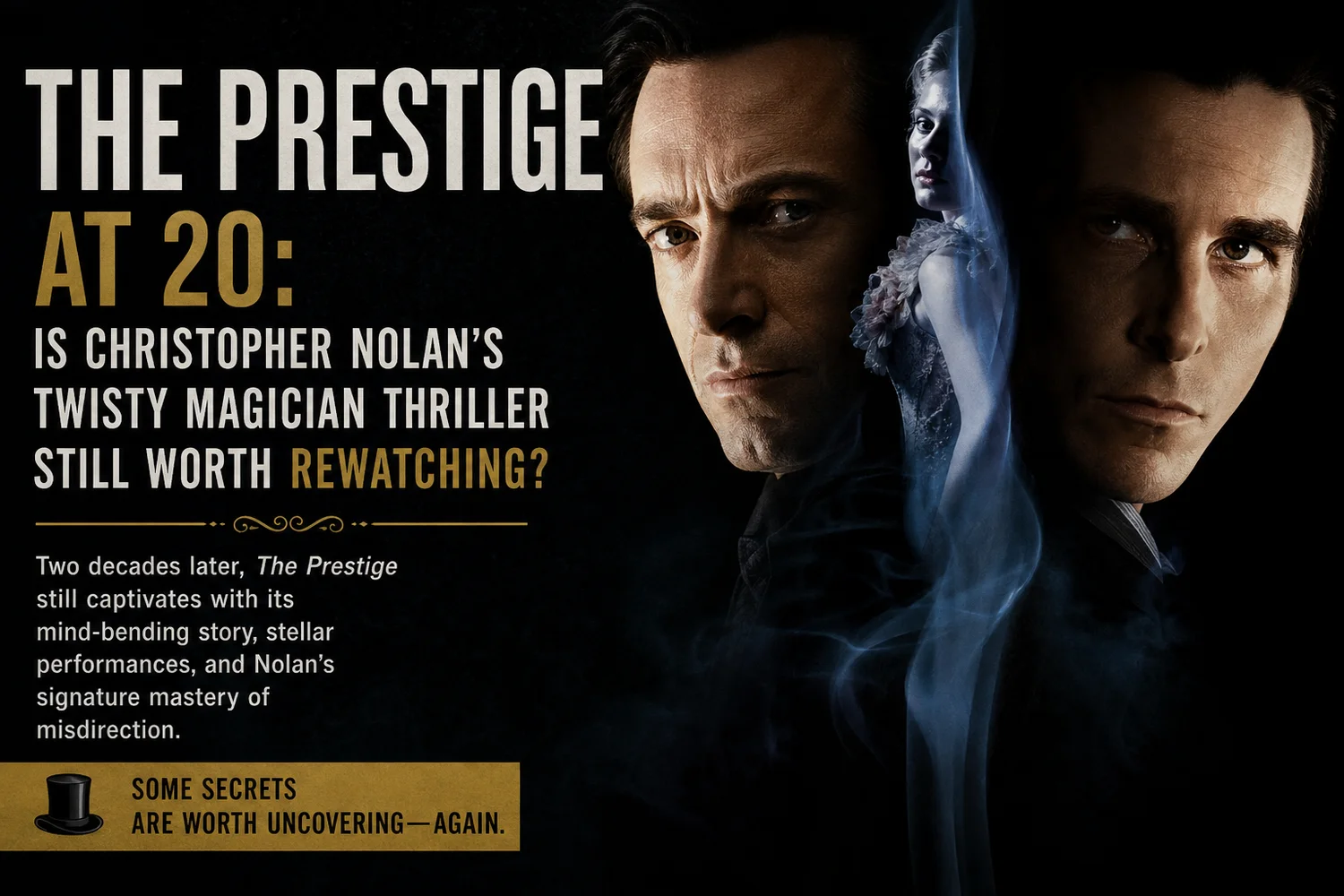
The Prestige at 20: Is Christopher Nolan's Twisty Magician Thriller Still Worth Rewatching?
TL;DR — The Prestige is marking its 20th anniversary this year, and it's currently enjoying a genuine critical moment, with fresh retrospectives calling it Christopher Nolan's most underrated film, a fairly bold claim for a director whose filmography includes Inception, The Dark Knight, and Oppenheimer. Released in 2006, it stars Hugh Jackman and Christian Bale as rival stage magicians locked in an escalating, increasingly destructive obsession with outdoing each other, with Michael Caine, Scarlett Johansson, Rebecca Hall, Andy Serkis, and David Bowie, in a genuinely inspired bit of casting as Nikola Tesla, filling out the ensemble. Adapted from Christopher Priest's novel by Christopher and Jonathan Nolan, it's a film built entirely around the idea of a magic trick, structurally, thematically, and in its final twist, which still holds up as one of the more satisfying reveals of Nolan's career. It's streaming widely and absolutely worth a first watch or a rewatch twenty years on. Here's why it's resurfacing now, and my honest take on where it actually ranks in Nolan's body of work.
Get movie picks based on this article
If a rewatch isn't calling to you tonight, get a pick made for your mood instead.
Get movie picksTell us your mood. We'll do the picking.
8 quick questions. Real movie picks from real catalogs — not ads. Free, no sign-up.
Take the quizWhat is The Prestige actually about?
The Prestige follows Robert Angier, played by Hugh Jackman, and Alfred Borden, played by Christian Bale, two rival magicians in Victorian era London whose professional competition curdles into a genuinely dangerous personal obsession after a trick gone wrong leaves Angier's wife dead, a death Angier blames directly on Borden. From there, the film tracks their escalating attempts to outdo each other's illusions, and specifically their fixation on a single trick, "The Transported Man," which appears to let its performer step through one door and instantly emerge from another across the stage.
The structure of the film mirrors the structure of a magic trick itself, something Michael Caine's character, Cutter, explicitly lays out early on: every trick has three parts, the Pledge, where something ordinary is presented, the Turn, where that ordinary thing is made to do something extraordinary, and the Prestige, the final reveal that makes the whole thing worth watching. Nolan builds his entire film around that same three act structure, which means the movie is, quite literally, performing a magic trick on its audience the whole time you're watching it, right down to information he's withholding and revealing on his own schedule the same way a stage magician would.
Who's in the cast?
- Hugh Jackman as Robert Angier the flashier, more showman driven of the two rival magicians, increasingly consumed by his need to win.
- Christian Bale as Alfred Borden the more technically gifted, more secretive of the two, hiding a defining secret about his own identity for the entire film.
- Michael Caine as John Cutter Angier's ingenieur, the man who designs and builds the mechanical apparatus behind the illusions, and the film's closest thing to a moral center.
- Scarlett Johansson as Olivia Wenscombe a stage assistant caught between the two rivals, used by both men as a pawn in their escalating feud.
- Rebecca Hall as Sarah Borden Alfred's wife, whose slow realization that something is fundamentally wrong with her marriage becomes one of the film's most quietly devastating threads.
- David Bowie as Nikola Tesla the real life inventor, reimagined here as a reclusive, half mythical figure whose actual scientific breakthrough becomes the film's most shocking mechanism.
- Andy Serkis as Alley Tesla's assistant.
- Piper Perabo as Julia Angier's wife, whose death sets the entire feud in motion.
The casting of David Bowie as Tesla deserves special mention even within a stacked ensemble like this one. It's one of those pieces of stunt casting that could have easily become a distraction, a famous musician playing a famous inventor, and instead it works precisely because Bowie brings a genuinely alien, otherworldly presence to a character who needs to feel like he might actually be capable of the impossible.
Who made it, and what's it based on?
The Prestige is directed by Christopher Nolan, with a screenplay co-written by Nolan and his brother Jonathan Nolan, adapted from Christopher Priest's 1995 novel of the same name. It arrived in 2006, sandwiched between Batman Begins and The Dark Knight in Nolan's filmography, which is part of why it's historically gotten less attention than it probably deserves. Releasing a smaller scale, densely plotted period mystery in between two films that would go on to redefine the modern superhero genre meant The Prestige was always going to be somewhat overshadowed in the broader cultural conversation about Nolan's career, even as it quietly built a devoted following of its own.
Why is it trending now, twenty years later?
The film is currently enjoying a wave of fresh retrospective coverage tied directly to its 20th anniversary, with critics revisiting it and, in more than one case, explicitly arguing that it deserves to be ranked as Christopher Nolan's most underrated work. A 4K SteelBook reissue earlier this year and a Nolan approved theatrical re-release have both helped fuel that renewed attention. That's a genuinely striking claim to make about a filmmaker whose other films include some of the most discussed and dissected movies of the last two decades, and it speaks to just how tightly constructed The Prestige actually is once you look past the more visually explosive spectacle of Nolan's blockbuster output.
Part of what's driving the renewed appreciation is simply that the film rewards rewatching in a way that few twist driven thrillers actually manage. A lot of movies built around a single big reveal fall apart once you already know the twist, because the entire experience was designed around that one moment of surprise. The Prestige does the opposite. Once you know what Borden and Angier are each actually hiding, a second viewing becomes an entirely different, arguably richer experience, because you can watch both men construct their respective illusions in plain sight, catching the clues Nolan planted throughout that were always technically visible the first time around.
What actually happens at the end? (Spoilers ahead)
If you haven't seen it and want to go in cold, skip this section. If you're deciding whether a rewatch is worth your time, here's the core of it.
The film's central reveal is actually two intertwined twists. Alfred Borden, it turns out, has been two people the entire time, identical twin brothers who have spent their entire lives and careers sharing a single identity, alternating who performs and who lives as "Alfred Borden" at any given moment, and sacrificing enormous chunks of their personal autonomy, including Sarah's marriage, to maintain the illusion. That's how Borden's version of "The Transported Man" actually works, there's no teleportation involved at all, just two brothers who look identical stepping through two doors simultaneously.
Angier's version of the trick is darker, and considerably more disturbing once it's revealed. Rather than a twin, Angier acquires one of Tesla's real, working machines, a device capable of duplicating any object placed inside it, including a person. Angier has been using it to literally clone himself every single night, performing the trick, and then drowning the newly created duplicate in a water tank hidden beneath the stage, over and over, across the entire run of the show, while the "original" Angier walks out to take his bow. It's an escalation of obsession into genuine horror, and it reframes the entire back half of the film once you understand what he's actually been doing to win.
Does the film hold up on rewatch?
This is really the question the recent wave of retrospectives is answering, and the consensus is a pretty resounding yes. Because the mystery is embedded so thoroughly in the film's structure rather than just its plot, a second viewing lets you appreciate things you weren't equipped to notice the first time, the way Bale is subtly playing two different men throughout with small, distinct physical and behavioral tells, the way Nolan's editing constantly cuts between timelines to obscure exactly how much time has passed, and the way Cutter's opening explanation of the Pledge, Turn, and Prestige is quietly telling you exactly how the film itself is going to trick you.
My honest take on The Prestige
I think the recent retrospective wave calling this Nolan's most underrated film is making a genuinely defensible argument, and it's one I largely agree with. There's a version of this conversation where "underrated" gets thrown around loosely just because a film isn't as culturally ubiquitous as The Dark Knight or Inception, but I think The Prestige earns the label on actual craft grounds, not just relative obscurity.
What strikes me most on any rewatch is how disciplined the film is compared to some of Nolan's later, bigger budget work. There's a tendency, once a director has the resources to build entire cities or bend the rules of physics on screen, to let scale substitute for tightness. The Prestige doesn't have that problem, because it was made before Nolan had unlimited resources to lean on, and it shows in how ruthlessly efficient every scene is. Nothing in this film is wasted. Every seemingly small detail, a specific prop, a specific line of dialogue, a specific edit, is doing real structural work toward the eventual reveal, and that kind of discipline is genuinely rare, even in films explicitly built around a twist.
I also think Hugh Jackman and Christian Bale are doing some of the best work of their respective careers here, and it's a shame that work sometimes gets overshadowed by their more famous roles elsewhere. Jackman's Angier is a genuinely tragic figure, a man whose grief curdles into an obsession so total it costs him his own humanity by the end, and Jackman plays that slow curdle with real precision rather than just broad theatrical villainy. Bale, meanwhile, is quietly doing double duty as two distinct characters for the entire film without ever tipping his hand too obviously, which is an enormously difficult acting challenge to pull off in a way that still plays fair with the audience on a second viewing.
If you've never seen it, this is an easy, enthusiastic recommendation, and honestly one of the better entry points into Nolan's filmography if you want something tightly plotted rather than sprawling in scale. If you have seen it and it's been a while, the twentieth anniversary is as good an excuse as any to revisit it, because I genuinely think it's one of those rare films that gets better, not worse, once you already know where it's headed.
Frequently asked questions
Is The Prestige based on a true story? No, it's fiction, adapted from Christopher Priest's 1995 novel, though it does feature a fictionalized version of the real historical inventor Nikola Tesla.
What's the twist in The Prestige? Alfred Borden is secretly identical twin brothers sharing one identity, while Robert Angier has been using a real machine built by Tesla to clone himself, drowning each duplicate after every performance.
Who directed The Prestige? Christopher Nolan, with a screenplay he co-wrote with his brother Jonathan Nolan.
When was The Prestige released? 2006, the same period as Nolan's Batman Begins and The Dark Knight, which is part of why it's historically been somewhat overshadowed.
Is The Prestige worth rewatching if I already know the twist? Yes, arguably even more so. The film is built to reward a second viewing since the clues to both twists are visible throughout, once you know what to look for.
Who plays Nikola Tesla in The Prestige? David Bowie, in a widely praised piece of casting.
Is The Prestige similar to Inception or Memento? It shares Nolan's interest in nonlinear structure and withheld information, but it's a more grounded period mystery rather than a science fiction or high concept thriller.
Where can I watch The Prestige? It's widely available across major streaming and rental platforms.
Why is The Prestige trending now? It's currently marking its 20th anniversary, with a new 4K reissue and retrospective coverage reassessing it as one of Nolan's best and most underrated films.
Is The Prestige considered one of Christopher Nolan's best films? It's frequently cited by critics and fans as among his strongest, tightest work, even if it doesn't always get the same mainstream attention as his larger blockbusters.
Looking for your next movie night pick?
Take our mood based quiz at https://www.suggestionlabs.com/quiz/movies and let us do the deciding for you.