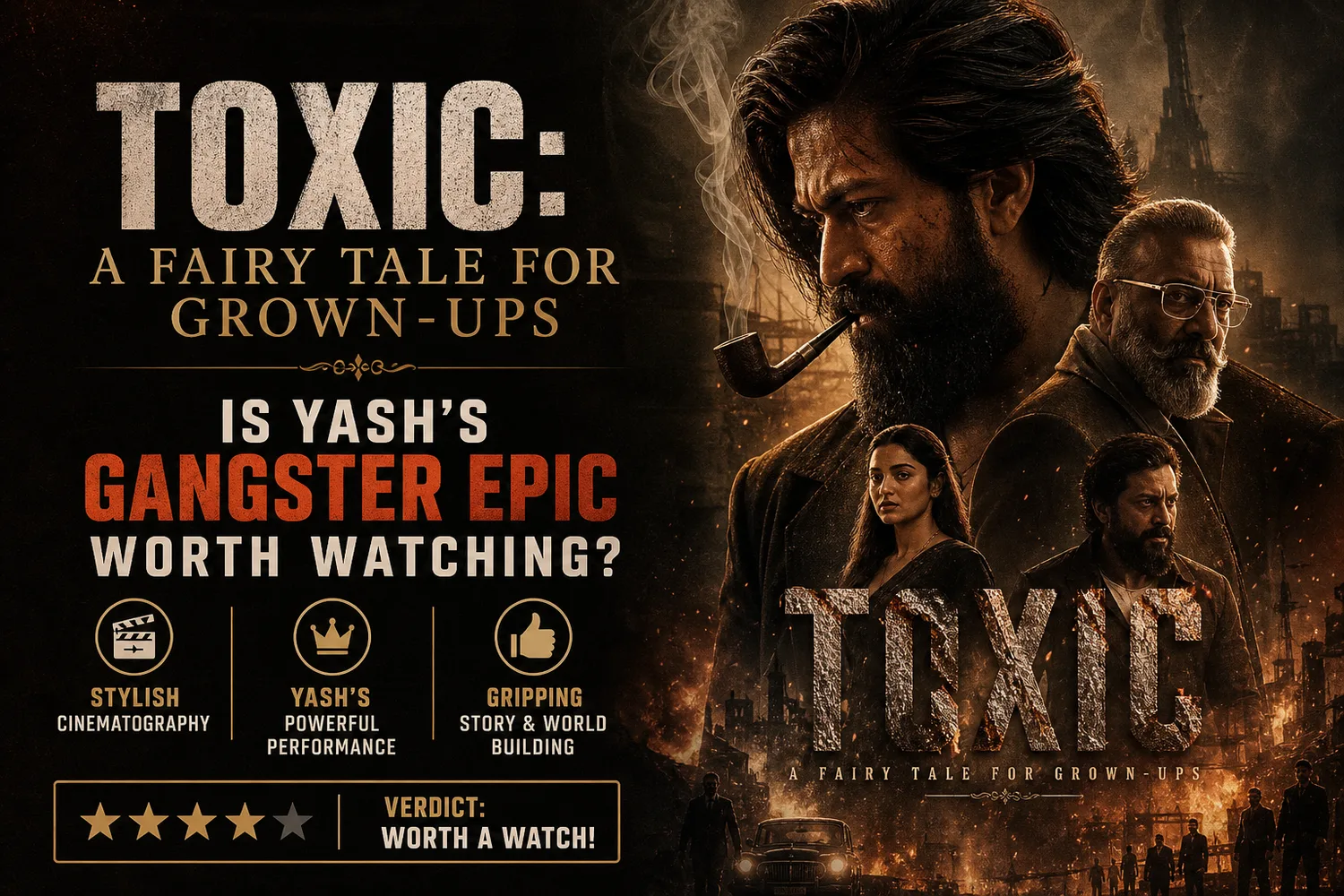
Toxic: A Fairy Tale for Grown-Ups: Is Yash's Gangster Epic Worth Watching?
TL;DR — Toxic: A Fairy Tale for Grown-Ups released worldwide on August 26, 2026, marking Kannada superstar Yash's first major film since the KGF franchise made him a pan-Indian icon. Directed by Geetu Mohandas, this sprawling, decades-spanning gangster epic set in Portuguese-era Goa cost somewhere between ₹500 and ₹1,000 crore, making it one of the most expensive Indian films ever produced. Despite a strong final worldwide box office of approximately ₹340 crore, critical reception has been decidedly mixed to negative. Here's everything confirmed, plus my honest opinion on why ambition and box office success don't always translate into a satisfying film.
Get movie picks based on this article
Want another sprawling crime saga with real scale and ambition? Skip the search and jump straight to picks built for that.
Get movie picksTell us your mood. We'll do the picking.
8 quick questions. Real movie picks from real catalogs — not ads. Free, no sign-up.
Take the quizWhat is Toxic actually about?
Set across the 1920s through the 1960s in Portuguese-controlled Goa, the story follows Raya, a ruthless underworld figure whose journey is shaped by witnessing his mother kill his father as a child. As Raya rises to become a feared criminal power player, he falls into a complicated romantic entanglement, involved with Nadia, a circus performer, while facing pressure from Rebecca Almeida, the daughter of a powerful figure named Salvador, who demands marriage.
The story takes a darker psychological turn following a tragic accident that claims the life of Raya's son, Ticket. In the aftermath, Raya develops what the film frames as a fractured psyche, manifesting as a version of his deceased son that seems to exist as a separate, vengeance-seeking personality. Yash plays both roles, Raya and the "Ticket" persona, in what's essentially a dual performance built around a late-film psychological twist revealing that Ticket has been a manifestation of Raya's own broken mind all along.
Who's in the cast?
This is a stacked, pan-Indian ensemble cast, reflecting the scale of ambition behind the project. Bringing together major stars from Kannada, Hindi, and Tamil cinema (Nayanthara in particular carries enormous star power from her extensive South Indian film career) for a single project signals a deliberate strategy to maximize the film's reach across India's various regional film industries and language markets, a strategy that's become increasingly common for the biggest pan-Indian tentpole productions following the success of franchises like KGF and Baahubali.
- Yash in a dual role as Raya and Ticket
- Kiara Advani as Nadia, the circus performer at the center of the story's central romance
- Nayanthara as Ganga, Raya's sister
- Huma Qureshi as Elizabeth, Salvador's mistress
- Tara Sutaria as Rebecca Almeida, Salvador's daughter
- Rukmini Vasanth as Melissa, Raya's wife
- Akshay Oberoi as Tony
- Darrell D'Silva as Salvador Almeida
Who directs, and what's their background?
Geetu Mohandas directs and co-writes alongside Yash himself, who took a significant hand in shaping the story. Mohandas has built a strong reputation in Indian cinema for handling complex, emotionally layered narratives, which makes for an interesting pairing with a project this scaled-up and spectacle-driven; the question of whether that character-focused sensibility survives intact within a nearly ₹1,000 crore gangster epic is a fair one to ask, and it's one that reviewers have clearly grappled with given the film's mixed critical reception.
Just how expensive was this film?
Extraordinarily expensive. Reported budgets range from ₹500 crore to ₹1,000 crore (roughly $60 million to $120 million USD, depending on the specific figure), which places Toxic among the most expensive films ever produced in India, a country where even blockbuster productions have traditionally operated on considerably smaller budgets than Hollywood's biggest tentpoles. That scale reflects Yash's massive box office draw following KGF: Chapter 2's record-breaking success, and it also reflects a broader trend of Indian pan-regional cinema increasingly competing with, and in some cases exceeding, Hollywood-level production budgets for its biggest star vehicles.
The production numbers back up that scale: over 1,000 crew members, more than 450 actors, and a shoot spanning from August 2024 to October 2025 across locations including Bengaluru, Mumbai, Goa, Thoothukudi, and Jaipur.
How did Toxic perform at the box office?
Strongly, though not spectacularly relative to its enormous budget. The film's final worldwide gross landed at approximately ₹340 crore (early-week tallies of ₹328.45 crore were widely reported before the total settled), a substantial number for any film, but one that raises real questions about ultimate profitability given production costs that may have run as high as ₹1,000 crore. That gap between box office gross and reported budget is worth sitting with, since even accounting for additional revenue streams beyond theatrical (satellite rights, streaming deals, and international distribution), a film this expensive needs massive box office performance to clear profitability, and Toxic's numbers, while strong in absolute terms, may not have been quite strong enough to fully justify the reported investment.
How was Toxic received critically?
Not well, unfortunately, especially relative to the enormous anticipation surrounding Yash's first major project since KGF: Chapter 2. The film sits at just 24% on Rotten Tomatoes with a 4.80 out of 10 average rating, reflecting what's been described as "mostly negative reviews." Critics have generally praised the performances and the film's technical, visual craftsmanship, the cinematography, production design, and overall spectacle clearly represent a massive, well-executed investment, but have been considerably more critical of the screenplay, pacing, and what's been characterized as excessive, often gratuitous violence.
Why did such an ambitious, star-studded project struggle critically?
This is worth examining honestly, because it's an instructive case study in the risks of scale-first filmmaking. When a production commits this much money and this many resources primarily toward spectacle, star power, and technical scale, there's a real risk that fundamental storytelling craft, pacing, screenplay discipline, a clear and well-modulated emotional throughline, gets deprioritized relative to simply delivering bigger and more visually impressive set pieces. The specific criticisms leveled at Toxic (pacing issues, screenplay problems, and excessive violence) are exactly the kinds of complaints that tend to surface when a film's ambition outstrips its narrative discipline.
It's also worth noting that Yash's prior signature success, the KGF franchise, built its massive audience specifically through a relatively straightforward, mythic underdog-rises-to-power narrative structure that audiences found viscerally satisfying without requiring huge narrative complexity. Toxic's decades-spanning, psychologically twisty structure (the dual-role reveal involving Raya's fractured psyche) represents a considerably more ambitious and structurally complicated storytelling approach, and based on the critical reception, that added complexity doesn't appear to have translated into a more satisfying viewing experience for a lot of critics, even if it clearly represented a genuine creative swing.
My honest take on Toxic
I have real respect for the ambition here, even as I think the end result, based on the critical consensus, seems to have fallen short of its own goals. There's something admirable about a massive star like Yash, fresh off the biggest commercial success of his career, choosing to pursue a structurally ambitious, tonally darker, and considerably more psychologically complex project rather than simply repeating the KGF formula that had already proven so commercially reliable. Taking on a dual role built around a difficult psychological twist, rather than a straightforward mass-hero performance, is a real creative risk for a star at the peak of his commercial power, and I think that risk-taking deserves acknowledgment even when the execution doesn't fully land.
That said, the specific criticisms here, pacing and screenplay discipline in particular, point to something I've seen recur across a lot of the biggest recent pan-Indian tentpole productions: a tendency to let scale and spectacle crowd out the kind of tight narrative construction that actually makes an audience care about a story's stakes and characters. A decades-spanning gangster epic with a dual-role psychological twist is an enormously ambitious structure to execute well within a single film's runtime (even at roughly 194 minutes for the regional cut (176 minutes for the English-dubbed India release), which is itself a lot to ask an audience to sit through), and when critics specifically flag pacing and screenplay issues, that usually points to a film trying to accomplish more than its runtime and structure can comfortably support.
I do think the technical craft, universally praised even by critics who found the overall film disappointing, is worth genuine recognition. A production of this scale, over a thousand crew members, extensive location shooting across multiple Indian states, and clearly substantial post-production investment, represents real filmmaking ambition regardless of how the final narrative execution landed. Films this technically accomplished, even when critically divisive on story grounds, tend to push the broader industry's technical standards forward in ways that benefit future productions.
For viewers specifically drawn to Yash as a performer, or curious about India's biggest recent swing-for-the-fences tentpole production, Toxic is probably still worth watching on those terms, as a genuine technical and performative showcase, even if you should go in with tempered expectations about the storytelling itself given the critical consensus. If you're looking for something closer to the tightly constructed, viscerally satisfying mass-entertainment experience that KGF delivered, this may not scratch quite the same itch.
Do you need to have seen KGF first?
No, Toxic is a standalone story with no direct narrative connection to the KGF franchise, beyond both starring Yash as a central figure in an ambitious Kannada-language gangster epic. Familiarity with Yash's screen presence and star power from KGF may heighten anticipation, but isn't required to follow this story.
Frequently asked questions
When did Toxic release? August 26, 2026, worldwide.
Who stars in Toxic? Yash in a dual role, alongside Kiara Advani, Nayanthara, Huma Qureshi, Tara Sutaria, Rukmini Vasanth, and Akshay Oberoi.
Who directs the film? Geetu Mohandas.
What is the film's budget? Reported between ₹500 crore and ₹1,000 crore, making it one of India's most expensive films.
How much did Toxic earn at the box office? Approximately ₹340 crore worldwide in its final tally.
What is the film's Rotten Tomatoes score? 24%, with a 4.80 out of 10 average critic rating.
What genre is Toxic? A psychological thriller and gangster epic.
Is Toxic connected to KGF? No, it's a standalone story, though both star Yash as the central lead.
What time period does the film cover? The 1920s through the 1960s, set in Portuguese-controlled Goa.
What languages is the film available in? Originally in Kannada and English, dubbed into Hindi, Tamil, and Telugu.
Looking for your next epic crime saga?
If sprawling, star-studded gangster epics are your thing, our movie recommendation quiz can help you find your next watch tonight.