Trap: The Complete Guide to M. Night Shyamalan's Twisty Thriller
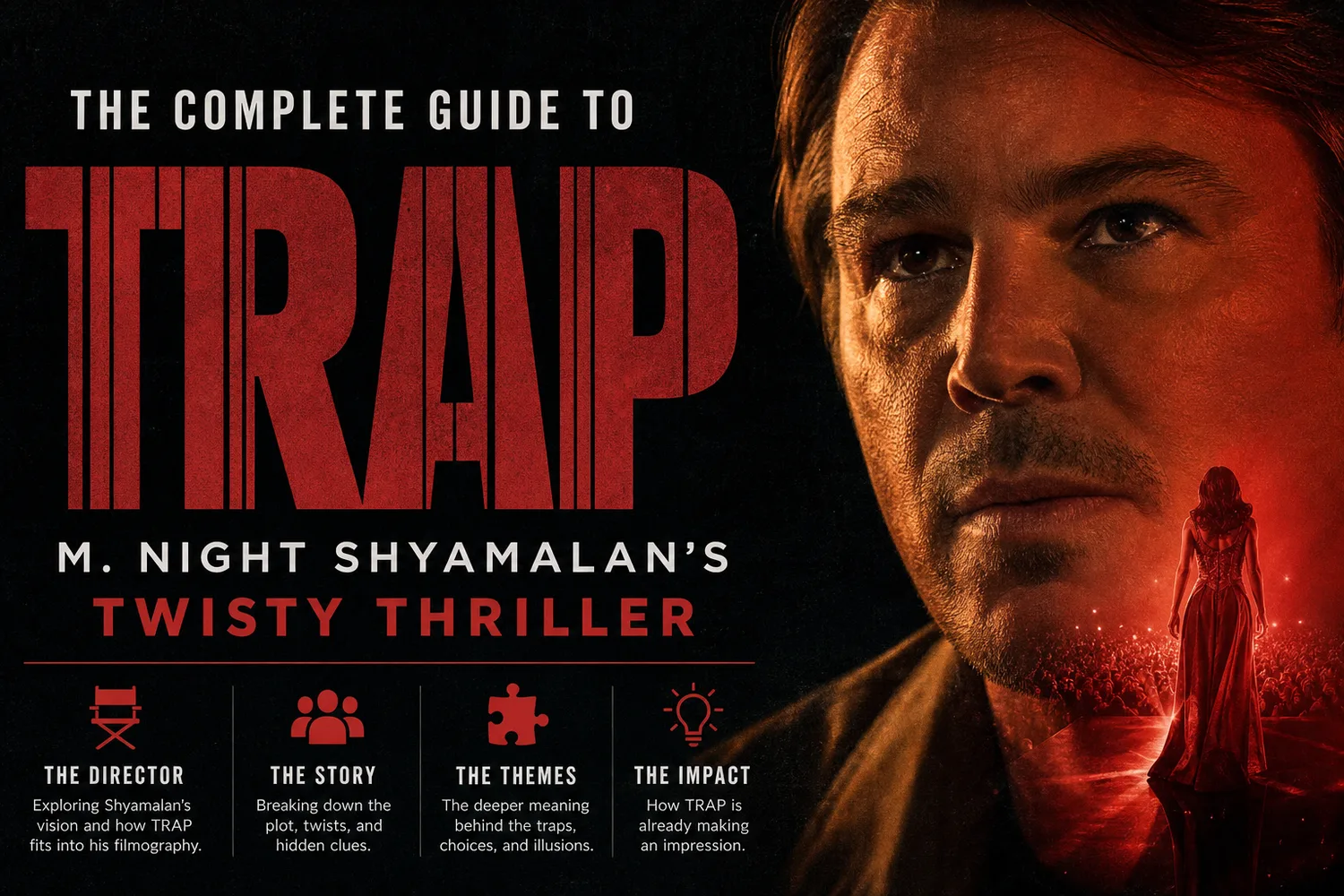
TL;DR — Trap continues to draw fresh search interest well after its 2024 theatrical release and subsequent Netflix streaming run, and it's easy to see why: Josh Hartnett stars as Cooper Abbott, a Philadelphia firefighter attending a pop concert with his teenage daughter, unaware the entire event is an elaborate FBI sting designed to catch a serial killer known as "The Butcher." What Cooper knows, and the audience learns almost immediately, is that he is The Butcher, turning the film into a sustained, escalating game of cat-and-mouse as thousands of law enforcement officers close in around him. Directed by M. Night Shyamalan, the film was partly inspired by a real 1985 US Marshals sting operation. Here's the complete guide, plus my honest opinion on why this is one of Shyamalan's most purely entertaining recent films.
Get movie picks based on this article
Want another thriller that plays games with what the audience already knows? Skip the search and jump straight to picks built for that.
Get movie picksTell us your mood. We'll do the picking.
8 quick questions. Real movie picks from real catalogs — not ads. Free, no sign-up.
Take the quizWhat is Trap actually about?
Cooper Abbott takes his daughter Riley to see her favorite pop star, Lady Raven, in concert as a special treat, a seemingly ordinary father-daughter bonding outing. What Cooper doesn't initially realize, but the audience is let in on almost immediately, is that the concert venue has been transformed into an elaborate, meticulously coordinated FBI sting operation, with thousands of law enforcement personnel embedded throughout the crowd, all working to identify and capture "The Butcher," a serial killer who, unbeknownst to his own family, is Cooper himself.
The film's central tension comes from watching Cooper, played with genuine, unsettling charm by Josh Hartnett, navigate the venue's steadily tightening net while trying to maintain his cover as a normal, devoted dad, all while the audience is fully aware of exactly what he actually is and what's at stake if he's caught, or if he manages to escape and continue his crimes. That structural choice, revealing the protagonist's true nature to the audience early rather than saving it as a late twist, is a distinctive Shyamalan choice that shifts the film's tension from "who is the killer" to "will he get caught, and what will he do to avoid it."
How does the story resolve, and what's the twist?
For readers who want the full picture: yes, Cooper is definitively confirmed as The Butcher throughout the film, this isn't a late-film reveal but the film's foundational premise. The genuine narrative turn comes through his wife Rachel, who gradually discovers unsettling signs about her husband, including small but telling details like his clothes constantly reeking of cleaning chemicals, clues that eventually lead her to the horrifying realization of what he actually is.
Rather than protecting Cooper once she learns the truth, Rachel chooses to work directly with the FBI, ultimately poisoning her own husband to weaken him and ensure he can be safely taken into custody, a dramatic and morally complicated choice for a character forced to weigh loyalty to her family against the horror of what her husband has actually done. Cooper is ultimately captured, but the film ends on a deliberately unsettling final beat: he frees himself from his handcuffs using a spoke pulled from his daughter's bicycle, grinning directly at the camera in a moment that strongly hints at either an imminent escape or, at minimum, sets up potential future installments. A comedic post-credits scene also reveals that Jamie, a merchandise vendor at the concert, unknowingly helped the FBI's operation against Cooper without ever realizing his own role in it.
Who's in the cast?
Josh Hartnett's performance as Cooper has become one of the most widely discussed elements of the film, and deservedly so; playing a character who has to simultaneously be a warm, believable, loving father figure and a dangerous predator, often within the same scene or even the same line of dialogue, requires an extraordinarily precise, controlled kind of performance. This film sits within a broader recent career resurgence for Hartnett, one built substantially around exactly this kind of morally ambiguous, genre-inflected role.
Saleka Shyamalan, the director's own daughter, plays Lady Raven and also contributed original music for the film's concert sequences, giving the production a personal, family-collaborative dimension beyond just the central father-daughter dynamic driving the plot itself.
- Josh Hartnett as Cooper Abbott
- Ariel Donoghue as Riley Abbott
- Saleka Shyamalan as Lady Raven, the pop star headlining the concert
- Alison Pill as Rachel Abbott
- Hayley Mills as Dr. Josephine Grant
- Jonathan Langdon as Jamie
- Mark Bacolcol as Spencer
- Kid Cudi as The Thinker
- Russell Vitale as Parker
Who directed Trap?
M. Night Shyamalan directs, continuing a career defined by tightly constructed, twist-driven thrillers, and Trap represents an interesting structural experiment even within that established body of work. Rather than building toward a hidden reveal (the structure that made Shyamalan famous with films like The Sixth Sense), Trap instead commits to full audience knowledge from very early on, building tension instead through the mechanics of pursuit and evasion, essentially inverting his own signature storytelling approach for a film explicitly built around the mechanics of a trap rather than a mystery.
What real event inspired the film?
Trap draws direct inspiration from Operation Flagship, a real 1985 sting operation in which US Marshals successfully arrested 101 fugitives using a similarly deceptive strategy, luring wanted criminals to a fake event under false pretenses in order to apprehend large numbers of them simultaneously in a controlled setting. Building an entire film's premise around scaling up that real strategy to catch a single, specific target (rather than the historical operation's goal of capturing many separate fugitives at once) gives Trap's central conceit a grounded, plausible foundation even as the film's specific execution leans into more heightened, purely cinematic thriller mechanics.
How was Trap received?
Reception was generally positive with some reservations, reflecting a fairly typical pattern for Shyamalan's recent filmography, where critics have often praised his ability to sustain genuine tension and craft interesting formal experiments even when the overall plot mechanics strain credibility under close scrutiny. Reviews specifically noted that the film offers real pleasures even when audiences can predict roughly where the story is heading, a testament to Hartnett's performance and Shyamalan's directorial control over pacing and tension even within a structure that reveals its central premise upfront rather than building toward a hidden twist.
Why does removing the traditional "hidden twist" structure work for this specific story?
This is interesting to unpack, because it represents Shyamalan deliberately subverting his own signature storytelling reputation. A lot of thrillers depend on withholding a killer's identity to generate suspense, but Trap makes the opposite bet: by revealing Cooper's true nature to the audience almost immediately, the film transforms its tension from "whodunit" mystery into something closer to a slow-motion heist thriller in reverse, rooting for (or against, depending on your reaction to Cooper) a character to either escape or be caught, rather than trying to guess who he even is.
That structural choice also creates an uncomfortable, effective form of dramatic irony throughout the film: every interaction Cooper has with his unsuspecting daughter, every moment of ordinary father-daughter bonding at the concert, carries an unsettling undercurrent for the audience that Riley herself doesn't share, since she has no idea what her father actually is. That's a potent, sustained source of tension that a more conventional "reveal the killer late" structure wouldn't be able to generate nearly as effectively across a full feature runtime.
My honest take on Trap
I think this is one of Shyamalan's most purely enjoyable and structurally interesting recent films, precisely because of how deliberately it plays against his own established reputation for hidden twists. There's something bold about a filmmaker best known for withholding information choosing instead to build an entire film around full audience knowledge from the outset, and the fact that it works, generating real, sustained tension through pursuit mechanics rather than mystery, speaks to real directorial confidence and craft.
Josh Hartnett's performance is doing an enormous amount of the heavy lifting required to make this structural gambit succeed. Cooper has to remain simultaneously charming and unsettling throughout, and the film's entire tension depends on the audience buying both halves of that portrayal completely: we need to believe he's capable of being a loving, attentive father in the moments the film lets us see that side of him, while never forgetting or losing sight of what he actually is underneath that facade. That's an extraordinarily difficult tightrope for an actor to walk convincingly across a full feature runtime, and Hartnett's specific career context, an actor rebuilding and expanding his range through exactly this kind of morally complex material, makes the casting feel especially well-considered.
The Rachel subplot, and her choice to actively work against her own husband once she uncovers the truth, is also one of the film's smartest structural elements. It would have been easy, and considerably less interesting, to make Rachel either entirely oblivious throughout or simply a passive victim once she learns the truth; instead, giving her genuine agency in Cooper's eventual downfall adds real moral weight to the film's back half, forcing the story to grapple seriously with what it actually means to discover that someone you've built a life and family with is capable of genuine monstrosity.
The ending's ambiguous final beat, Cooper freeing himself and grinning at the camera, is an effective way to leave audiences unsettled rather than fully satisfied by a clean, comfortable resolution, and it fits the film's overall commitment to prioritizing sustained discomfort and tension over easy catharsis. Whether or not Shyamalan ever actually follows through on the sequel potential that ending gestures toward, it's a smart final note for a film this committed to keeping its audience off-balance throughout.
Overall, if you're looking for a tense, well-constructed thriller that finds a fresh angle on familiar serial-killer-thriller territory through a clever structural inversion, Trap remains well worth seeking out, whether you're revisiting it or catching it for the first time.
Where can you watch Trap?
The film is available on Netflix in the US, alongside standard digital rental and purchase options across major platforms.
Frequently asked questions
Who plays the lead role in Trap? Josh Hartnett as Cooper Abbott.
Is Cooper actually the killer? Yes, he's confirmed as "The Butcher" from very early in the film, not as a late twist.
Who directed Trap? M. Night Shyamalan.
What real event inspired the film? Operation Flagship, a 1985 US Marshals sting operation that arrested 101 fugitives using a similar deception strategy.
How does the film end? Cooper is captured after his wife Rachel poisons him and cooperates with the FBI, but the final scene shows him freeing himself from his handcuffs, suggesting he may escape.
Who plays Lady Raven? Saleka Shyamalan, the director's daughter, who also contributed original music to the film.
Where can I watch Trap? It's available on Netflix in the US, as well as through digital rental and purchase platforms.
What genre is Trap? A crime thriller with horror elements.
Is there a post-credits scene? Yes, a comedic scene revealing that a concert vendor unknowingly helped the FBI's operation against Cooper.
How long is Trap? 1 hour and 45 minutes.
Looking for your next twisty thriller pick?
If tense, structurally inventive thrillers are your thing, our movie recommendation quiz can help you find your next watch tonight.