Twilight Movies in Order: The Complete Watch Guide
TL;DR — The Twilight Saga consists of five films released between 2008 and 2012: Twilight, The Twilight Saga: New Moon, The Twilight Saga: Eclipse, The Twilight Saga: Breaking Dawn - Part 1, and The Twilight Saga: Breaking Dawn - Part 2. Unlike a lot of franchises on this site, there's no confusing chronology puzzle here, release order is story order, full stop. The only real decision a new or returning viewer has to make is whether to marathon all five in one sitting or spread them out, and whether to bother with the extended editions of the first two films. Here's the full breakdown, plus an honest take on why this franchise is worth taking seriously again, more than a decade after Breaking Dawn - Part 2 closed it out.
Get movie picks based on this article
Marathoning all five Twilight films is a real commitment. Get a pick for tonight if you need a break.
Get movie picksTell us your mood. We'll do the picking.
8 quick questions. Real movie picks from real catalogs — not ads. Free, no sign-up.
Take the quizThe five Twilight movies, in order
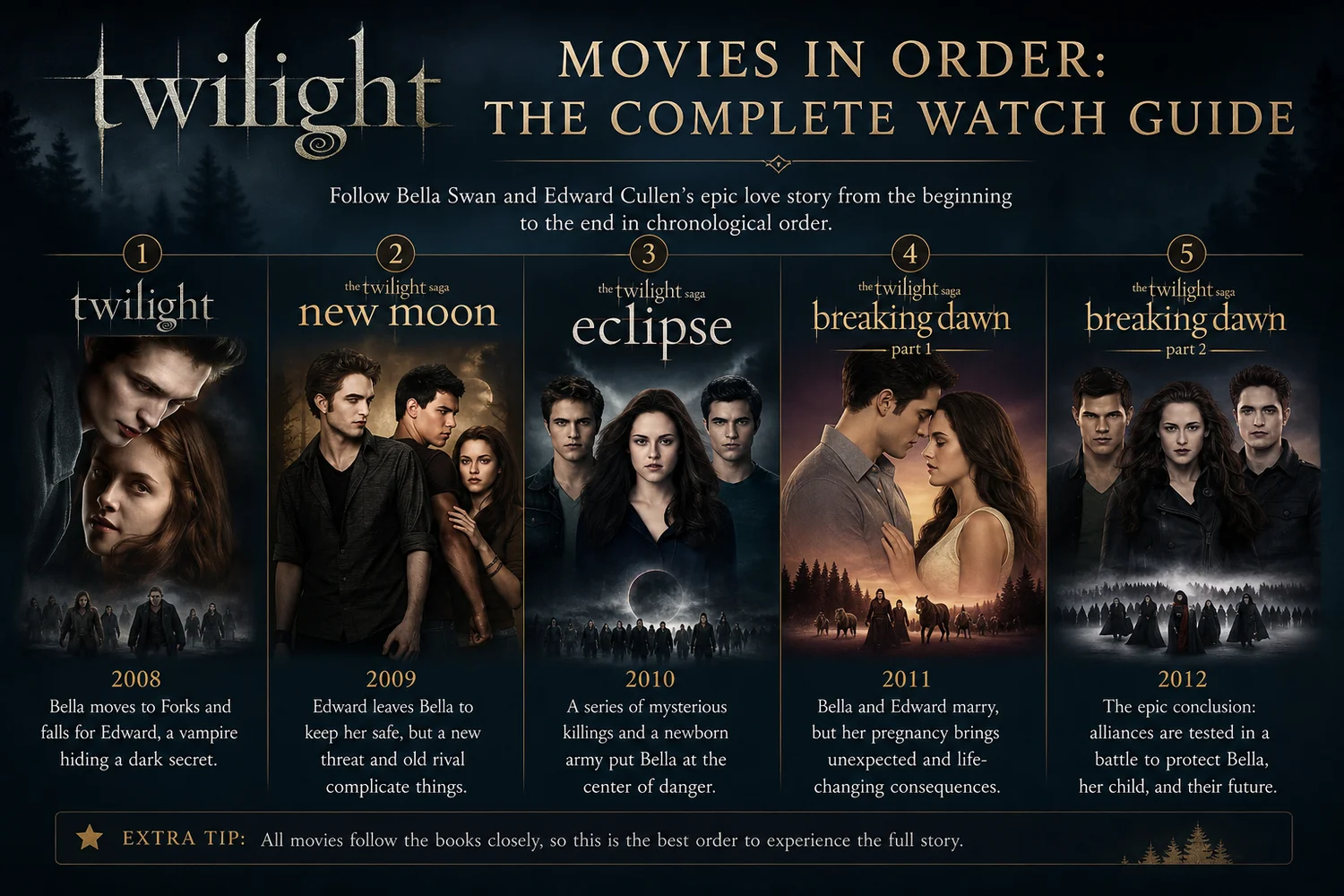
- Twilight (2008) Bella Swan moves to the perpetually overcast town of Forks, Washington, and falls for Edward Cullen, a member of a vegetarian vampire family who has been quietly attending high school for the better part of a century.
- The Twilight Saga: New Moon (2009) Edward leaves to protect Bella, and her friendship with Jacob Black deepens as the werewolf side of this universe gets properly introduced.
- The Twilight Saga: Eclipse (2010) A love triangle collides with a genuine external threat as a vengeful vampire assembles an army, forcing the Cullens and the Quileute wolf pack into an uneasy alliance.
- The Twilight Saga: Breaking Dawn - Part 1 (2011) Bella and Edward marry, and the saga takes a hard, deliberate turn into body horror territory with one of the more talked about childbirth sequences in mainstream studio filmmaking.
- The Twilight Saga: Breaking Dawn - Part 2 (2012) The saga's climax, bringing the Cullens, the wolf pack, and the Volturi into a confrontation that closes out Bella's arc for good.
That's the whole list, and it's also the correct viewing order in every sense that matters. There's no prequel spinoff film to worry about slotting in, no alternate timeline entry, no reboot. Whatever confusion exists around this franchise tends to be about the books versus the films, not about the films' own internal order.
Why is there no confusing timeline here?
It's worth pausing on this, because so many franchises covered on this site come with an asterisk, watch in this order, except for this one film, which technically happens earlier but was released later. Twilight genuinely doesn't have that problem. Stephenie Meyer's four novels were adapted essentially in publication order, with the fourth book, Breaking Dawn, split into two films simply because of its length and the sheer amount of plot it needed to cover. That's a studio decision made for pacing and box office reasons, not a storytelling one, and it doesn't complicate the actual chronology at all.
The one mild wrinkle, if you want to call it that, is that Breaking Dawn - Part 2 includes a fairly significant fakeout sequence near its climax showing an alternate, much darker version of how the final confrontation could go, before pulling back to reveal it as a vision rather than the actual outcome. It's a clever narrative device, but it's not a continuity issue, it happens within Part 2 itself and doesn't affect how you'd watch the films.
Should you watch the extended editions?
Both Twilight and New Moon received extended cuts with additional footage not shown theatrically, and they're worth seeking out if you're doing a full rewatch rather than a first watch. The extended Twilight in particular fleshes out some of Bella and Edward's early relationship beats that the theatrical cut moves through fairly quickly, giving their initial connection a bit more room to breathe. For a first time viewer, though, the theatrical cuts are perfectly fine and arguably the better entry point, since they move at a tighter pace and hit the same major story beats.
What's the saga actually about, underneath the vampire romance hook?
It's easy, and honestly pretty common, to reduce Twilight to its most meme-able surface elements, sparkling vampires, brooding love triangles, intense stares held a beat too long. What tends to get lost in that reduction is that the saga is fundamentally a coming of age story about a teenage girl trying to figure out who she wants to become while everyone around her, human and supernatural alike, has extremely strong opinions about who she should be instead.
Bella spends the first three films caught between two lives quite literally represented by Edward and Jacob, a controlled, careful, immortal existence versus a warmer, more chaotic, mortal one, and the saga takes her choice seriously even when the execution around it gets melodramatic. By Breaking Dawn, the story shifts from that choice to its consequences, motherhood, transformation, and the genuine cost of getting exactly what you thought you wanted. That's a more interesting throughline than the franchise's reputation as a purely fluffy teen romance usually gives it credit for.
Who's in the cast across all five films?
- Kristen Stewart as Bella Swan the saga's narrator and emotional center throughout all five films.
- Robert Pattinson as Edward Cullen the vampire love interest whose casting turned him into a genuine global star almost overnight.
- Taylor Lautner as Jacob Black Bella's other major relationship, and a werewolf whose arc gets significantly more screen time starting with New Moon.
- Peter Facinelli and Elizabeth Reaser as Carlisle and Esme Cullen the Cullen family's parental figures.
- Ashley Greene as Alice Cullen, Kellan Lutz as Emmett Cullen, Nikki Reed as Rosalie Hale, and Jackson Rathbone as Jasper Hale the rest of the Cullen family, each getting more individual spotlight as the saga progresses.
- Billy Burke as Charlie Swan Bella's father, and one of the saga's more consistently grounding presences.
- Michael Sheen as Aro the leader of the Volturi, the vampire world's closest thing to a governing authority, played with an unhinged theatrical relish that's genuinely one of the franchise's better performance choices.
- Dakota Fanning as Jane a young but genuinely menacing Volturi enforcer.
Why is Twilight having a cultural moment again?
The saga's return to the cultural conversation over the past few years has been driven by a few overlapping factors. There's been a broader critical and cultural reassessment of mid 2000s and early 2010s female led romantic and genre franchises that were dismissed or mocked at the time, largely by critics and commentators who weren't the intended audience, and are now being revisited with more genuine critical seriousness. Twilight has been a major beneficiary of that reassessment, alongside a wave of nostalgia from the generation that grew up with it, who are now old enough to be writing think pieces and hosting rewatch podcasts about it.
There's also been renewed streaming interest driving the films back into trending conversations periodically, plus ongoing, still unconfirmed chatter about potential future television or film expansions of the universe. None of that changes the five film core of the saga, but it's part of why "how do I watch Twilight in order" remains a genuinely common search years after Breaking Dawn - Part 2 closed the story out.
My honest take on the Twilight Saga
I think Twilight gets an unfair amount of residual snobbery even now, well past the peak of its cultural mockery era. A lot of that mockery was, frankly, gendered in a way that similarly melodramatic, similarly earnest genre franchises aimed at other audiences never had to deal with to the same degree. Nobody spent a decade mocking the internal logic of a war epic or a spy franchise with the same intensity that got aimed at Twilight for having an intense teenage romance at its center, and I think that disparity is worth naming directly.
Once you actually sit with the films rather than their reputation, there's real craft here, particularly as the series progresses. New Moon and Eclipse are genuinely well constructed as pieces of escalating tension, Breaking Dawn - Part 1's willingness to go all the way into body horror territory during the childbirth sequence is a genuinely bold, unexpected choice for a mainstream studio franchise built around a teen audience, and Michael Sheen's Aro is one of the more purely enjoyable, scenery devouring performances in any studio franchise from this era.
Is it a perfect saga? No. The pacing in the middle stretch of the first film is uneven, some of the dialogue is exactly as stilted as its detractors claim, and the werewolf pack characters outside of Jacob never get quite enough development to feel like more than a supporting chorus. But I think the emotional sincerity at the saga's core, its willingness to take a teenage girl's interior life completely seriously without irony or condescension, is exactly the thing that's aged into its biggest strength, not its biggest weakness. If you dismissed it a decade ago, it's genuinely worth a second look now.
Frequently asked questions
How many Twilight movies are there? Five: Twilight, New Moon, Eclipse, Breaking Dawn - Part 1, and Breaking Dawn - Part 2.
Is there a correct order to watch the Twilight movies in? Yes, and it's simply release order, which matches the story's chronology exactly with no need to reshuffle anything.
Why is Breaking Dawn split into two movies? The fourth novel in the saga was long enough, and dense enough with plot, that the studio chose to adapt it across two films rather than condensing it into one.
Do I need to read the books first? No, the films work as a self contained adaptation, though the books do include additional detail, particularly around some of the side characters.
Which Twilight movie is considered the best? Opinions vary, but New Moon and the two Breaking Dawn films tend to get the most credit for taking genuine narrative and tonal risks compared to the more restrained first film.
Are the extended editions worth watching? Yes, if you're doing a full rewatch. Twilight and New Moon both have extended cuts with meaningful additional footage, though the theatrical cuts are perfectly fine for a first watch.
Where can I watch the Twilight movies? They're available across major streaming and rental platforms, availability shifts periodically so it's worth checking your preferred service directly.
Is Twilight a horror franchise or a romance? It's genuinely both, blending teen romance with vampire and werewolf mythology, and leaning increasingly into horror elements as the saga progresses, especially in Breaking Dawn - Part 1.
Who plays the villain in Twilight? The saga has several antagonists across its run, but Michael Sheen's Aro, leader of the Volturi, is generally considered the standout.
Is a new Twilight project actually happening? As of this writing, there's ongoing fan speculation and unconfirmed industry chatter about future expansions of the universe, but nothing officially confirmed beyond the original five films.
Looking for your next movie night pick?
Take our mood based quiz at https://www.suggestionlabs.com/quiz/movies and let us do the deciding for you.