Watchmen: Is Damon Lindelof's HBO Sequel Series Still Worth Watching?
TL;DR — HBO's Watchmen, created by Damon Lindelof and released in 2019, isn't a straightforward adaptation of Alan Moore and Dave Gibbons' seminal graphic novel but a bold, mostly original sequel set decades later, opening with a devastating dramatization of the real 1921 Tulsa Race Massacre and following Regina King's masked police detective Angela Abar confronting a resurgent white supremacist movement. The show swept the 2020 Emmys, winning Outstanding Limited Series among 11 total wins. Here's everything worth knowing about the show and the real history it engages with, plus my honest opinion on why remixing rather than simply adapting Moore's material was the right call.
Get series picks based on this article
Want another ambitious drama that takes real creative risks? Skip the search and jump straight to picks built for that.
Get series picksTell us your mood. We'll do the picking.
8 quick questions. Real series picks from real catalogs — not ads. Free, no sign-up.
Take the quizWhat is Watchmen about?
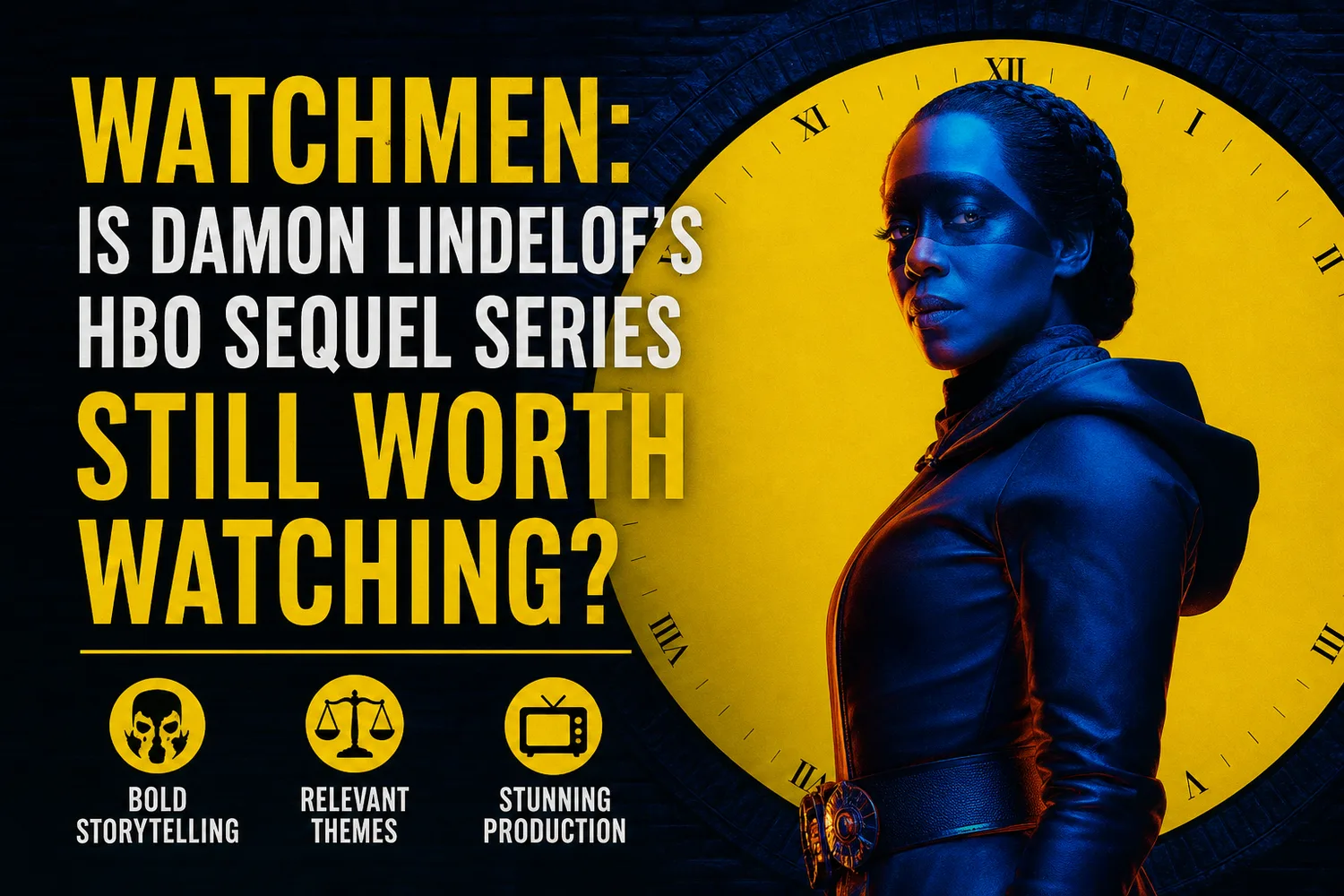
Set in an alternate 2019, roughly three decades after the events of Alan Moore and Dave Gibbons' original graphic novel, the series follows Angela Abar, a retired police detective operating under the masked persona "Sister Night" in Tulsa, Oklahoma, where police officers now conceal their identities following a coordinated, violent attack by a white supremacist group called the Seventh Kavalry. The season opens with an extended, devastating dramatization of the real 1921 Tulsa Race Massacre, one of the deadliest instances of racial violence in American history, establishing that historical atrocity as a foundational, generational trauma directly connected to the show's present-day storyline in ways that unfold across the season.
As Angela investigates the murder of her police chief and uncovers a far-reaching conspiracy connected to both the resurgent Seventh Kavalry and figures from the original Watchmen mythology, the show weaves together original graphic-novel characters, several recast or reimagined for this new timeline, with an entirely new ensemble and narrative, using the source material's foundational ideas (masked vigilantism, moral compromise, hidden conspiracy) as a launching point for a story fundamentally concerned with American racial history and its unresolved, ongoing consequences.
Who's in the cast?
- Regina King as Angela Abar / Sister Night
- Don Johnson as Judd Crawford, Tulsa's police chief
- Jean Smart as Laurie Blake (formerly Laurie Juspeczyk / Silk Spectre from the original graphic novel)
- Tim Blake Nelson as Wade Tillman / Looking Glass
- Yahya Abdul-Mateen II as Cal Abar / Doctor Manhattan
- Jeremy Irons as an aging, mysterious figure revealed to be Adrian Veidt / Ozymandias
- Hong Chau as Lady Trieu
Regina King anchors the series with a performance that earned her the 2020 Emmy for Outstanding Lead Actress in a Limited Series, carrying the considerable weight of a character grappling with generational trauma, personal loss, and an escalating conspiracy while maintaining the show's central moral seriousness throughout. Jean Smart brings genuine connective tissue to the original graphic novel as an older, wearier Laurie Blake, now working for the FBI's dedicated masked-vigilante task force, while Jeremy Irons' extended, deliberately mysterious sequences as an unnamed aging aristocrat, eventually revealed to be Adrian Veidt living in a bizarre, isolated exile, provide some of the show's most distinctive, unsettling tonal detours.
Who created the show?
Damon Lindelof, previously known for Lost and The Leftovers, served as creator and showrunner, bringing his well-established reputation for ambitious, thematically dense, structurally unconventional television to Moore's famously dense source material. Lindelof has been open about his hesitance in approaching Moore's work, and Moore himself hasn't simply stayed neutral on the result: he's actively disowned the show, told Lindelof never to contact him again after receiving a letter that described its writers as "the bastards currently destroying Watchmen," called it "embarrassing," and said he's never watched it, consistent with his long-standing hostility toward screen adaptations of his work. Lindelof ultimately positioned the series as a "remix" rather than a direct continuation or adaptation, deliberately building new original material and themes on top of the graphic novel's established world rather than simply extending its existing plot.
How does the show connect to the real 1921 Tulsa Race Massacre?
This is worth examining in detail, because it's central to understanding the show's ambitions. The Tulsa Race Massacre was a real, historically significant act of racial violence in which a white mob attacked Black residents and destroyed the prosperous Greenwood District (known as "Black Wall Street") in Tulsa, Oklahoma, over two days in 1921, killing an estimated hundreds of Black residents and displacing thousands more, an event that for decades received strikingly little mainstream historical attention or acknowledgment relative to its scale and significance.
Watchmen's decision to open its season with an extended, unflinching dramatization of the massacre, and to structure its entire present-day narrative around that historical trauma's direct, ongoing generational consequences, represents a bold creative choice for a show ostensibly rooted in superhero and masked-vigilante genre material. Rather than treating the massacre as background historical texture, the show positions it as the story's true originating trauma, arguably more central to the season's themes than anything drawn directly from Moore's original graphic novel.
How was the show received?
Extremely well. Watchmen won the Emmy for Outstanding Limited Series at the 2020 ceremony, part of an 11-award sweep that also included wins for Regina King's lead performance, Yahya Abdul-Mateen II's supporting performance, and numerous below-the-line categories, out of 26 total nominations. Critics widely praised the show's ambition, its handling of serious real-world historical and political themes, and its willingness to structurally deviate from straightforward genre expectations.
Does Alan Moore endorse this adaptation?
No. Moore, historically vocal about his dissatisfaction with prior screen adaptations of his work and generally disengaged from the comics industry more broadly by the time the show was produced, was not involved in the series and has gone well beyond simple non-endorsement, actively disowning it and stating he never watched it, consistent with his long-standing general position on screen adaptations of his material.
My honest take on Watchmen
I think this remains one of the most ambitious and successfully executed pieces of "legacy sequel" television ever produced, and Damon Lindelof's specific decision to treat Moore's graphic novel as a foundation for entirely new thematic territory, rather than attempting a more conventional continuation of its existing plot, was unquestionably the right creative call. Moore's original work was itself a deeply subversive deconstruction of superhero conventions; a more straightforward, reverent continuation would have risked betraying exactly the spirit of formal and thematic audacity that made the source material so significant in the first place.
Grounding the entire season in the real 1921 Tulsa Race Massacre is the show's single boldest and most successful creative decision. It would have been considerably easier, and less risky, for the show to build its present-day conspiracy around invented, fictional historical trauma; choosing instead to center a real, historically underacknowledged atrocity, and to structure the entire season's exploration of masked identity, inherited trauma, and moral complicity around that specific historical reality, gives Watchmen a genuine moral seriousness and cultural relevance that elevates it considerably beyond typical superhero-adjacent television.
Regina King's performance as Angela Abar deserves every bit of its awards recognition; she carries a demanding role requiring both physical intensity and real emotional interiority, a character processing generational trauma, personal grief, and an escalating conspiracy simultaneously, and King never loses the character's core humanity amid the show's more elaborate genre mechanics and structural experimentation.
The show's willingness to structurally experiment, most notably in its widely acclaimed sixth episode exploring Wade Tillman's backstory and its extended, largely standalone exploration of Adrian Veidt's mysterious exile, reflects genuine confidence in trusting audiences to follow ambitious, non-conventional storytelling choices rather than defaulting to more straightforward, expected genre-television structure. That's exactly the kind of formal ambition that honors Moore's original spirit of genre deconstruction, even while diverging substantially from his specific original plot and characters.
Given its thematic ambition, exceptional central performance from Regina King, and a bold historical grounding that gives its superhero-adjacent premise real moral weight and cultural relevance, I think this remains essential television, one of the relatively rare "expanded universe" projects that manages to feel as vital and purposeful as the original work it's building on rather than simply trading on established brand recognition.
Do you need to have read the original graphic novel first?
Strongly recommended, though not strictly required; the show does provide enough context to follow its present-day plot independently, but familiarity with Moore and Gibbons' original graphic novel significantly deepens understanding of the show's characters, themes, and specific narrative choices.
Frequently asked questions
When did HBO's Watchmen release? 2019, as a nine-episode limited series.
Who stars in Watchmen? Regina King as Angela Abar, alongside Jean Smart, Tim Blake Nelson, Yahya Abdul-Mateen II, and Jeremy Irons.
Who created the show? Damon Lindelof, known for Lost and The Leftovers.
Is this a direct adaptation of the graphic novel? No, it's positioned as a "remix" or sequel, set decades after the original story with mostly new characters and plot.
Is Alan Moore involved? No, he was not involved in the series and has publicly disowned it.
What awards did the show win? The Emmy for Outstanding Limited Series in 2020, part of an 11-award sweep out of 26 nominations.
How does the show relate to the 1921 Tulsa Race Massacre? It opens with and is thematically structured around a real historical atrocity, using it as the story's central originating trauma.
Do I need to read the graphic novel first? Strongly recommended, though not strictly required to follow the plot.
Is there a season 2? No, it was conceived and released as a self-contained limited series with no continuation.
Where can I watch Watchmen? HBO and HBO Max.
Looking for your next boundary-pushing drama?
If ambitious, thematically rich television that takes real creative risks is your thing, our series recommendation quiz can help you find your next watch.