Beastars: Is It Worth Watching?
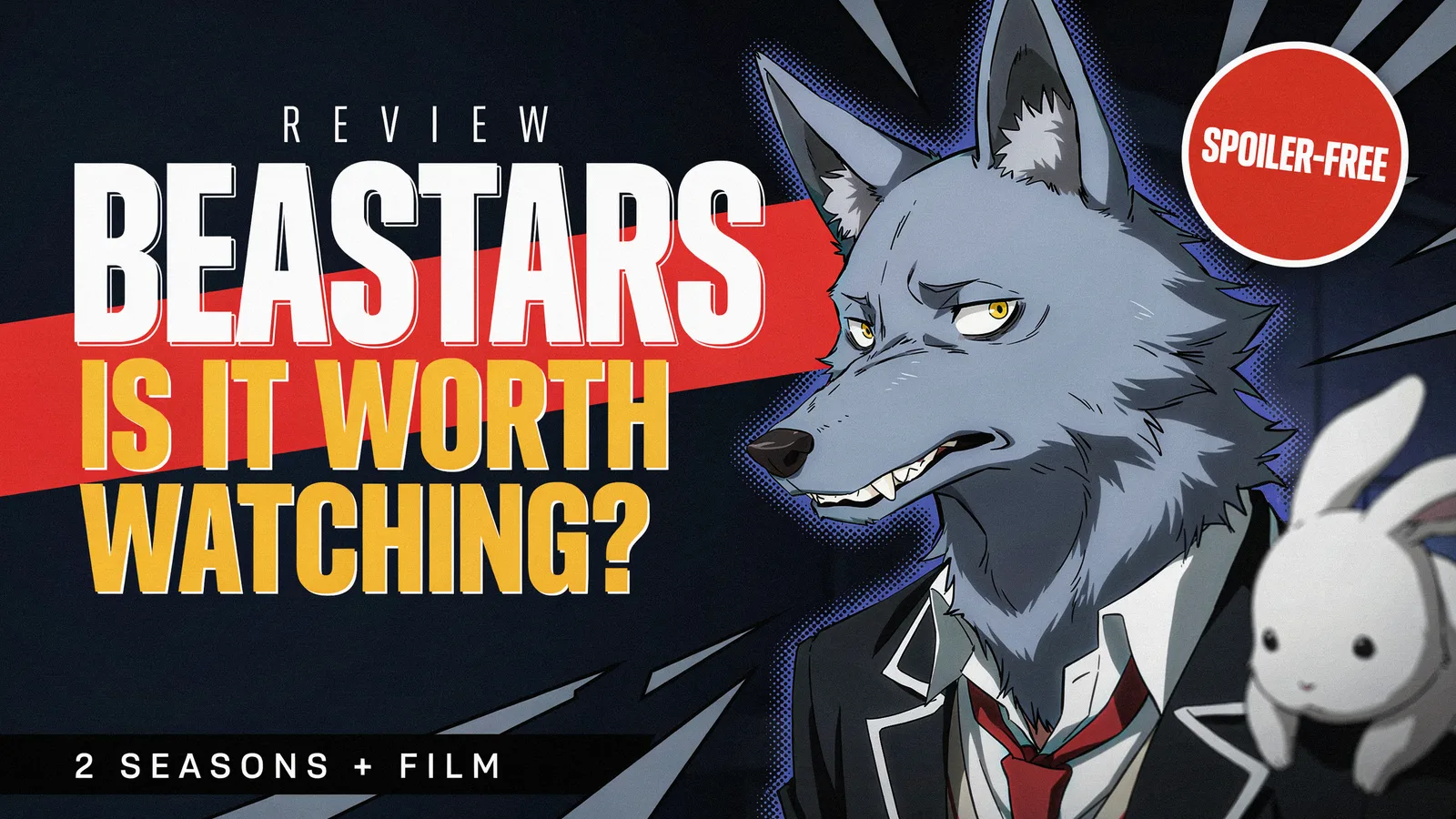
TL;DR — Beastars follows Legoshi, a genuinely gentle, anxious gray wolf navigating high school in a world where carnivores and herbivores coexist under an uneasy social truce, complicated by his own predatory instincts and a genuine murder investigation at his school. Two seasons plus a film exist. Here's what makes this genuinely inventive allegory for prejudice and repressed desire such a distinctive watch.
Get anime picks based on this article
Want an unusual premise treated with real thematic seriousness? Skip the guide and jump straight to picks built for that.
Get anime picksTell us your mood. We'll do the picking.
8 quick questions. Real anime picks from real catalogs — not ads. Free, no sign-up.
Take the quizWhat's the actual premise?
In a society where carnivorous and herbivorous animals coexist, governed by strict social codes designed to suppress carnivores' predatory instincts, Legoshi, a large but genuinely gentle wolf, struggles with his own suppressed urges after a student is murdered at his school's drama club. His growing, genuinely complicated feelings for Haru, a small rabbit classmate, force him to confront both his own nature and the broader social prejudices structuring his entire world.
Why is the carnivore-herbivore social structure considered such an effective allegory?
Because it gives the show a genuinely flexible framework for exploring real social prejudice, suppressed desire, and the tension between biological instinct and social conformity, without directly mapping onto any single real-world issue, letting viewers draw their own connections to genuine questions about difference and coexistence.
Is the show's central romance handled with real depth, or is it played mostly for shock value?
Genuine depth, despite the premise's inherently provocative setup, a predator falling for potential prey. The show takes real, sustained care exploring Legoshi's genuine internal conflict between affection and instinct, giving the relationship actual psychological weight rather than treating the taboo pairing as pure titillation.
Does the show's murder mystery plot hold up as compelling on its own?
Reasonably, though it functions more as a structural device driving the broader themes than a genuinely twisty, self-contained mystery. The investigation matters more for what it reveals about the society's underlying tensions than for its specific procedural satisfaction.
Is the animation style notable for this show specifically?
Yes, genuinely, using a distinctive blend of 2D and 3D CG animation that gives the animal characters real, tactile physicality, fur texture, body language, that traditional 2D alone might not convey as effectively, particularly during the show's more intense physical or intimate scenes.
Is the content in this show appropriate for younger viewers, given its animal characters?
No, genuinely not, despite the anthropomorphic animal designs, which might read as family-friendly at a glance, the show explores genuinely mature themes including violence, sexuality, and psychological complexity that make it clearly intended for an adult audience.
How many seasons are there, and does the story reach a satisfying conclusion?
Two seasons plus a film adaptation of the manga's ending, together adapting the complete story to its actual conclusion, giving the show a genuinely full arc rather than leaving major threads unresolved.
Is this a good anime for someone who wants a genuinely unusual premise handled with real thematic seriousness?
Yes, genuinely, its central conceit could easily have been played for pure shock or comedy, but the show consistently treats its characters' struggles with real psychological and social weight.
Frequently asked questions
What's the actual premise of Beastars? A gentle wolf navigates suppressed predatory instincts and a forbidden romance amid a school murder investigation in a world of coexisting carnivores and herbivores.
Is the central romance in Beastars handled with real depth? Yes, genuinely, exploring the protagonist's internal conflict with real psychological weight rather than pure shock value.
Is Beastars appropriate for younger viewers? No, despite its animal character designs, it explores mature themes including violence and sexuality.
How many seasons of Beastars are there? Two seasons plus a film, together adapting the complete manga story.
Is the animation style notable? Yes, using a distinctive blend of 2D and 3D CG that gives characters real tactile physicality.
Does the murder mystery plot work as a standalone thriller? Reasonably, though it functions more as a structural device for the broader themes than a self-contained mystery.
Is this a good pick for someone who wants an unusual premise handled seriously? Yes, genuinely, treating its provocative conceit with real thematic weight rather than shock or comedy.
Does the story reach a complete conclusion? Yes, the two seasons plus film together adapt the manga's full story to its actual ending.