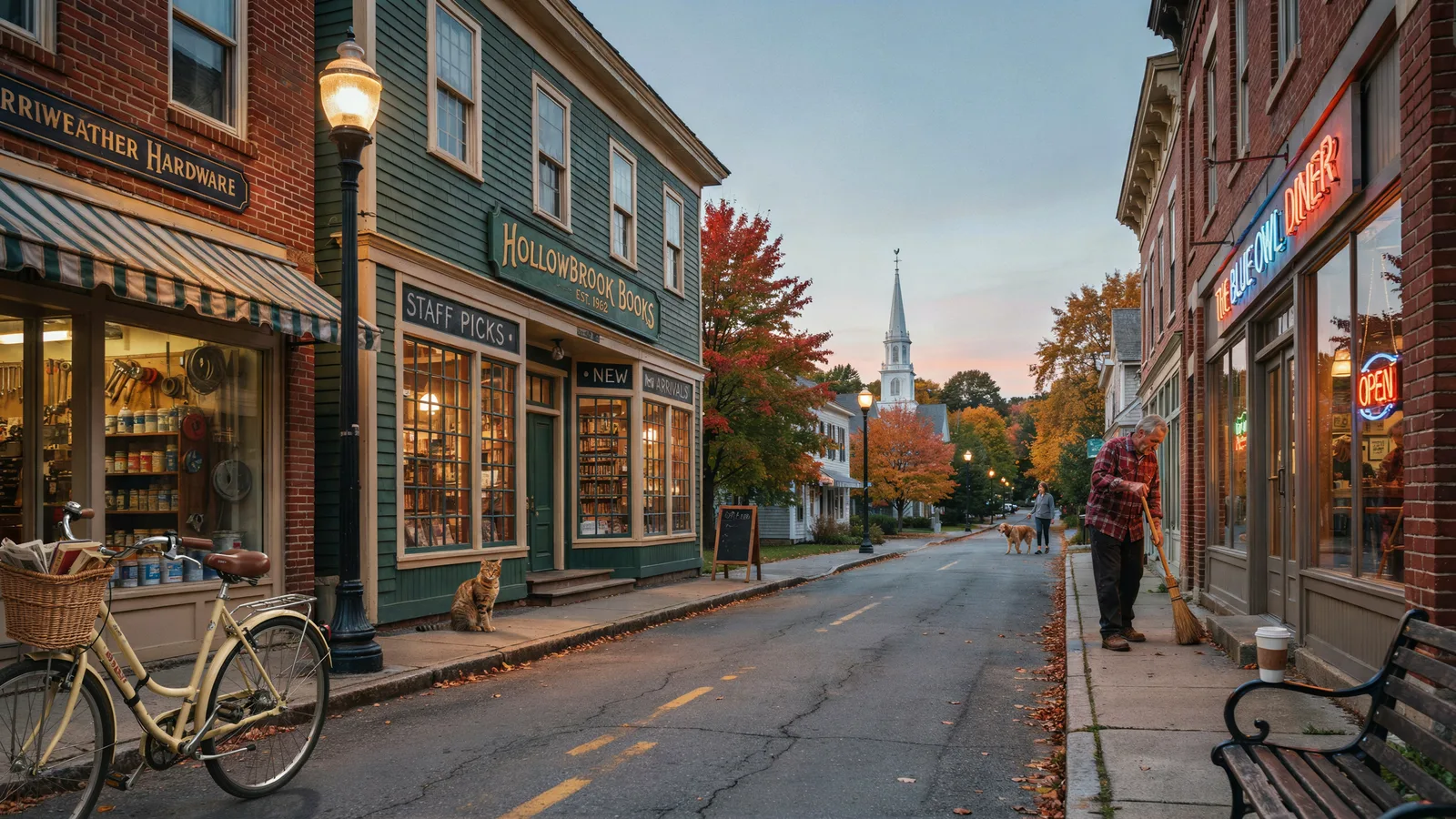
Best Books Set in Small Towns
TL;DR — A small-town setting gives novels a genuinely reliable structure, a contained, recurring cast of community members whose lives naturally and repeatedly intersect, a dynamic that a sprawling city setting often can't replicate as tightly. Here's a list sorted by what specific kind of small-town story each novel tells, plus my honest take on why this setting works so well as its own genre-agnostic backdrop.

Get book picks based on this article
Want a contained community whose lives keep intersecting? Skip the list and jump straight to picks built for that.
Get book picksTell us your mood. We'll do the picking.
8 quick questions. Real book picks from real catalogs — not ads. Free, no sign-up.
Take the quizWhy does a small-town setting work so reliably as a structural device for fiction specifically?
Because it naturally limits and concentrates a novel's world, forcing genuine, recurring interaction between the same characters, which tends to produce richer, more layered community dynamics than a setting where characters could plausibly never cross paths again, giving every relationship real accumulated weight and history.
If you want a small-town novel exploring genuine mystery or dark secrets
Sharp Objects, Gillian Flynn. Uses a genuinely oppressive small Missouri town to explore family dysfunction and dark secrets with real psychological tension, treating the town's own gossip and judgment as an active force in the plot.
Peyton Place, Grace Metalious. A genuinely groundbreaking, once-scandalous novel exposing small-town hypocrisy and hidden secrets, controversial enough at its 1956 release to become a genuine cultural phenomenon.
If you want a small-town novel exploring genuine warmth and community
A Man Called Ove, Fredrik Backman. Uses its small community setting to explore genuine curmudgeonly transformation and neighborly connection, treating small, everyday interactions as genuinely meaningful.
Gilead, Marilynne Robinson. Explores genuine small-town faith and family history with real contemplative depth, using a minister's reflective letter to his young son as its narrative frame.
If you want a small-town novel exploring genuine coming-of-age themes
To Kill a Mockingbird, Harper Lee. Uses its small Alabama town setting to explore genuine questions of justice and moral courage within a tight-knit community, giving real weight to how the town's own social fabric shapes the central trial's outcome.
If you want a small-town novel exploring genuine economic decline or struggle
Winter's Bone, Daniel Woodrell. A genuinely stark, atmospheric exploration of rural poverty and family loyalty in the Ozarks, treating the specific, harsh economic and social realities of that region with real precision.
If you want a small-town novel exploring genuine generational change
Olive Kitteridge, Elizabeth Strout. Uses a small Maine coastal town as the backdrop for genuinely interconnected stories spanning years and multiple perspectives, letting the town itself accumulate a genuine, lived-in sense of collective history.
If you want a small-town novel exploring genuine religious or cultural insularity
Peace Like a River, Leif Enger. Explores genuine faith and family within a small Midwestern town, blending realism with subtle magical elements woven into its otherwise grounded small-town setting.
My honest opinion on why Olive Kitteridge uses its small-town setting so effectively
I think it's because Strout treats the town itself almost as a character, with recurring figures appearing across different stories from different angles, creating a genuine sense of a fully realized, lived-in community that few novels achieve this thoroughly regardless of their specific plot focus.
Does a small-town novel need to explore dark secrets specifically, or can it capture genuine warmth without hidden darkness?
Genuinely both work, some of the strongest examples, Sharp Objects especially, use the small-town setting specifically for dark secrets and dysfunction, while others, A Man Called Ove especially, use the same tight-knit structure for genuine warmth and community connection instead.
Frequently asked questions
What's a small-town novel exploring genuine dark family secrets? Sharp Objects by Gillian Flynn uses an oppressive small Missouri town to explore family dysfunction with real tension.
Is Olive Kitteridge considered a strong example of small-town interconnected storytelling? Yes, genuinely, using a small Maine town as the backdrop for stories spanning years and multiple perspectives.
What's a groundbreaking novel exposing small-town hypocrisy? Peyton Place was once considered scandalous for exposing hidden secrets beneath small-town propriety.
Does A Man Called Ove use its small community for warmth rather than dark secrets? Yes, genuinely, exploring curmudgeonly transformation and neighborly connection instead.
Is To Kill a Mockingbird considered a small-town novel? Yes, using its small Alabama town setting to explore justice and moral courage within a tight-knit community.
What's a small-town novel exploring rural poverty specifically? Winter's Bone offers a stark, atmospheric exploration of rural poverty and family loyalty in the Ozarks.
Do small-town novels need dark secrets to work well? Not necessarily, some of the strongest examples use the same tight-knit structure for genuine warmth instead.
Why does a small-town setting work so reliably as a structural device? It naturally limits and concentrates a novel's world, forcing genuine, recurring interaction between the same characters.
How controversial was Peyton Place at its original release? Genuinely scandalous, controversial enough to become a real cultural phenomenon upon its 1956 publication.
Does Gilead use a specific narrative framing device? Yes, genuinely, structured as a minister's reflective letter to his young son.
Does Peace Like a River blend realism with other elements? Yes, genuinely, weaving subtle magical elements into its otherwise grounded small Midwestern town setting.
Does Winter's Bone treat its region's economic realities with specificity? Yes, genuinely, treating the Ozarks' specific harsh economic and social conditions with real precision.
Want to discover your next read?
Our book recommendation quiz can help you find something new that fits your mood.