Best Books With Unreliable Narrators
TL;DR — An unreliable narrator asks a genuinely different kind of engagement from a reader than a straightforward story does, active skepticism rather than passive trust in what you're being told. Here's a list sorted by exactly how the unreliability functions, plus my honest take on why this device works especially well in prose specifically, better in some ways than it does on screen.
Get book picks based on this article
Want a narrator you genuinely can't trust? Skip the list and jump straight to book picks built around active skepticism.
Get book picksTell us your mood. We'll do the picking.
8 quick questions. Real book picks from real catalogs — not ads. Free, no sign-up.
Take the quizWhy does unreliable narration work particularly well in book form?
Because prose gives an author direct, sustained access to a character's internal voice in a way film usually can't replicate as thoroughly. A novel narrated in first person lets an author control every single piece of information you receive, filtered entirely through a potentially compromised perspective, creating a more immersive, harder-to-escape unreliability than a film's more objective camera typically allows.
If you want a narrator who's deliberately deceiving you
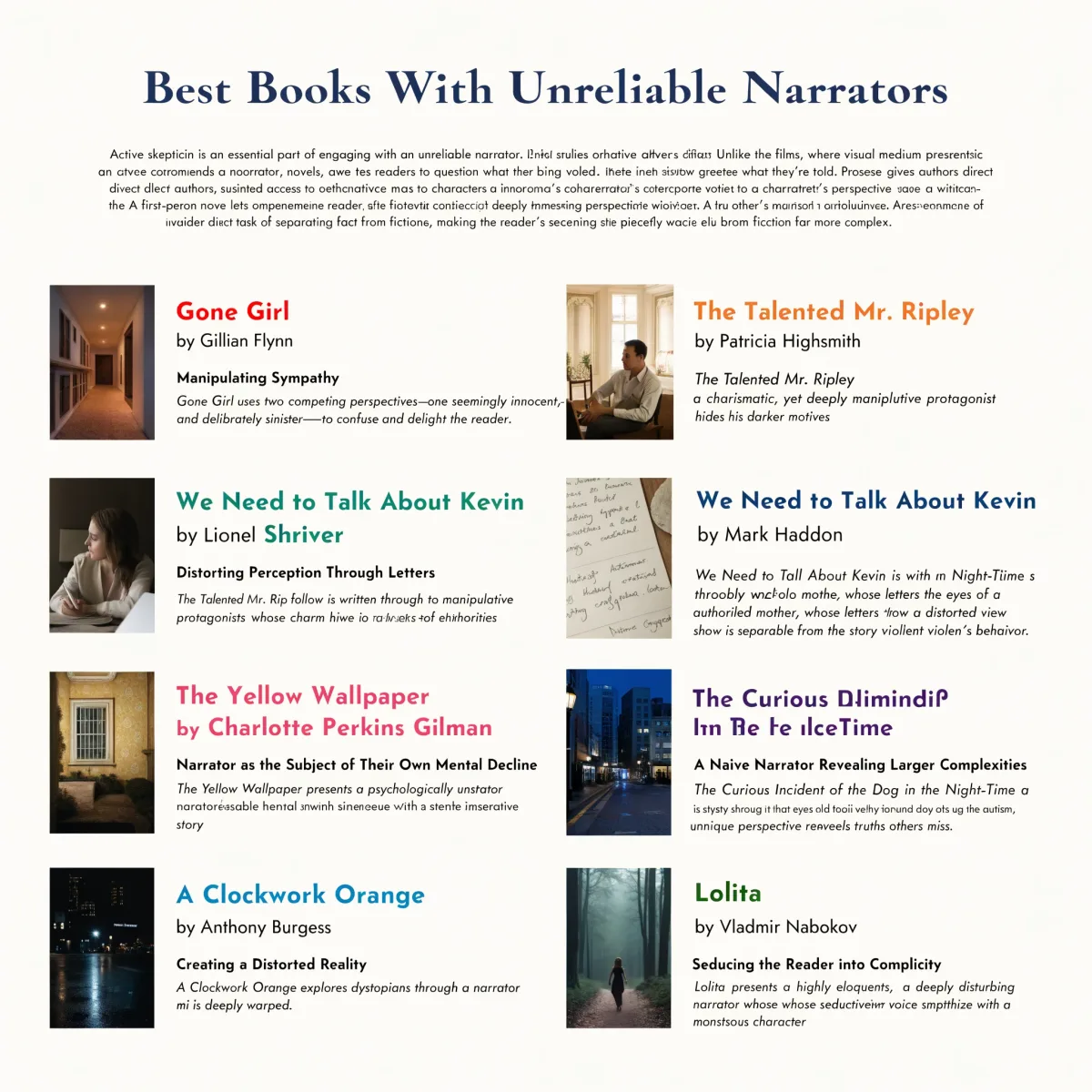
Gone Girl, Gillian Flynn. Uses dual, competing narrators specifically to manipulate the reader's sympathies, with a genuinely audacious structural reveal partway through that recontextualizes everything you thought you understood.
The Talented Mr. Ripley, Patricia Highsmith. Follows a genuinely charming, morally hollow narrator whose justifications for his own actions become increasingly unsettling the more you actually examine them.
If you want a narrator whose perception of reality is genuinely compromised
We Need to Talk About Kevin, Lionel Shriver. Told entirely through one mother's letters, with genuine ambiguity about how much her account of her son can actually be trusted, given her own clear emotional stake in how the story gets told.
The Yellow Wallpaper, Charlotte Perkins Gilman. A genuinely unsettling short work where the narrator's own deteriorating mental state becomes inseparable from the story itself, making her account increasingly difficult to trust as the narrative progresses.
If you want a narrator who's simply naive or limited, rather than malicious
The Curious Incident of the Dog in the Night-Time, Mark Haddon. Narrated by a boy whose particular way of processing the world means readers often understand more about the adult situations around him than he consciously does himself.
A Clockwork Orange, Anthony Burgess. Uses a narrator whose own moral framework is so fundamentally skewed that readers have to actively work to separate his perspective from any kind of objective truth about his actions.
If you want a genuinely classic, foundational example
Lolita, Vladimir Nabokov. Perhaps the single most studied example of unreliable narration in modern literature, using its narrator's genuinely seductive, articulate voice specifically to implicate readers in nearly sympathizing with someone whose actions are genuinely monstrous, a deliberate and deeply uncomfortable authorial choice.
My honest opinion on why Lolita remains such a difficult but important example of this device
I think it's specifically because Nabokov weaponizes his narrator's genuine eloquence against the reader, forcing an uncomfortable awareness of how persuasive and charming a genuinely terrible perspective can sound when it's given full narrative control. That discomfort is the actual point of the book, not an accident, and it's a genuinely instructive, if difficult, example of how unreliable narration can be used for real moral and thematic purpose rather than just a clever structural trick.
Should you read reviews or spoilers before starting an unreliable narrator novel?
I'd genuinely recommend against it if you can help it. Part of the specific pleasure of this device is experiencing your own trust in the narrator gradually erode or get manipulated in real time, an experience that spoilers or heavy pre-reading tend to flatten considerably.
Is unreliable narration always a twist-driven device?
No, and that's worth knowing going in. Some of the strongest examples, The Yellow Wallpaper and We Need to Talk About Kevin especially, use unreliability as a sustained atmosphere and character study rather than building toward one single dramatic reveal.
Frequently asked questions
What's considered the most studied example of an unreliable narrator in literature? Lolita, which uses its narrator's eloquence to deliberately implicate readers in a deeply uncomfortable way.
Is Gone Girl a good starting point for this genre? Yes, it's a genuinely accessible entry point with a clear, audacious structural twist that showcases the device well.
Does an unreliable narrator novel always have a big reveal? No, some, like We Need to Talk About Kevin, use unreliability as a sustained character study rather than building toward one twist.
Should I avoid reviews before reading an unreliable narrator book? Generally yes, since part of the experience is your own trust in the narrator shifting in real time as you read.
Want something else matched to your mood?
Our book recommendation quiz can help you find your next read in this genre or something completely different.