Best Dystopian Novels Worth Reading
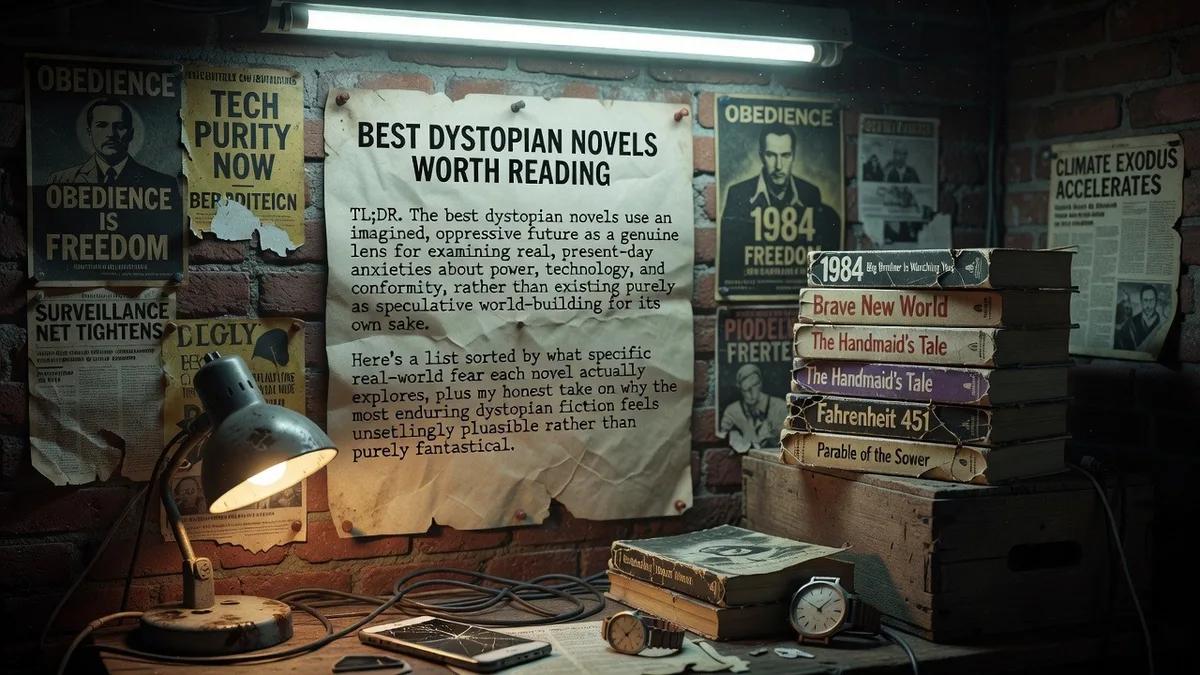
TL;DR — The best dystopian novels use an imagined, oppressive future as a genuine lens for examining real, present-day anxieties about power, technology, and conformity, rather than existing purely as speculative world-building for its own sake. Here's a list sorted by what specific real-world fear each novel actually explores, plus my honest take on why the most enduring dystopian fiction feels unsettlingly plausible rather than purely fantastical.
Get book picks based on this article
Want a future that feels uncomfortably plausible? Skip the list and jump straight to picks built for that.
Get book picksTell us your mood. We'll do the picking.
8 quick questions. Real book picks from real catalogs — not ads. Free, no sign-up.
Take the quizWhy do the most effective dystopian novels feel plausible rather than purely fantastical?
Because the strongest examples extrapolate genuine, existing societal trends and anxieties to their logical extreme, rather than inventing an entirely disconnected fictional threat, giving readers a real, uncomfortable sense of "this could actually happen" rather than pure escapist fantasy.
If you want a foundational classic exploring totalitarian surveillance
1984, George Orwell. Still one of the most influential dystopian novels ever written, exploring genuine anxieties about government surveillance, propaganda, and the manipulation of truth itself.
Brave New World, Aldous Huxley. Explores a genuinely different kind of dystopian control, built around engineered contentment and consumerism rather than overt oppression, arguably feeling even more relevant to certain modern anxieties.
If you want a dystopian novel exploring gender and reproductive control
The Handmaid's Tale, Margaret Atwood. A genuinely unsettling exploration of theocratic control over women's bodies and autonomy, built on historically grounded extrapolation rather than purely invented threat.
If you want a dystopian novel exploring genuine class and economic inequality
The Hunger Games, Suzanne Collins. Uses its brutal televised competition to explore genuine class exploitation and the spectacle of inequality, resonating with real contemporary anxieties about media and wealth disparity.
Parable of the Sower, Octavia Butler. Explores genuine societal collapse driven by climate change and economic inequality, considered eerily prescient by many recent readers.
If you want a dystopian novel exploring censorship and anti-intellectualism specifically
Fahrenheit 451, Ray Bradbury. Explores a genuine society that's banned books and reading, using that premise to examine real anxieties about conformity and anti-intellectualism.
If you want a dystopian novel exploring artificial intelligence or technological control
We, Yevgeny Zamyatin. A genuinely foundational, early dystopian novel that influenced both 1984 and Brave New World, exploring totalitarian control through rigid, dehumanizing systemization.
Never Let Me Go, Kazuo Ishiguro. A genuinely quiet, devastating dystopian novel exploring bioethics and human worth through an unusually restrained, understated narrative approach.
My honest opinion on why Brave New World has aged into feeling more prescient than 1984 for certain modern readers
I think it's because Huxley's vision of control through pleasure, distraction, and engineered contentment maps genuinely well onto anxieties about consumerism and digital distraction that feel more immediately present to many contemporary readers than 1984's more overt, totalitarian surveillance state, even though both remain genuinely relevant in their own distinct ways.
Do dystopian novels always need to be set in the future to work?
Not strictly, some of the strongest examples are set in an alternate present or a barely-shifted version of contemporary reality, proving the genre's core interest, extrapolating real anxieties to their logical extreme, doesn't require a literal future setting to function effectively.
Frequently asked questions
What's considered the most influential dystopian novel about surveillance? 1984 by George Orwell remains one of the most influential works exploring government surveillance and propaganda.
Is Brave New World considered more relevant than 1984 today? Some readers find it more prescient, given its focus on control through pleasure and distraction resonating with modern consumerism anxieties.
What's a dystopian novel exploring reproductive rights and control? The Handmaid's Tale explores theocratic control over women's bodies with genuine, historically grounded extrapolation.
Is Parable of the Sower considered prescient by modern readers? Yes, many recent readers find its depiction of climate-driven societal collapse eerily relevant.
What's a foundational early dystopian novel that influenced later classics? We by Yevgeny Zamyatin is widely credited with influencing both 1984 and Brave New World.
Do dystopian novels need to be set in the future? Not strictly, some strong examples use an alternate present or barely-shifted contemporary reality instead.
Is Never Let Me Go considered a traditional dystopian novel? It's a quieter, more restrained take on the genre, exploring bioethics and human worth rather than overt societal collapse.
What makes The Hunger Games effective as dystopian fiction? It uses its televised competition to explore real class exploitation and the spectacle of inequality.
Want to discover your next great dystopian read?
Our book recommendation quiz can help you find something new that fits your mood.