Best Movies With Non-Linear Timelines
TL;DR — Telling a story out of chronological order is a genuine structural risk, one that can confuse audiences if handled poorly, but the best examples use non-linear structure to reveal meaning a straightforward telling couldn't achieve. Here's a list sorted by why each film's structure actually matters to its content, plus my honest take on why this technique should never be used purely for style.
Get movie picks based on this article
Want a scrambled chronology that reveals real meaning? Skip the list and jump straight to picks built for that.
Get movie picksTell us your mood. We'll do the picking.
8 quick questions. Real movie picks from real catalogs — not ads. Free, no sign-up.
Take the quizWhy does a non-linear structure need real justification to work well?
Because scrambling chronology inherently asks more effort from the audience, requiring them to actively track and reassemble the actual timeline, and if that effort isn't rewarded with genuine insight or emotional payoff, the structure becomes a gimmick rather than a meaningful creative choice. The best non-linear films make the fragmented order itself part of the story's actual meaning, not just a stylistic flourish.
If you want a non-linear structure built around memory and identity
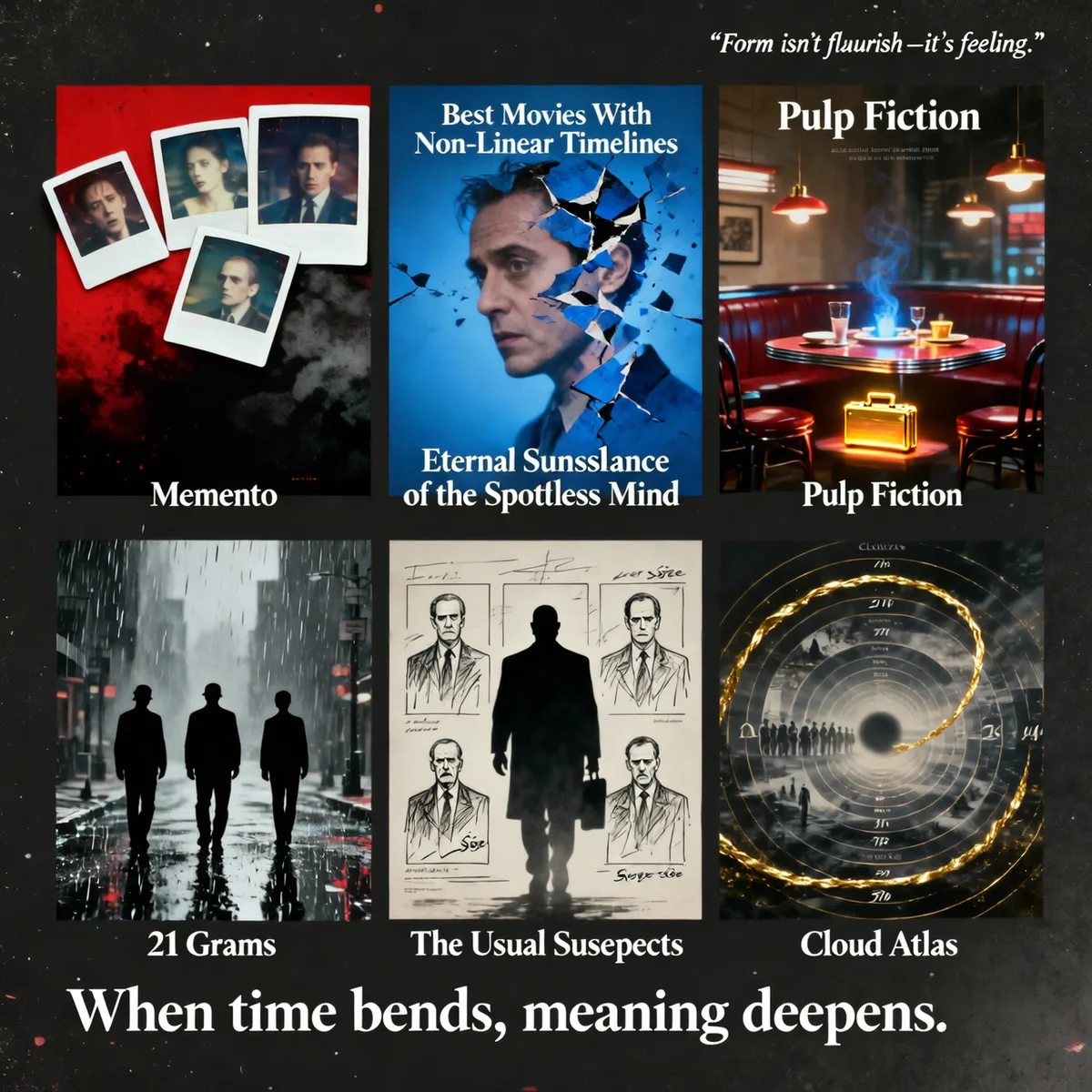
Memento. Told partly in reverse, mirroring its protagonist's short-term memory loss condition directly, making the structure inseparable from the story's actual content and putting the audience in his exact disoriented position.
Eternal Sunshine of the Spotless Mind. Uses a genuinely fragmented, memory-erasure-driven structure to explore how we selectively remember and reconstruct past relationships.
If you want an ensemble story where timeline fragmentation reveals connection
Pulp Fiction. Its non-linear structure lets seemingly disconnected stories reveal genuine, satisfying connections once you see how the pieces actually fit together, rewarding attentive viewers with a genuine puzzle-box structure.
21 Grams. Uses fragmented chronology to build genuine emotional weight around how three strangers' lives intersect through tragedy, deliberately withholding full context until later in the film.
If you want a mystery that depends entirely on its scrambled order
The Usual Suspects. Uses non-linear storytelling specifically to control what the audience knows and when, essential to its famous twist landing with full force.
Rashomon. Akira Kurosawa's foundational film uses contradictory, nonlinear retellings of the same event to explore genuine questions about the unreliability of memory and perspective.
If you want a genuinely ambitious, sprawling nonlinear epic
Cloud Atlas. Weaves together six distinct timelines and stories across centuries, using genuine thematic echoes between eras as the connective tissue holding its ambitious structure together.
My honest opinion on why Memento remains the genre's most studied example
I think it's because the fragmented structure isn't just a stylistic choice, it's literally the audience experiencing the same confusion and unreliable memory as the protagonist, making form and content genuinely inseparable in a way few other films achieve this thoroughly.
Does a non-linear film reward rewatching more than a linear one?
Often yes, since a second viewing lets you piece together the full chronology with complete information, revealing details and connections a first, more confused viewing might miss entirely.
Should you actively try to reconstruct the timeline while watching, or just let it unfold?
I'd genuinely recommend letting the film's intended experience wash over you on a first watch rather than actively working to reconstruct the chronology in real time, since the confusion or disorientation is often part of the intended effect, and you can piece together the full order on a rewatch.
Frequently asked questions
What's considered the most studied non-linear film structure? Memento, whose reverse chronology directly mirrors its protagonist's memory condition.
Does Pulp Fiction's non-linear structure actually matter to the story? Yes, it reveals genuine connections between seemingly disconnected characters once you see how the timeline fits together.
Is a non-linear structure always a good creative choice? No, it needs genuine justification tied to the story's meaning, otherwise it risks feeling like an unnecessary gimmick.
Do non-linear movies reward rewatching? Often yes, a second viewing with full context reveals details a first, more confused watch might miss.
Is Rashomon a good introduction to non-linear storytelling? Yes, it's the foundational example of using contradictory retellings to explore memory and perspective.
Should I try to piece together the timeline during my first watch? Not necessarily, letting the intended disorientation happen naturally often serves the film better than actively reconstructing events in real time.
Want something else to watch tonight?
Our movie recommendation quiz can help you find your next watch.