Best Series With Morally Gray Protagonists
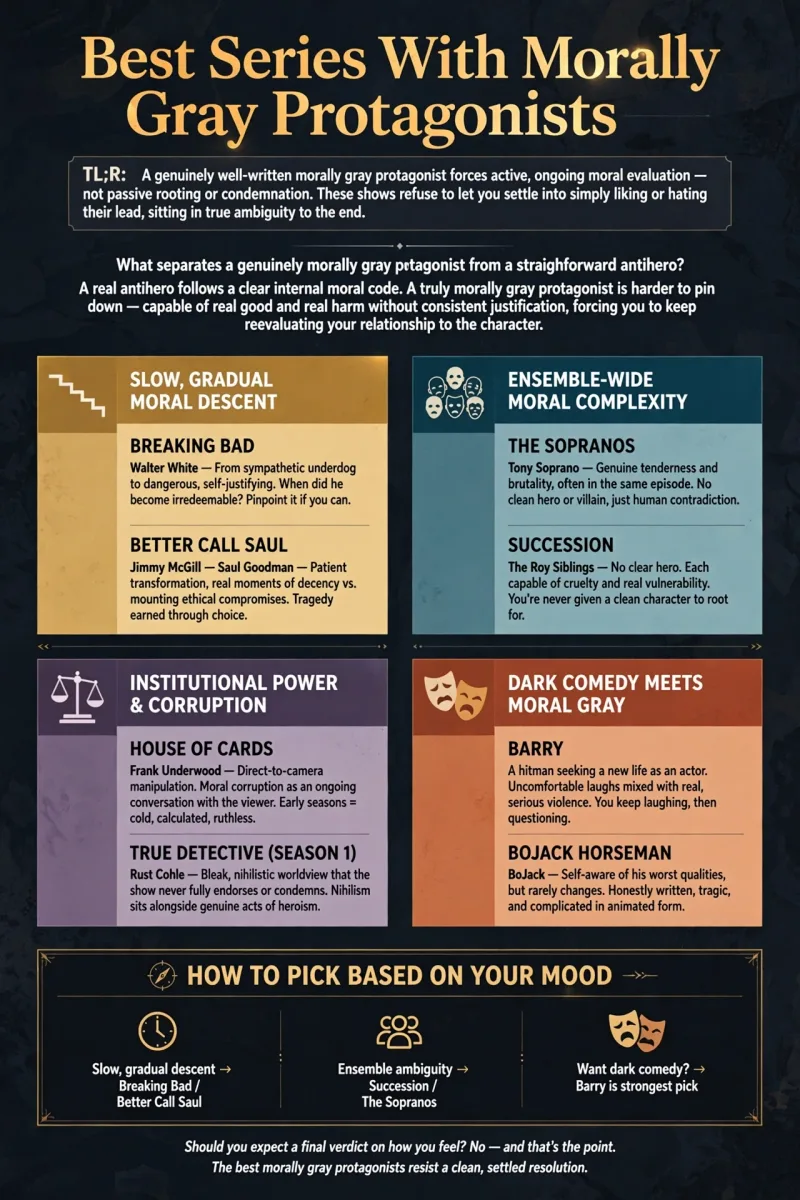
TL;DR — A genuinely well-written morally gray protagonist asks something different of you than a straightforward hero or villain, active, ongoing moral evaluation rather than passive rooting or condemnation. Here's a list sorted by how the show handles that ambiguity, plus my honest take on why the strongest examples never let you settle into simply liking or hating their lead.
Get series picks based on this article
Want a lead you genuinely can't settle into liking or hating? Skip the list and jump straight to series picks built around real moral ambiguity.
Get series picksTell us your mood. We'll do the picking.
8 quick questions. Real series picks from real catalogs — not ads. Free, no sign-up.
Take the quizWhat actually separates a genuinely morally gray protagonist from a straightforward antihero?
A real antihero often still operates within a clear internal moral code, even if that code differs from conventional heroism. A genuinely morally gray protagonist is harder to pin down even by their own logic, capable of real good and real harm without a consistent internal justification tying it all together, which forces you to keep actively reevaluating your own relationship to the character rather than settling into a fixed read on them.
If you want a protagonist whose moral complexity drives the entire show
Breaking Bad. Walter White's transformation from sympathetic underdog to genuinely dangerous, self-justifying figure is one of television's most studied examples of a character whose moral position shifts so gradually that pinpointing exactly when he became irredeemable is genuinely difficult.
The Sopranos. Tony Soprano's genuine capacity for both real tenderness and real brutality, often within the same episode, remains one of the most influential depictions of moral ambiguity in television.
If you want moral grayness explored through institutional power
Succession. None of the Roy siblings function as a clear hero, each capable of genuine cruelty and, occasionally, real vulnerability, refusing to give viewers a clean rooting interest among the family.
House of Cards, at least its earlier seasons, built its entire structure around a protagonist whose direct-to-camera manipulation of the audience makes his moral corruption an explicit, ongoing conversation with the viewer.
If you want a genuinely conflicted protagonist working within law enforcement or crime
True Detective, particularly its first season, gives Rust Cohle a genuinely bleak, morally complicated worldview that the show never fully endorses or condemns, letting his nihilism sit uncomfortably alongside real moments of genuine heroism.
Better Call Saul. Jimmy McGill's slow transformation into Saul Goodman is handled with genuine patience, showing real moments of decency alongside a mounting willingness to cut ethical corners that eventually defines him.
If you want moral grayness played with real dark comedy
Barry. A hitman trying to build a new life as an actor gives the show a genuinely uncomfortable structural tension, asking you to laugh along with a character capable of real, serious violence.
BoJack Horseman. BoJack's genuine self-awareness about his own worst qualities, without that awareness translating into consistent change, makes him one of the more honestly written morally complicated protagonists in animation.
My honest opinion on why Better Call Saul handles this trope better than most prequels manage
I think it's because the show resists rushing Jimmy's transformation into Saul, giving real weight and screen time to the moments where he genuinely could have chosen differently. That patience makes his eventual full transformation feel like a genuinely earned tragedy rather than a foregone conclusion the show is just killing time before delivering.
Should you expect to eventually feel resolved about how you feel toward these protagonists?
Honestly, no, and I'd consider that the point rather than a flaw. The strongest morally gray protagonists are specifically designed to resist a clean, settled verdict, and shows that eventually tip too clearly toward redemption or condemnation for their lead often feel less interesting than ones willing to sit in genuine ambiguity through to the end.
How should you pick from this list based on your mood?
If you want a slow, gradual moral descent, Breaking Bad or Better Call Saul deliver that patiently. If you want ensemble-wide moral complexity rather than one central figure, Succession or The Sopranos spread that ambiguity across a wider cast. If you want dark comedy complicating the ambiguity further, Barry is the strongest pick.
Frequently asked questions
What's the most studied example of a morally gray protagonist in television? Walter White in Breaking Bad, whose gradual transformation from sympathetic to dangerous remains a genre benchmark.
Is Succession really about morally gray characters, or is there a clear hero? No clear hero. Each Roy sibling is capable of genuine cruelty and occasional vulnerability, deliberately avoiding a clean rooting interest.
Does Better Call Saul rush Jimmy's transformation into Saul Goodman? No, the show takes genuine patience showing moments where he could have chosen differently, making his eventual transformation feel earned.
Is Barry a good example of morally gray characters in comedy? Yes, it creates genuine discomfort by asking viewers to laugh alongside a character capable of serious violence.
Want something matched more specifically to your mood?
Our series recommendation quiz can help you find something else in this register based on how much moral ambiguity you're in the mood for tonight.