Best Songs for Studying and Focus
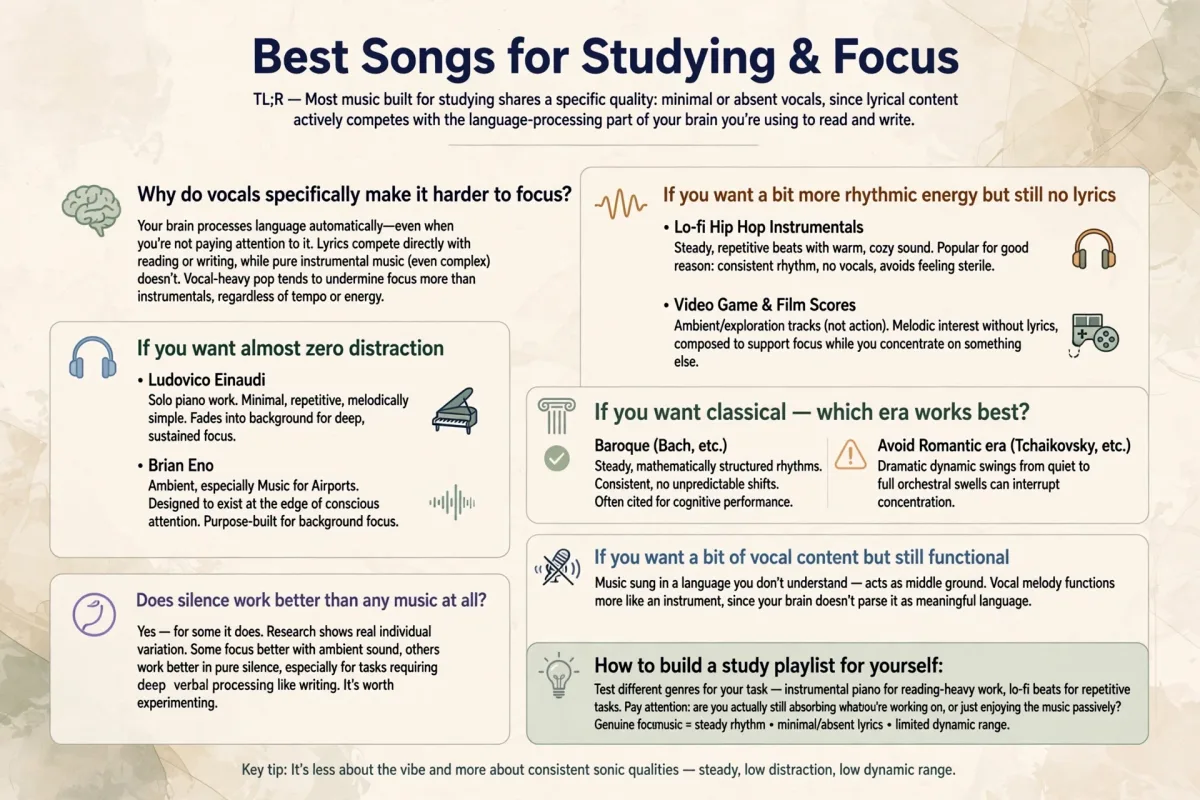
TL;DR — Most music genuinely built for studying shares a specific quality, minimal or absent vocals, since lyrical content actively competes with the language-processing part of your brain you're using to read and write. Here's a list sorted by exactly how much stimulation you actually want, plus my honest take on why "study music" playlists sometimes get this wrong.
Get song picks based on this article
Want music built specifically to fade into the background of real work? Skip the quiz and jump straight to picks in that register.
Get song picksTell us your mood. We'll do the picking.
8 quick questions. Real song picks from real catalogs — not ads. Free, no sign-up.
Take the quizWhy do vocals specifically make music harder to focus with, more than instrumentation does?
Because your brain processes language whether you're paying deliberate attention to it or not, meaning lyrics compete directly with the reading or writing you're trying to do, in a way that pure instrumental music, even complex instrumental music, generally doesn't. This is why vocal-heavy pop, however much you enjoy it casually, tends to undermine focus more than instrumental genres do, regardless of tempo or energy level.
If you want something with almost zero distraction
Ludovico Einaudi's solo piano work. Genuinely minimal, repetitive, and melodically simple enough to fade into the background rather than demanding active attention, ideal for deep, sustained focus work.
Ambient work by Brian Eno, particularly Music for Airports, was explicitly designed to exist at the edge of conscious attention, making it a genuinely purpose-built choice for background focus music.
If you want something with a bit more rhythmic energy but still no lyrics
Lo-fi hip hop instrumentals. A genuinely popular modern study genre for good reason, steady, repetitive rhythms without vocal distraction, and enough sonic warmth to avoid feeling sterile or clinical.
Video game and film scores, particularly ambient or exploration-focused tracks rather than action set pieces, offer genuine melodic interest without lyrical distraction, since they're specifically composed to support attention on something else, originally gameplay or narrative, rather than demand attention themselves.
If you specifically want classical music, and want to know which era actually works best
Baroque era composers, particularly Bach, are frequently cited in research on background music and cognitive performance, their steady, mathematically structured rhythms providing genuine consistency without unpredictable dynamic shifts that can pull focus.
Avoid full symphonic Romantic era work for deep focus specifically, composers like Tchaikovsky build in genuinely dramatic dynamic swings, from whisper-quiet to full orchestral swells, that can actually interrupt concentration rather than support it.
If you want something with a bit of vocal content but still functional for focus
Music sung in a language you don't understand can work as a genuine middle ground, since your brain doesn't automatically parse the lyrics as meaningful language, letting the vocal melody function more like an instrument than competing linguistic content.
My honest opinion on why some popular "study playlists" actually undermine focus
I think a lot of playlists marketed for studying default purely to a certain aesthetic, mellow, chill-sounding music, without actually accounting for whether the specific tracks have distracting vocals or unpredictable dynamic shifts. Genuine focus music is less about a general vibe and more about specific, consistent sonic qualities, steady rhythm, minimal or absent lyrics, limited dramatic dynamic range, that a lot of casually curated "chill study vibes" playlists don't actually optimize for.
Does silence work better than any music at all for some people?
Genuinely yes, for some individuals, and it's worth experimenting with rather than assuming music always helps. Research on background music and cognitive performance shows real individual variation, some people focus better with any ambient sound at all, while others do genuinely better in silence, particularly for tasks requiring deep verbal processing like writing.
How should you actually build a study playlist for yourself?
Test a few different genres specifically for your own task type, instrumental piano for reading-heavy work, lo-fi beats for more repetitive tasks, and pay attention to whether you're actually still absorbing what you're working on rather than just enjoying the music passively in the background.
Frequently asked questions
Why do vocals make it harder to focus while studying? Your brain processes language automatically, meaning lyrics compete directly with the reading or writing you're trying to do.
What classical era works best for studying? Baroque composers like Bach are frequently cited for their steady, consistent rhythms, better suited to focus than the dramatic dynamic swings of Romantic era symphonic work.
Is lo-fi hip hop actually good for studying? Yes, its steady, repetitive rhythms and lack of distracting vocals make it a genuinely popular and effective modern study genre.
Does music in a foreign language work for studying? Often yes, since your brain doesn't automatically parse unfamiliar language content, letting vocals function more like an instrument.
Want to discover more music for other parts of your day?
Our song recommendation quiz can help you find something new for when you're not trying to focus.