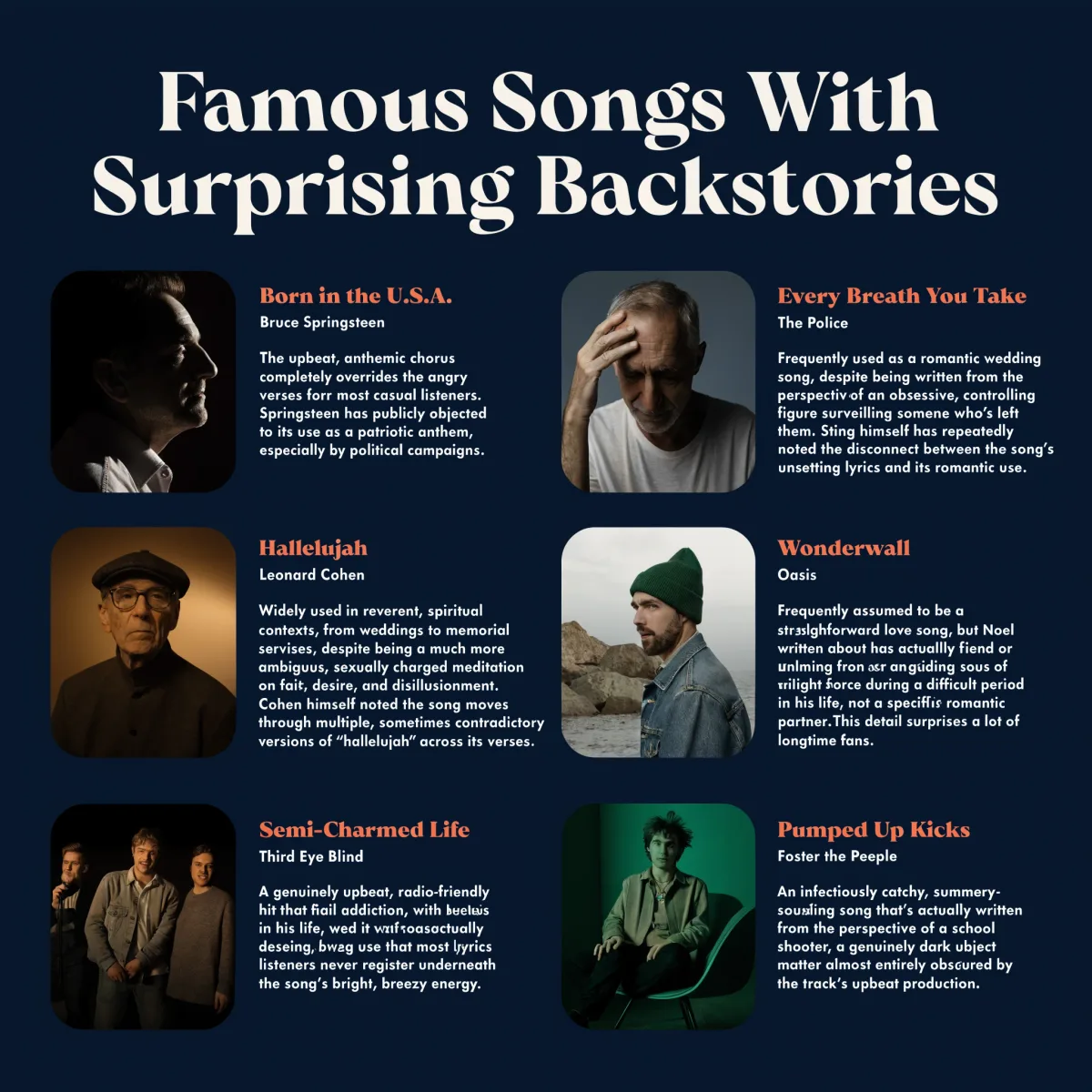
Famous Songs With Surprising Backstories
TL;DR — A lot of genuinely beloved songs mean something completely different from what most listeners assume, whether that's a misread lyric, a misunderstood tone, or a genuinely dark origin hiding under an upbeat melody. Here's a list of songs whose real backstories will probably change how you hear them, sorted by how far off the popular interpretation actually is.

Get song picks based on this article
Want to actually listen closer to songs you already know? Skip the quiz and jump straight to picks that reward paying attention to the words.
Get song picksTell us your mood. We'll do the picking.
8 quick questions. Real song picks from real catalogs — not ads. Free, no sign-up.
Take the quizWhy do so many famous songs end up misunderstood by casual listeners?
Mostly because melody and delivery can completely override lyrical content in how a song actually lands emotionally. An upbeat, catchy melody can carry genuinely dark or ironic lyrics right past listeners who are responding to the song's energy rather than its actual words, which is exactly how several genuinely famous songs ended up wildly misinterpreted as celebratory or romantic when they're actually about something much darker or more complicated.
Songs mistaken for something more celebratory than they actually are
"Born in the U.S.A.," Bruce Springsteen. Widely adopted as a patriotic anthem, including by political campaigns Springsteen has publicly objected to using it, the song is actually a bitter, critical account of a Vietnam veteran's disillusionment and mistreatment after returning home. The upbeat, anthemic chorus completely overrides the genuinely angry verses for most casual listeners.
"Every Breath You Take," The Police. Frequently used as a romantic wedding song, despite being written from the perspective of an obsessive, controlling figure surveilling someone who's left them. Sting himself has repeatedly noted the disconnect between the song's genuinely unsettling lyrics and its widespread romantic use.
Songs whose meaning is more personal or specific than commonly assumed
"Hallelujah," Leonard Cohen. Widely used in genuinely reverent, spiritual contexts, from weddings to memorial services, despite being a much more ambiguous, sexually charged meditation on faith, desire, and disillusionment, with Cohen himself noting the song moves through multiple, sometimes contradictory versions of "hallelujah" across its verses.
"Wonderwall," Oasis. Frequently assumed to be a straightforward love song, but Noel Gallagher has said it was actually written about an imaginary friend or guiding force during a difficult period in his life, not a specific romantic partner, a detail that surprises a lot of longtime fans.
Songs with genuinely dark or unexpected origins hiding under catchy production
"Semi-Charmed Life," Third Eye Blind. A genuinely upbeat, radio-friendly hit that's actually explicitly about crystal meth addiction, with lyrics detailing drug use that most casual listeners never register underneath the song's bright, breezy energy.
"Pumped Up Kicks," Foster the People. An infectiously catchy, summery-sounding song that's actually written from the perspective of a school shooter, a genuinely dark subject matter almost entirely obscured by the track's upbeat production.
My honest opinion on why these misinterpretations happen so consistently
I think it comes down to how much emotional information a melody carries compared to lyrics, especially on a first or casual listen. Listeners generally process the overall feel of a song, tempo, key, vocal delivery, faster and more instinctively than they parse specific lyrical content, which means a genuinely dark or critical song wrapped in an upbeat melody will read as celebratory to most people until they specifically sit down and pay attention to the words.
Does knowing the real backstory change how these songs should be used or enjoyed?
That's genuinely a personal call, and I don't think there's one right answer. Some artists, like Springsteen with "Born in the U.S.A.," have been vocal about wanting their intended meaning respected in how their songs get used publicly. Others seem more relaxed about audiences finding their own meaning regardless of original intent. Either way, knowing the actual backstory at least gives you the full picture before deciding how you personally want to engage with a song.
Frequently asked questions
Is "Born in the U.S.A." actually a patriotic song? No, it's a critical account of a Vietnam veteran's disillusionment, despite its anthemic chorus leading many listeners to assume otherwise.
What is "Every Breath You Take" actually about? It's written from the perspective of an obsessive, controlling figure, not a romantic declaration, despite its common use at weddings.
Is "Pumped Up Kicks" really about a school shooting? Yes, its lyrics are written from a school shooter's perspective, a fact largely obscured by the song's upbeat, catchy production.
Was "Wonderwall" written about a specific romantic partner? No, according to Noel Gallagher, it was inspired by an imaginary guiding presence during a difficult period, not a specific person.
Want to discover more songs with real depth beneath the surface?
Our song recommendation quiz can help you find something new that rewards a closer listen.