Blue Lock: What to Know Before You Start
TL;DR — Blue Lock takes soccer, a sport most sports anime treat as a wholesome team game, and turns it into a genuinely ruthless psychological competition about ego and individual greatness. Two seasons plus a movie currently exist. Here's what makes it so different from typical sports anime, and why the premise alone is worth knowing before you start.
Skip ahead
Get anime recommendations based on this article
Hooked on Blue Lock's ruthless competitive edge? Skip the list and jump straight to anime picks with that same intensity.
Get anime picksSkips the quiz — takes you straight to a real shortlist.Or take the quiz
Tell us your mood. We'll do the picking.
8 quick questions. Real anime picks from real catalogs — not ads. Free, no sign-up.
Take the quizWhat's the actual premise?
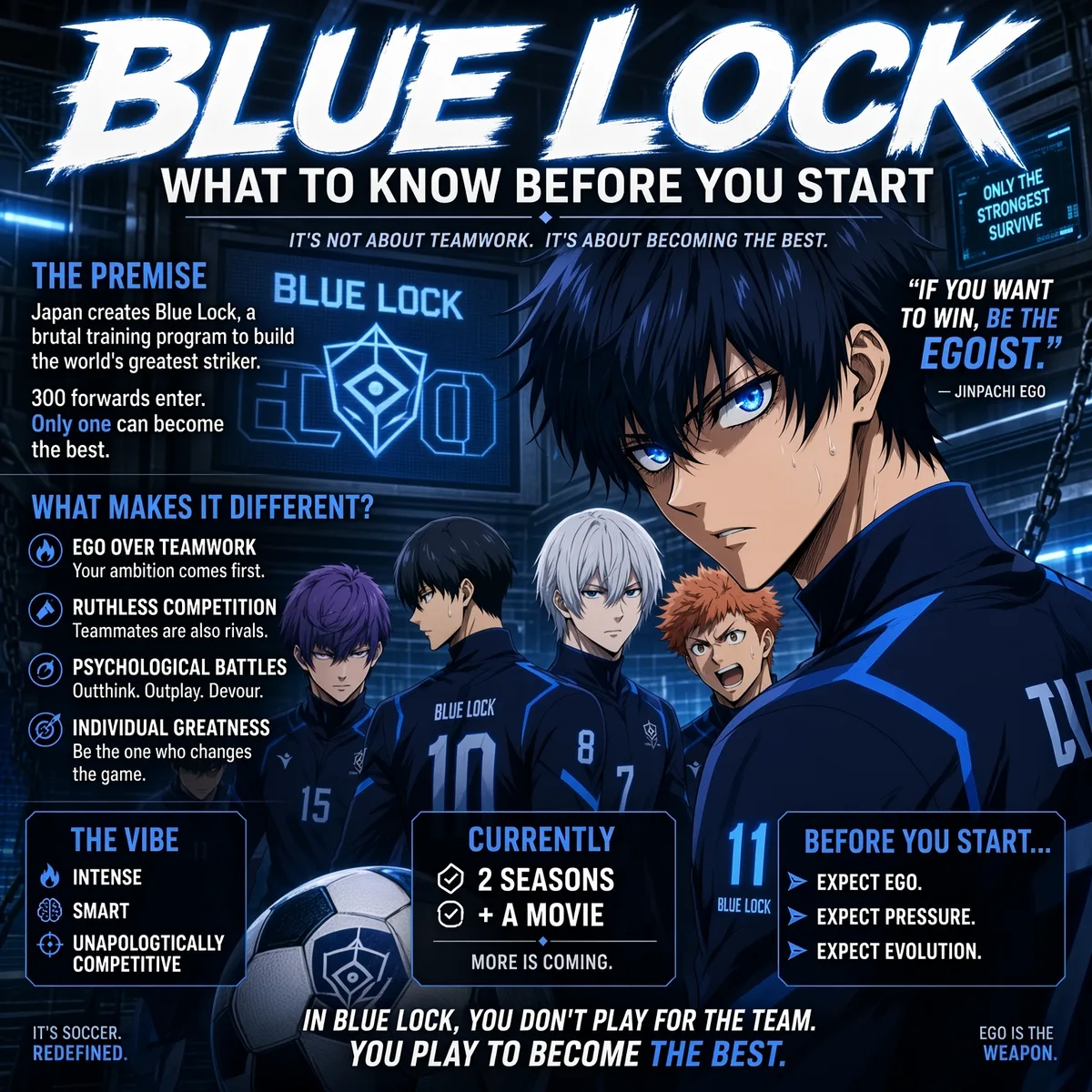
After Japan's national team suffers a crushing loss at the World Cup, a mysterious coach named Ergo Jinpachi creates the Blue Lock program, gathering 300 of the country's best young strikers and forcing them to compete against each other, not cooperate, in a brutal, elimination-based training program designed to produce a single, supremely selfish egotistical striker capable of winning Japan a World Cup alone. The show follows Yoichi Isagi, an unremarkable player forced to confront what it actually takes to become genuinely great.
Why does this premise feel so different from typical sports anime?
Because most sports anime, even ones with real intensity, are fundamentally about teamwork and friendship carrying a group toward a shared goal. Blue Lock inverts that completely, arguing that Japan's soccer culture has historically produced too many "good teammates" and not enough players with the selfish killer instinct required to actually be the best in the world. The show's actual conflict isn't players versus an opposing team, it's players versus each other, which creates a genuinely different, much more psychologically tense dynamic than the genre usually attempts.
Is this actually about soccer, or is that just the setting?
Genuinely both, though the psychological and philosophical elements are what set it apart. There's real, well animated soccer action throughout, but the show's actual preoccupation is with ego, self-worth, and what someone is willing to sacrifice, relationships, teamwork, even basic likability, in pursuit of individual greatness. If you're expecting a straightforward "friendship and hard work win the day" sports narrative, Blue Lock is deliberately arguing against that formula.
How many seasons are there, and how much do I need to watch?
Two seasons currently exist, plus a theatrical film, Blue Lock: Episode Nagi, which functions as a side story focused on a specific character rather than a continuation of the main plot. The two TV seasons should be watched in order, since the story builds continuously, while the movie is more optional depending on how invested you get in that specific character.
Is the ego-driven premise actually likable, or does it make the characters hard to root for?
This is honestly the most divisive aspect of the show, and I think it's worth being upfront about it. Some viewers find the constant emphasis on ego and selfishness genuinely refreshing, a legitimately new angle on a well worn genre. Others find the characters' single minded self-obsession genuinely off putting, especially early on before the show develops more nuance around what these characters actually want beyond raw ego. My own take is that the show earns its premise more as it goes, but the first several episodes ask real patience if the concept doesn't immediately click for you.
Is this a good anime for someone who doesn't normally watch sports anime?
I'd say cautiously yes, more than most entries in the genre. Because the show's real interest is psychological and philosophical rather than purely athletic, viewers who don't care about soccer specifically can still find real hooks in the character dynamics and the show's central argument about ego and greatness. That said, if you have zero patience for sports as a backdrop at all, even a psychologically driven one, this might not convert you.
Frequently asked questions
How many seasons of Blue Lock are there? Two seasons, plus a theatrical film, Blue Lock: Episode Nagi, which functions as an optional side story.
Is Blue Lock actually about teamwork, like most sports anime? No, quite the opposite. The show's premise is built around individual ego and selfishness as the actual path to greatness, rejecting typical sports anime teamwork themes.
Do I need to watch the Blue Lock movie? Not strictly. It's a side story focused on a specific character rather than a continuation of the main plot.
Is Blue Lock good for someone who doesn't like soccer or sports anime generally? Possibly, since its real focus is psychological and philosophical rather than purely athletic, though it does still require some tolerance for sports as a backdrop.
Want something else with this kind of intense, competitive edge?
If Blue Lock's ego-driven competitive angle appeals to you, our anime recommendation quiz can help point you toward something similar.