Steins;Gate: Is It Worth Watching?
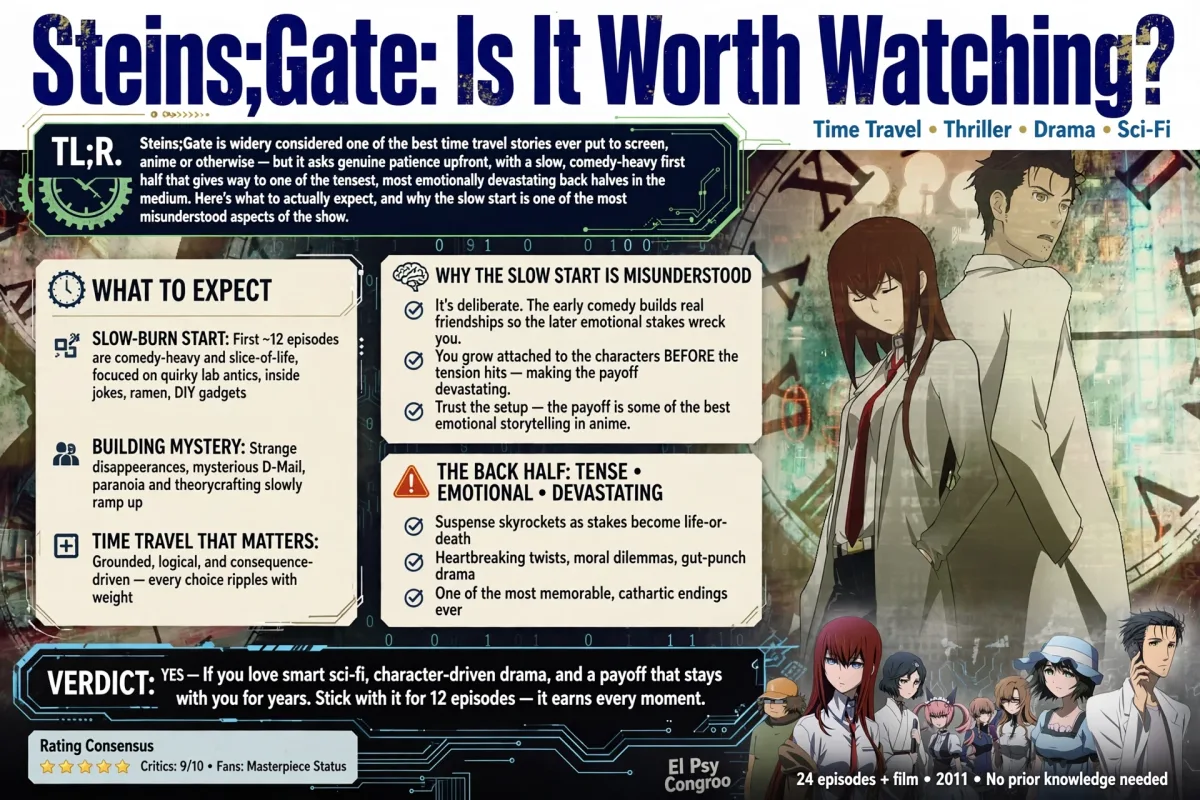
TL;DR — Steins;Gate is widely considered one of the best time travel stories ever put to screen, anime or otherwise, but it asks genuine patience upfront, with a slow, comedy-heavy first half that gives way to one of the tensest, most emotionally devastating back halves in the medium. Here's what to actually expect, and why I think the slow start is one of the most misunderstood aspects of the show.
Get anime picks based on this article
Want a slow burn that pays off with real emotional devastation? Skip the quiz and jump straight to anime picks in that register.
Get anime picksTell us your mood. We'll do the picking.
8 quick questions. Real anime picks from real catalogs — not ads. Free, no sign-up.
Take the quizWhat's the actual premise?
Rintaro Okabe, a self-styled mad scientist running a tiny lab with a handful of friends, accidentally discovers a way to send messages into the past using a modified microwave. What starts as a quirky, low-stakes curiosity spirals into a genuinely harrowing exploration of causality, sacrifice, and the specific, agonizing weight of trying to fix one timeline without destroying everything else you care about in the process.
Why do people warn that the first half is slow?
Because it genuinely is, by design. The early episodes lean heavily into comedic slice-of-life material, establishing the lab members' dynamic and Okabe's eccentric, self-aggrandizing persona, with the actual time travel stakes escalating gradually rather than immediately. Some viewers bounce off this stretch, expecting a tenser sci-fi thriller from the start and getting comedy instead.
Is the slow start actually necessary, or is it just poor pacing?
Genuinely necessary, in my opinion, and this is worth understanding before you start. The back half's emotional devastation only lands as hard as it does because you've spent real time with these characters in their mundane, funny, lower-stakes original state. Okabe's transformation as the stakes rise depends entirely on establishing who he was before the weight of what he discovers changes him. Rushing or skipping the setup would genuinely gut the show's most acclaimed stretch of its actual impact.
How does the show's central time travel mechanic actually work?
Without spoiling specifics, the show is built around the idea that certain events resist being changed no matter how the timeline is altered, a concept the show terms "convergence," while other details can shift more freely. This isn't just technobabble, it becomes the actual emotional and narrative engine of the story's back half, as Okabe discovers just how much he can and can't actually control, no matter how many times he tries.
Do I need to watch the movie or any spinoffs to get the full story?
The main series tells a complete, satisfying story on its own. Steins;Gate 0, a sequel series exploring an alternate path from the original's ending, expands the universe further but isn't required to feel like the original story reached a real conclusion. The film, Steins;Gate: The Movie, Load Region of Déjà Vu, is a direct continuation specifically for viewers who want more after finishing the main series, not essential viewing to understand the core story.
Is this a good anime for someone who doesn't normally watch sci-fi?
Genuinely yes, and I'd push back on anyone assuming otherwise based on the time travel premise. The show's real interest is character and emotional stakes rather than hard science fiction concepts, meaning the sci-fi elements serve the human drama rather than requiring genuine scientific literacy or a background in the genre to follow and appreciate.
What should I do if I find the first several episodes genuinely too slow?
Push through at least to around episode 12 or so before deciding the show isn't for you. This is consistently cited as the point where the tone shifts and the stakes become genuinely gripping, and abandoning the show before that turn means missing the entire reason it has the reputation it does.
Frequently asked questions
Is Steins;Gate's slow start worth pushing through? Yes, genuinely. The comedic setup in the first half is necessary for the emotional weight of the back half to actually land.
Do I need to watch Steins;Gate 0 or the movie? No, the original series tells a complete story on its own. Steins;Gate 0 and the film are for those who want to continue exploring the universe afterward.
Is Steins;Gate too hard science fiction for someone who doesn't like the genre? No, its real focus is character and emotional stakes rather than requiring scientific literacy to follow.
At what point does Steins;Gate's pacing pick up? Around episode 12, which is widely cited as the turning point where the tone shifts from comedic setup to genuine tension.
Want something else with this kind of emotional payoff?
If Steins;Gate's blend of slow burn setup and devastating payoff appeals to you, our anime recommendation quiz can help point you toward something similar.