Guide·Updated September 6, 2026·6 min read·By Harshit Chawla

Suggest Me Something: How Recommendation Quizzes Work

TL;DR — Suggest me something is genuinely one of the most honest, direct things a person can type when they're stuck between endless options and simply want a real answer rather than another wall of choices to evaluate themselves. This guide covers why mood-based recommendation quizzes genuinely work better than browsing a platform's homepage or reading a generic best-of list, what makes a quiz actually useful versus a gimmick, and how to get the best possible match out of one.

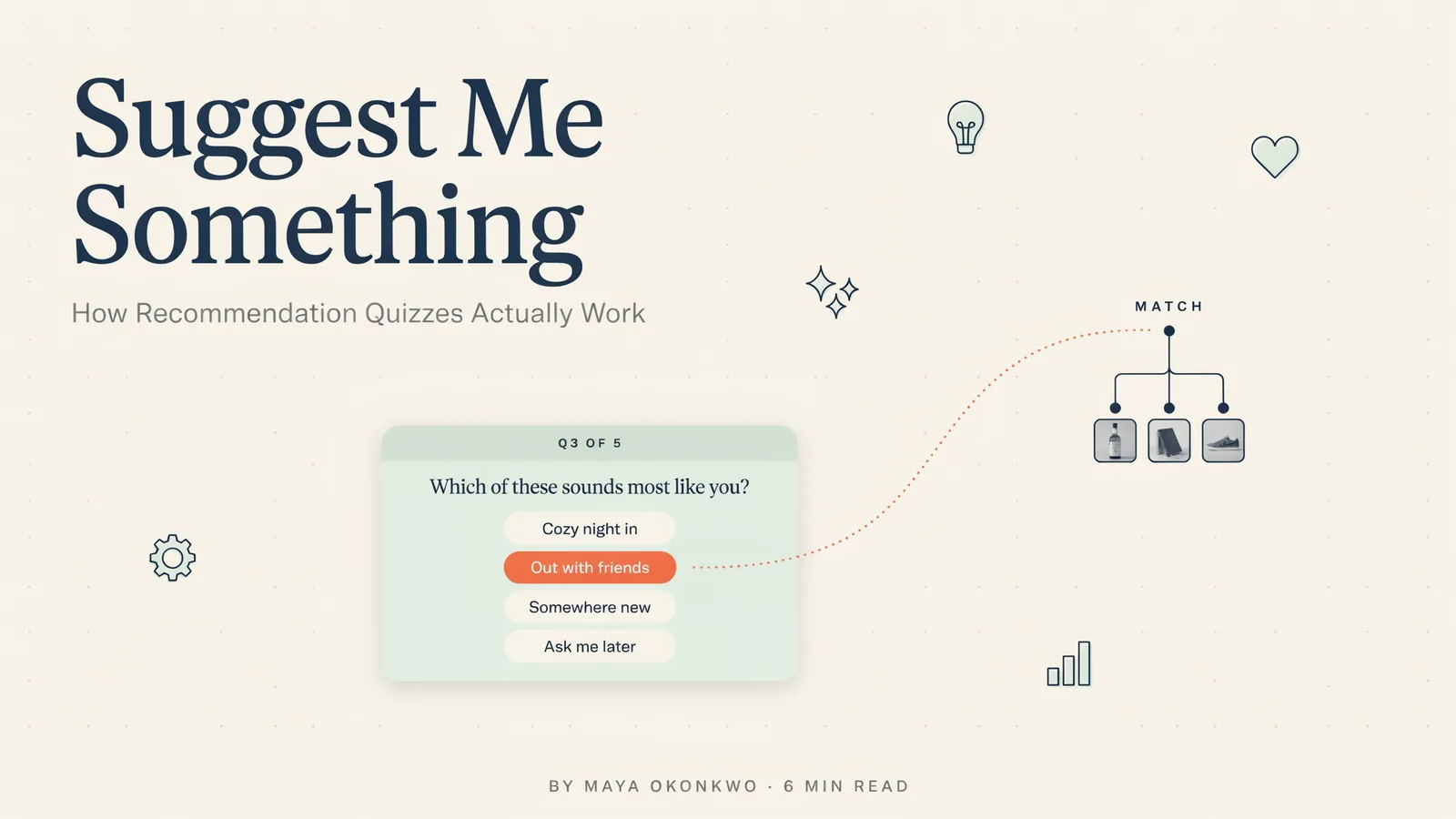
A magazine-style cover reading Suggest Me Something beside a mock quiz screen matching a viewer to a curated set of picks.
A good recommendation quiz does the narrowing work for you, converting an unlimited catalog into one real answer.

Why does "suggest me something" work better as a request than "show me everything available"?

Because a genuinely good suggestion does the narrowing work for you, converting an overwhelming, effectively unlimited catalog into a single, specific, matched recommendation, while "show me everything" simply hands the entire evaluation burden back to you, which is precisely the situation that produces choice paralysis in the first place. The actual value of a suggestion isn't the content itself, most of it exists somewhere in a catalog you already have access to, it's the narrowing, the removal of the burden of evaluating hundreds of alternatives yourself.

What makes a recommendation quiz genuinely useful rather than just a gimmick?

Genuinely, the specificity of the questions asked. A quiz that simply asks you to pick a genre and then returns whatever's currently popular within that category isn't meaningfully different from browsing a platform's genre row, it hasn't actually done any real matching work beyond basic filtering. A genuinely useful quiz asks about mood, energy level, tolerance for emotional intensity, how much time you have, who you're watching or reading with, the same specific factors covered throughout this whole collection of guides, since those factors predict actual satisfaction far better than genre labels alone.

Why does mood matter more than genre for a good recommendation?

Genuinely, because two titles within the exact same genre can serve completely different emotional needs, a gentle, low-stakes comedy and a sharp, biting satire are both technically "comedy," but which one is right for you depends entirely on your actual current state, not your general preference for comedy as a category. A quiz built around mood rather than genre alone captures this distinction directly, rather than leaving you to sort through an entire genre's worth of tonally varied options yourself.

How does a quiz actually differ from a streaming platform's algorithmic recommendations?

Genuinely, in a few important ways. Platform algorithms are typically weighted to promote content the platform has a financial or strategic interest in surfacing, new releases, exclusive content, titles the platform is currently paying to license, regardless of whether that content is genuinely the best match for you specifically in this moment. A dedicated recommendation quiz, when built well, has no such competing incentive, its entire purpose is finding you the best actual match, not promoting specific titles for business reasons unrelated to your satisfaction.

Does a quiz work for every medium, or just movies?

Genuinely, the same underlying approach, ask about mood and specific situational factors rather than just genre, works directly across movies, TV series, anime, books, and music, since the actual psychology of matching entertainment to your current state doesn't fundamentally change based on which medium you're engaging with. What changes is simply the specific vocabulary and factors relevant to each medium, pacing and episode count for TV, page count and chapter structure for books, tempo and lyrical content for music.

What should I actually expect when I take a mood-based recommendation quiz?

Genuinely, expect to answer a small number of specific questions, your current mood, how much time you have, who you're consuming this with, if anyone, and perhaps something about your existing taste or recent favorites, before receiving a small, curated set of matches rather than an overwhelming list. The entire process should genuinely take under two minutes if it's well designed, since the goal is removing decision burden, not adding a new, lengthy evaluation process of its own.

Can a quiz genuinely know me well enough to give a good recommendation from just a few questions?

Genuinely, yes, more than intuition might suggest, precisely because mood and situational factors, rather than deep personal taste profiling, are actually the dominant predictors of whether you'll enjoy something right now. A handful of well-chosen questions about your current state can meaningfully outperform even a detailed personal taste profile that ignores your actual present mood and circumstances.

Should I retake a quiz if I didn't love its first suggestion?

Genuinely, yes, absolutely, and this isn't a sign the quiz failed, moods and circumstances genuinely change from day to day and even hour to hour, and a quiz answered honestly for how you're feeling right now should produce a different, equally valid result on a different day when your actual state has changed.

Is it better to answer a recommendation quiz honestly or based on how I wish I felt?

Genuinely, answer honestly based on your actual current state, not an aspirational version of yourself. If you're genuinely tired and want comfort content but answer as though you're energized and want something demanding, the resulting recommendation will mismatch your actual mood, producing exactly the kind of dissatisfaction this whole approach is designed to avoid.

What's the actual philosophy behind building a recommendation tool around "suggest me something" as a request?

Genuinely, it starts from taking that specific request completely literally and seriously, rather than treating it as a vague, throwaway phrase. When someone genuinely says "suggest me something," they're not asking for a comprehensive catalog, they're asking for the actual burden of choice to be lifted, for someone or something else to do the narrowing work and hand them a real, specific, confident answer rather than more options to evaluate.

My honest take on why this approach genuinely matters more as entertainment catalogs keep growing

I think the sheer scale of content now available across streaming, publishing, and music platforms has genuinely outpaced any individual's realistic capacity to browse and evaluate it all effectively, and that gap is only going to keep widening as catalogs continue to grow. Tools built specifically to close that gap, through genuine mood-matching rather than pure algorithmic popularity-tracking, aren't a minor convenience, they're becoming a genuinely necessary part of actually enjoying the abundance of entertainment now available rather than being paralyzed by it.

Frequently asked questions

Why does "suggest me something" work better than browsing everything myself? A good suggestion does the narrowing work for you, removing the evaluation burden that produces choice paralysis when facing an overwhelming catalog.

What makes a recommendation quiz actually useful rather than just a gimmick? The specificity of its questions; a quiz asking about mood, energy, and situational factors produces far better matches than one simply filtering by genre.

Why does mood matter more than genre for a good recommendation? Two titles in the same genre can serve completely different emotional needs, so mood-based matching captures distinctions genre alone misses entirely.

How is a recommendation quiz different from a streaming platform's algorithm? Platform algorithms are often weighted toward promoting content the platform has a financial interest in, while a dedicated quiz has no such competing incentive.

Does the same recommendation approach work for books and music, not just movies? Yes, genuinely, the same mood-first approach applies across every medium, with the specific relevant factors adjusted for each one.

How long should a good recommendation quiz take to complete? Under two minutes ideally, since the entire purpose is removing decision burden rather than adding a new, lengthy evaluation process.

Should I retake a quiz if I didn't love its first suggestion? Yes, absolutely, since moods and circumstances change, and an honest answer on a different day should produce a different, equally valid result.

Should I answer a quiz honestly or based on how I wish I felt? Honestly, based on your actual current state, since answering aspirationally produces a mismatch between the recommendation and your real mood.

Can a quiz really know me from just a few questions? Yes, genuinely, since mood and situational factors are actually the dominant predictors of enjoyment, often outperforming even detailed taste profiles that ignore your current state.

Why does this kind of tool matter more as entertainment catalogs keep growing? Because the scale of available content has outpaced any individual's realistic capacity to browse it effectively, making genuine mood-matching increasingly necessary rather than a minor convenience.

Ready to actually try it?

Our movie, series, anime, book, and song quizzes put this exact approach into practice, so you can finally stop scrolling and actually watch, read, or listen to something.

Related essays from the Journal

Stranger Things: Tales From '85 Season 2: Everything to KnowAugust 23, 2026The Pitt Season 3: Everything to KnowAugust 21, 2026

More guides like this

Best Series About Poker and High-Stakes GamblingSeptember 2, 2026Best Series Set in PrisonSeptember 2, 2026