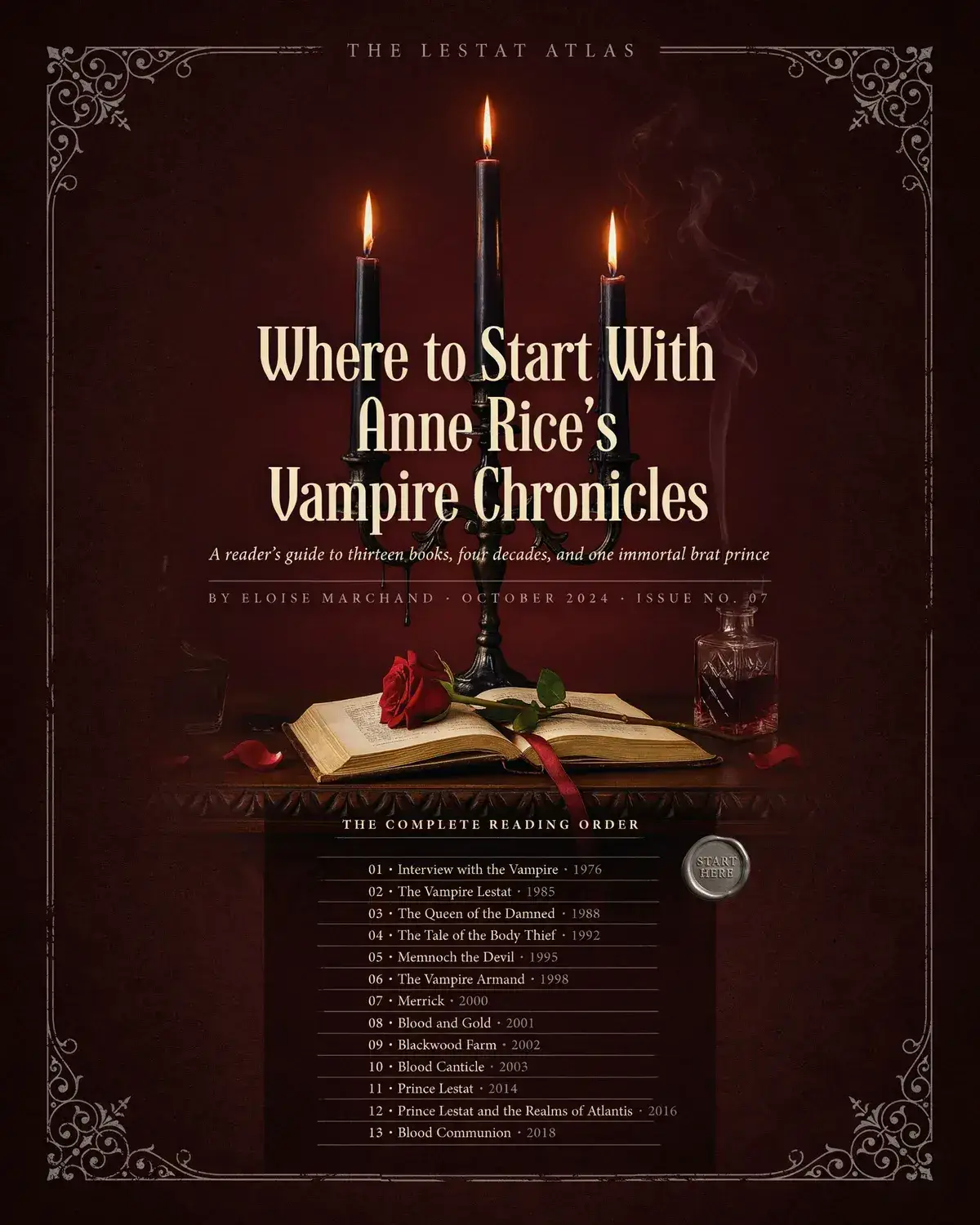
Where to Start With Anne Rice's Vampire Chronicles
TL;DR — Start with Interview with the Vampire, not The Vampire Lestat, even though Lestat becomes the series' central figure and the second book is named after him. Publication order still makes the most sense despite the shifting narrators and decades-spanning scope of the full 13-book series.
Get book picks based on this article
Want your next atmospheric read? Skip the guide and jump straight to picks built for that.
Get book picksTell us your mood. We'll do the picking.
8 quick questions. Real book picks from real catalogs — not ads. Free, no sign-up.
Take the quizThe complete reading order
- Interview with the Vampire (1976)
- The Vampire Lestat (1985)
- The Queen of the Damned (1988)
- The Tale of the Body Thief (1992)
- Memnoch the Devil (1995)
- The Vampire Armand (1998)
- Merrick (2000)
- Blood and Gold (2001)
- Blackwood Farm (2002)
- Blood Canticle (2003)
- Prince Lestat (2014)
- Prince Lestat and the Realms of Atlantis (2016)
- Blood Communion (2018)
Why did Anne Rice write the series with such an unusual narrator structure?
Interview with the Vampire is told entirely from Louis's perspective, framed as an extended confession to a young reporter. Louis is a far more melancholy, guilt-ridden narrator than Lestat, who takes over starting with the second book and becomes the series' central personality. Rice has spoken about how Lestat took on a life of his own beyond his original role as a supporting antagonist in the first book; it was only in writing The Vampire Lestat that she gave him his own voice and let him directly contradict how Louis portrayed him, creating an unreliable-narrator dynamic across the two books that rewards reading them in written order.
Can I skip straight to The Vampire Lestat since he's the title character?
You could — Rice wrote the second book with enough self-contained context that it works reasonably as a starting point. But read Interview with the Vampire first if possible, since Lestat's book directly references, recontextualizes, and often disputes events from Louis's narration, and those moments land with more weight if you've read the original one-sided account first.
How many books are in the full series, and how does the tone shift?
Thirteen total, published across nearly four decades from 1976 through 2018. The tone shifts considerably across that span. The earliest books carry a gothic, brooding intensity concerned with guilt and existential despair. Later entries, from Memnoch the Devil onward, incorporate more explicit theological and metaphysical exploration, reflecting Rice's own evolving relationship with Catholicism. The final trilogy returns to vampire-society political intrigue with Prince Lestat's ascension to leadership.
Do you need to read all thirteen books?
No. The first five or six books cover the series' most foundational, frequently referenced material. Many readers treat that earlier stretch as a complete, satisfying arc and dip into later entries selectively based on which characters or storylines they want more of.
How does the recent TV adaptation fit into this?
AMC's Interview with the Vampire series, which began in 2022, adapts the first novel with significant creative changes — most notably updating the setting and reworking Louis's backstory and racial identity in ways that add thematic layers around race and power in the American South not present in the 1976 novel. It's been well received critically, and its success has contributed to renewed interest in the source novels, introducing a new generation of readers through the show first.
What made Rice's original approach so influential?
Before Interview with the Vampire, vampire fiction largely followed the monstrous framing of Bram Stoker's Dracula. Rice's radical innovation was giving her vampires real interiority — guilt, longing, existential doubt, romantic and sexual complexity — treating them as tragic protagonists rather than antagonists to be defeated. That approach directly influenced decades of subsequent vampire fiction across every medium.
Frequently asked questions
What order should I read the Vampire Chronicles in? Publication order, starting with Interview with the Vampire rather than the Lestat-titled second book.
Can I start with The Vampire Lestat since he's the more famous character? You could, but Interview with the Vampire provides context that makes Lestat's own narration land with more weight and dramatic irony.
How many books are in the full series? Thirteen, published between 1976 and 2018, with the earliest five or six generally considered the core arc.
Why does the series switch narrators between the first two books? Anne Rice has said Lestat took on a life of his own beyond his original role as a supporting antagonist, prompting her to give him his own narrative voice in the sequel.
Does the AMC Interview with the Vampire TV show follow the books closely? It makes significant creative changes to the setting and Louis's backstory, adding new thematic layers not present in the original 1976 novel.
Is Anne Rice considered influential to the vampire fiction genre? Yes, widely credited as one of the most influential figures in shaping vampires as sympathetic, tragic protagonists rather than pure monstrous antagonists.
Do I need to read all thirteen books to understand the core story? No, the first five or six books cover the most foundational material and work as a satisfying complete arc on their own.
How does the tone of the series change across its four-decade span? It shifts from early gothic, guilt-focused intensity toward increasingly explicit theological exploration, and eventually toward vampire political intrigue in the final trilogy.
Want to discover your next great read?
Our book recommendation quiz can help you find something similar.