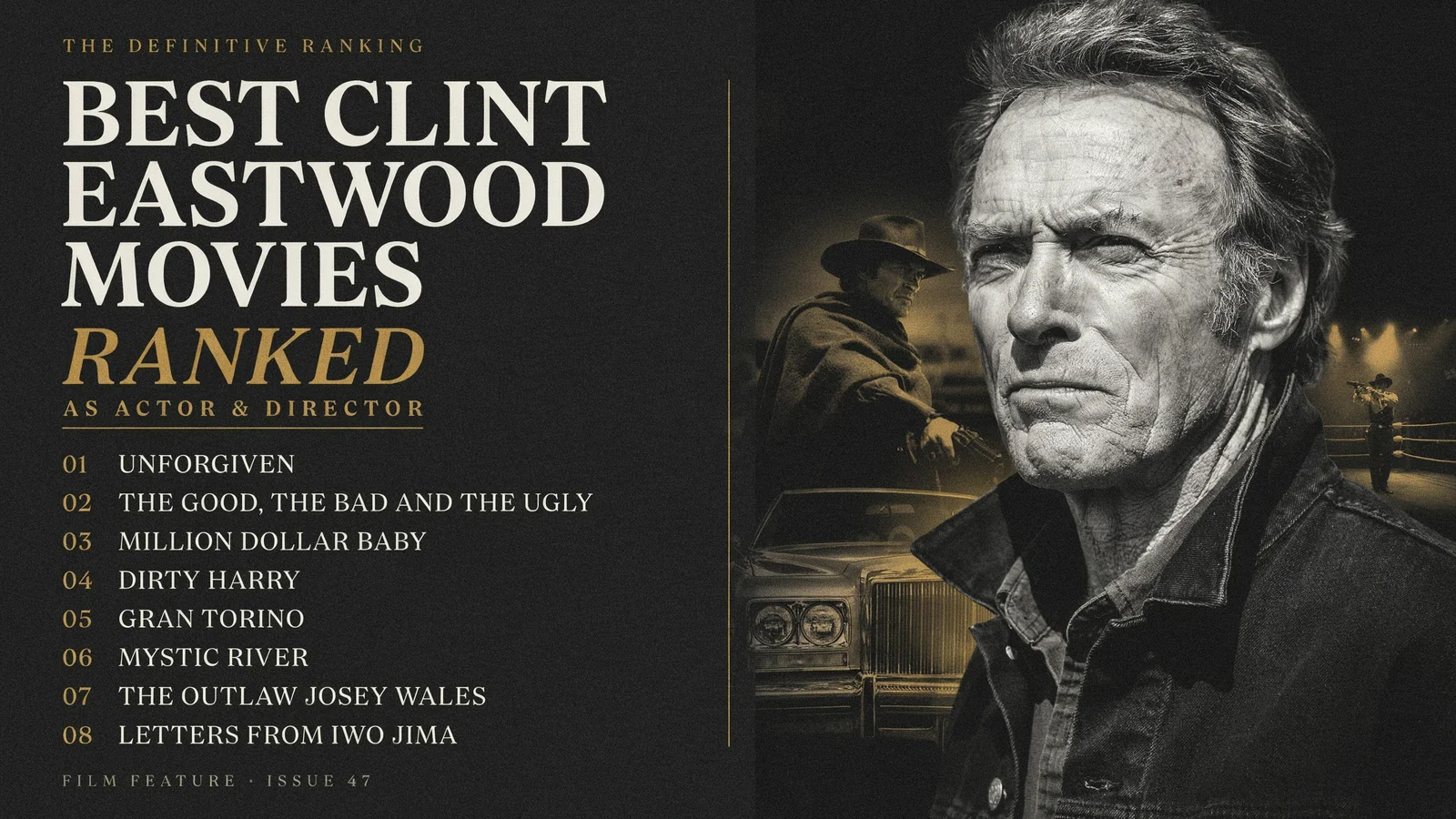
Best Clint Eastwood Movies, Ranked: As Actor and Director
TL;DR — Few figures in film history have had a career quite like Clint Eastwood's, a genuine icon of the Western genre as an actor in the 1960s and 70s who then reinvented himself as one of the most respected and prolific directors in Hollywood, winning multiple Best Director and Best Picture Oscars along the way. His essentials span both sides of the camera, Dirty Harry and the Man with No Name trilogy as an actor, Unforgiven and Million Dollar Baby as a director, with Gran Torino standing as one of the clearest bridges between his iconic on screen persona and his more reflective later directorial work. Here's a ranked, opinionated guide to his most essential films, and an honest take on what makes his late career directorial run so genuinely remarkable.
Get movie picks based on this article
Eastwood's filmography spans seven decades. Get something to watch tonight while you work through this list.
Get movie picksTell us your mood. We'll do the picking.
8 quick questions. Real movie picks from real catalogs — not ads. Free, no sign-up.
Take the quizWhy Clint Eastwood's career needs to be considered in two parts
Unlike almost anyone else on this site, Eastwood's filmography genuinely splits into two distinct, both extraordinarily accomplished careers, one as an actor, largely defined by his icy, laconic Western and cop thriller persona through the 1960s, 70s, and 80s, and a second, even more critically acclaimed run as a director that's continued deep into his nineties. Ranking his work means weighing both halves of that career, and the honest answer is that his directorial output, particularly from the 1990s onward, represents some of the most consistently respected filmmaking of any American director of his generation.
The best Clint Eastwood movies, ranked
1. Unforgiven (1992)
Eastwood's masterpiece, both as director and star, a bleak, morally complicated deconstruction of the exact heroic gunslinger mythology that made him a star in the first place. It won Best Picture and Best Director, and it remains the clearest possible statement of Eastwood using his own iconic persona to interrogate the genre that built his career.
2. The Good, the Bad and the Ugly (1966)
The definitive entry in Sergio Leone's Dollars Trilogy, and arguably the greatest Western ever made. Eastwood's Man with No Name is the character most responsible for his global stardom, and the film's operatic scale, Ennio Morricone's iconic score, and Eastwood's sheer screen presence make it essential viewing regardless of genre preference.
3. Million Dollar Baby (2004)
Eastwood's second Best Picture and Best Director win, a boxing drama that takes a hard, devastating turn in its back half into questions of mortality and mercy. Eastwood also stars, opposite Hilary Swank's Oscar winning performance, in one of the most quietly devastating films of his directorial career.
4. Dirty Harry (1971)
Directed by Don Siegel, Eastwood's Harry Callahan became one of the most iconic and influential characters in American film, a rogue San Francisco police detective whose willingness to bend the rules launched an entire subgenre of maverick cop cinema and one of the most quoted lines in movie history.
5. Mystic River (2003)
One of Eastwood's finest directorial efforts, a devastating drama about childhood trauma and its long shadow over three men's adult lives, anchored by Oscar winning performances from Sean Penn and Tim Robbins.
6. Gran Torino (2008)
Eastwood's own performance as a bitter, racist Korean War veteran who forms an unexpected bond with his Hmong immigrant neighbors is one of his most fully realized late career acting turns, directly engaging with and complicating his own tough guy screen persona in ways that feel genuinely personal.
7. Letters from Iwo Jima (2006) and Flags of Our Fathers (2006)
A remarkable directorial achievement, two companion films made back to back depicting the same World War II battle from both the American and Japanese perspectives, with Letters from Iwo Jima in particular earning acclaim for its empathetic, non-jingoistic portrayal of the Japanese soldiers.
8. Escape from Alcatraz (1979)
One of Eastwood's best pure acting showcases outside the Western and cop thriller genres, playing a real life prisoner attempting one of the few plausible escapes from the infamous island prison, in a restrained, physically precise performance.
9. In the Line of Fire (1993)
A strong late career action thriller performance as a Secret Service agent still haunted by his failure to protect JFK decades earlier, now facing off against a new assassin, played with real menace by John Malkovich.
10. American Sniper (2014)
One of Eastwood's most commercially successful directorial efforts, adapting Chris Kyle's memoir into a film that generated real, substantial debate about its politics and perspective on the Iraq War, alongside widespread praise for Bradley Cooper's central performance.
11. Sully (2016)
A tightly constructed, tense docudrama about pilot Chesley Sullenberger's emergency landing on the Hudson River, with Tom Hanks anchoring the lead role. It's a good example of Eastwood's later career interest in real life stories of quiet, unglamorous heroism.
What about his most divisive later films?
Being honest about Eastwood's full directorial output means acknowledging some genuinely divisive later work, films like The 15:17 to Paris, which controversially cast the real life subjects of its story as themselves rather than professional actors, and Cry Macho, released when Eastwood was in his early nineties, drew mixed reviews and are fair to flag as lesser entries in an otherwise remarkably strong directorial run. That said, even his more uneven later films tend to reflect a director still genuinely curious about new formal approaches well into his tenth decade, which is itself a remarkable thing to be able to say.
My honest take on Clint Eastwood's dual legacy
What makes Eastwood such a fascinating figure to survey is how directly his directorial career engages with and complicates the iconic screen persona his acting career built. The Man with No Name and Dirty Harry are both, in their own ways, mythologized figures of masculine violence and moral certainty, and Unforgiven exists specifically to dismantle that mythology from the inside, using Eastwood's own real, weathered screen presence to argue that violence has genuine, lasting cost rather than the clean heroic payoff his earlier work often implied. That's an extraordinarily rare thing for any actor turned director to attempt, actively interrogating the mythology of your own stardom, and doing it as effectively as Unforgiven does.
I also think his late career directorial output deserves real credit for its sheer sustained quality and curiosity. A lot of directors in their seventies and eighties slow down considerably or settle into safe, familiar territory. Eastwood kept making formally ambitious, genuinely risky films, two simultaneous companion pieces about the same battle from opposing perspectives, a real life story told by casting its actual non-actor subjects, well into an age where most filmmakers have long since stopped taking those kinds of risks. Whatever you think of any individual later film, that sustained creative restlessness is genuinely admirable.
If you're new to his work, start with Unforgiven to see both halves of his career in conversation with each other, then The Good, the Bad and the Ugly for the pure iconic Western stardom, then Mystic River or Million Dollar Baby for the directorial range that's defined his more recent legacy.
Frequently asked questions
What is Clint Eastwood's best movie? Unforgiven is the most frequently cited, both for its own quality and for how directly it engages with his broader career and persona.
How many Oscars has Clint Eastwood won? He's won Best Director and Best Picture twice, for Unforgiven and Million Dollar Baby.
What is Clint Eastwood's most iconic acting role? The Man with No Name from Sergio Leone's Dollars Trilogy and Dirty Harry are both frequently cited as his most influential and recognizable characters.
Is Clint Eastwood still directing? He has continued directing well into his nineties, making him one of the oldest active directors in Hollywood history.
What is Clint Eastwood's most underrated movie? Mystic River and Letters from Iwo Jima are both frequently cited as underappreciated relative to their actual critical acclaim and craft.
Did Clint Eastwood direct Dirty Harry? No, Dirty Harry was directed by Don Siegel, though Eastwood starred in and later directed several sequels in the franchise.
What genre is Clint Eastwood most associated with? The Western, thanks to his early career with Sergio Leone, though his directorial work spans war films, dramas, and biographical films as well.
What is Clint Eastwood's most controversial movie? American Sniper generated significant public debate over its portrayal of the Iraq War and its central real life subject.
Has Clint Eastwood acted in his own directed films? Yes, including Unforgiven, Million Dollar Baby, and Gran Torino, among others.
Where should I start if I only know Clint Eastwood as a director? The Good, the Bad and the Ugly or Dirty Harry, both essential to understanding the screen persona his directorial work later interrogates.
Looking for your next movie night pick?
Take our mood based quiz at https://www.suggestionlabs.com/quiz/movies and let us do the deciding for you.