Coyote vs. Acme: The Shelved Movie That Finally Got Released, Explained
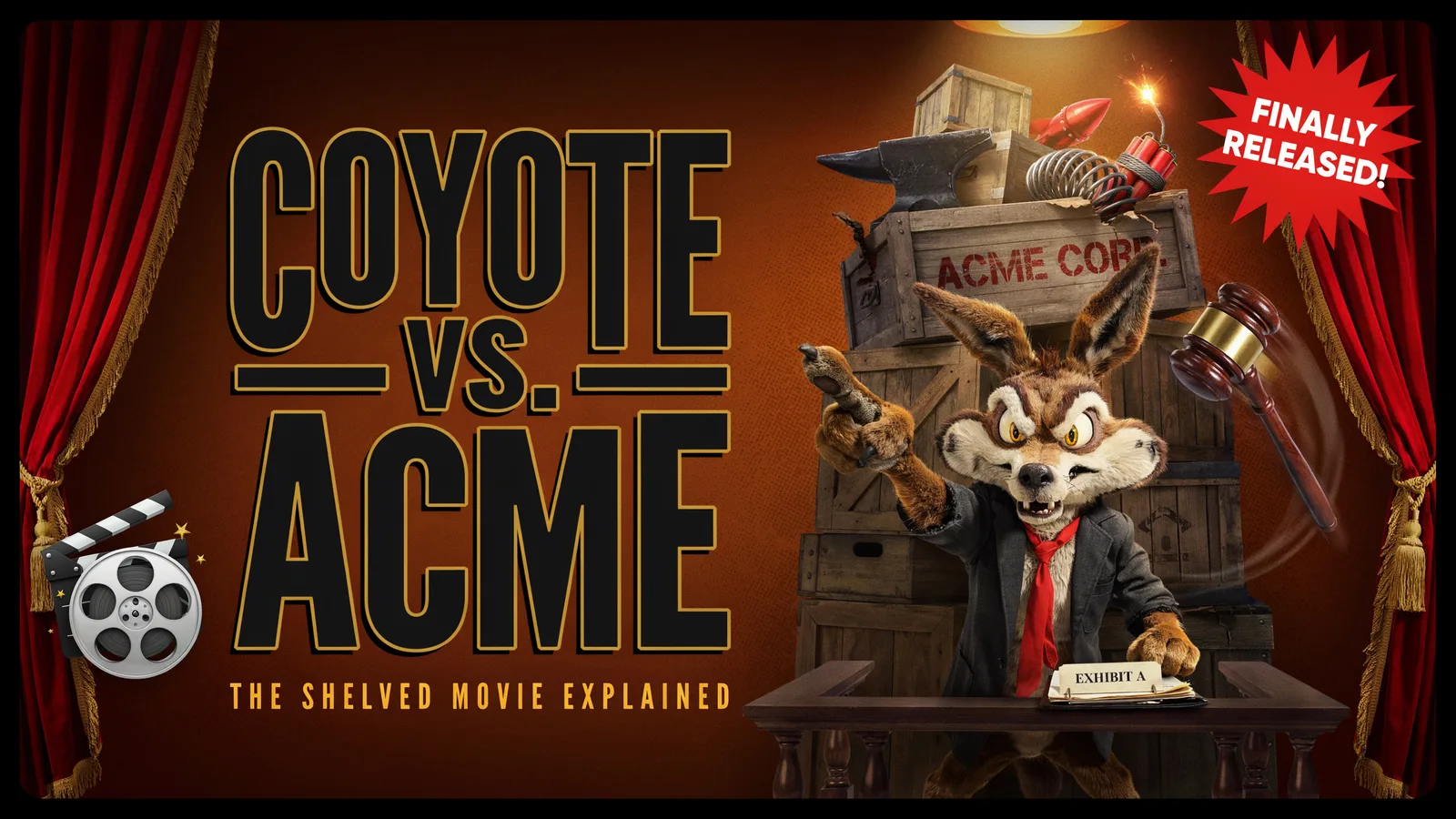
TL;DR — Coyote vs. Acme finally hit theaters August 28, 2026, nearly three years after Warner Bros. Discovery shelved the completed film in November 2023 purely to claim a tax write-off, sparking a genuine industry firestorm. Ketchup Entertainment eventually bought the finished film for roughly $50 million and released it, and it's now sitting at a remarkable 96% on Rotten Tomatoes with an A CinemaScore. Will Forte and John Cena lead the cast in a Looney Tunes-adjacent legal comedy about Wile E. Coyote suing the Acme Corporation. Here's the full saga, plus my honest opinion on why this story matters far beyond one cartoon coyote's day in court.
Get movie picks based on this article
Want another comedy pick with real heart behind the jokes? Skip the search and jump straight to picks built for that.
Get movie picksTell us your mood. We'll do the picking.
8 quick questions. Real movie picks from real catalogs — not ads. Free, no sign-up.
Take the quizWhat is Coyote vs. Acme actually about?
The film follows Wile E. Coyote, tired of decades of exploding products, malfunctioning rocket skates, and anvils that never quite land where they're supposed to, hiring a personal injury attorney to sue the Acme Corporation for selling him defective, dangerous products. Will Forte plays Kevin Avery, the underdog lawyer who takes the case, with Lana Condor as his intern niece Paige Avery helping build it. As the lawsuit proceeds, the story evolves from a comedic legal underdog premise into something with real satirical teeth, uncovering "Project Sisyphus," a scheme that exposes genuine corporate misconduct at the heart of Acme's business.
John Cena plays Buddy Crane, Acme's aggressive opposing counsel, giving the film a genuine comedic and dramatic antagonist beyond just the abstract corporate villainy of Acme itself. Eric Bauza, a voice actor with deep, well-regarded history performing classic Looney Tunes characters, voices multiple roles across the film's animated cast.
Why was Coyote vs. Acme shelved in the first place?
This is one of the more infamous stories in recent Hollywood history, and it's worth understanding the full arc because it says something important about how the modern entertainment industry operates. In November 2023, Warner Bros. Discovery shocked the industry by shelving the fully completed film specifically to claim a $30 million tax write-off, a practice that's become increasingly common in the streaming-consolidation era, where studios can sometimes gain more immediate financial benefit from writing off a finished project's cost than from actually releasing it and hoping for box office or streaming returns.
The decision blindsided the people who'd actually made the film. According to reporting at the time, cast and crew weren't informed of the shelving decision until after it had already happened, which triggered a wave of public backlash from filmmakers, animation professionals, and industry commentators who saw the move as a particularly cynical example of finance-driven decision-making overriding creative and human investment in a finished piece of work.
What happened after the backlash?
Under sustained public pressure, Warner Bros. reversed course by November 13, 2023, just days after the initial shelving decision, agreeing to let the filmmakers shop the completed film to other distributors rather than simply burying it permanently. Netflix, Amazon, and Paramount all reportedly expressed real interest in acquiring the finished film. Warner Bros., however, rejected all of those bids, reportedly demanding a price in the $75 to 80 million range, which none of the interested parties were willing to meet at that time.
The film then sat in limbo for well over a year before Ketchup Entertainment, a distributor with prior success releasing another Looney Tunes-related film, acquired worldwide rights in March 2025 for approximately $50 million, considerably less than Warner Bros.'s original asking price. That gap between the original demand and the eventual sale price is itself a small story about how much leverage and patience mattered in this negotiation, and how a project's perceived value can shift once it's been publicly tainted by a shelving controversy and left sitting for over a year.
How did the film finally get released?
Following the March 2025 sale, Ketchup Entertainment built toward a proper release, with footage debuting at San Diego Comic-Con on July 25, 2026, generating real fan anticipation after years of uncertainty about whether the film would ever see daylight. The full theatrical release followed on August 28, 2026, nearly three full years after the original shelving decision first made headlines.
How was Coyote vs. Acme received once it actually came out?
Remarkably well, and this is really the twist that makes the whole saga so satisfying as a story. The film holds a 96% score on Rotten Tomatoes with a 7.9 out of 10 average rating, alongside a 77 out of 100 "generally favorable" score on Metacritic. It also earned an A grade from CinemaScore, the audience-polling service that tracks how opening-weekend crowds actually respond to a film in real time, which is a strong signal of audience satisfaction beyond just critical praise.
The film opened to $15.9 million domestically, a modest start, but held well and went on to gross roughly $49 million domestic and $69 million worldwide, comfortably clearing its roughly $50 million acquisition cost and turning the years of off-screen corporate drama into a genuine box-office win rather than a footnote. That's a reminder that a rocky, headline-generating road to release doesn't have to end in a box-office shortfall, especially once the film's own quality and a sympathetic backstory both work in its favor with audiences who'd spent years assuming they'd simply never get to see it.
Why does this story matter beyond one cartoon movie?
The Coyote vs. Acme saga became something close to a genuine industry parable during the period it was shelved, cited repeatedly in conversations about the broader trend of studios writing off completed content for tax purposes in the post-streaming-merger landscape. Warner Bros. Discovery, formed through the 2022 merger of WarnerMedia and Discovery, made several similar shelving decisions in the year or so before Coyote vs. Acme, most notably the already-completed Batgirl film in August 2022, which never received any release at all, and Coyote vs. Acme became a specific, sympathetic rallying point precisely because it was built around beloved, decades-old, universally recognizable characters, Wile E. Coyote and the Road Runner, whose fate resonated with a much broader public than a more niche or less iconic project might have.
The eventual happy ending, an acclaimed film finding its way to release and earning both strong reviews and a rare A CinemaScore, gives the whole saga a satisfying narrative arc that a lot of similarly shelved projects (Batgirl chief among them) never got to have. It's become something of a case study in how sustained public pressure and industry backlash can, occasionally, actually change a studio's course, even if it takes years to fully play out.
My honest take on Coyote vs. Acme
I find this whole story fascinating, and I think the film's eventual critical success makes it even more pointed as a piece of industry commentary than it would have been if it had simply been a modest, forgettable comedy. A 96% Rotten Tomatoes score with an A CinemaScore isn't a marginal, "well, it wasn't terrible" outcome; it's a strong reception that retroactively makes Warner Bros.'s original decision to write off the film rather than release it look even more shortsighted in hindsight. This wasn't a mediocre project that got unfairly maligned by a shelving controversy; by most accounts, it was a good film that got caught in a purely financial calculation that had nothing to do with its actual quality.
What strikes me most is the meta-textual irony sitting right at the center of the film's own premise. Coyote vs. Acme is, on its surface, a comedy about a corporation selling defective products and getting away with real harm through corporate maneuvering, until someone finally holds them accountable. That's almost uncomfortably close to the film's own real-world production story: a massive media corporation made a decision that harmed the people who'd invested years of work into a finished product, purely for financial optimization, until public pressure forced a course correction. I have to assume the people who made this film, and certainly plenty of critics reviewing it, didn't miss that parallel, and it probably added a layer of genuine catharsis to watching Wile E. Coyote finally get his day in court against Acme.
I also think this story is worth holding onto as a small but real example of collective industry and public pressure actually working, at least partially. Warner Bros. didn't fully reverse course on their own initiative; they were pushed into allowing the film to be shopped elsewhere by sustained, vocal backlash from filmmakers, critics, and fans. That's not a guaranteed outcome; plenty of similarly shelved projects, Batgirl being the most obvious example, never got that same reversal despite plenty of their own public criticism. What seems to have made the difference here is the specific cultural weight of Looney Tunes as intellectual property, beloved across generations in a way that gave this particular shelving decision an unusually broad and vocal constituency of people upset about it.
For anyone who followed this story as it unfolded over the past three years, actually watching the finished film now carries a real sense of vindication. For anyone coming to it fresh without that context, it sounds like a well-executed, funny, and surprisingly sharp comedy on its own merits, one that uses its Looney Tunes foundation as a launching point for real satirical commentary about corporate accountability rather than just cashing in on nostalgia for classic cartoon characters.
Do you need any prior Looney Tunes knowledge to enjoy this?
Not really. While the affection for Wile E. Coyote and the Road Runner runs deeper if you grew up on the classic Looney Tunes shorts, the film's core premise, a legal comedy about corporate accountability with a charismatic human cast anchoring the story, works on its own terms even without deep prior nostalgia for the source material.
Frequently asked questions
When did Coyote vs. Acme finally release? August 28, 2026, in the United States.
Why was the film originally shelved? Warner Bros. Discovery shelved it in November 2023 specifically to claim a tax write-off, without informing the cast and crew beforehand.
Who eventually bought and released the film? Ketchup Entertainment, acquiring worldwide rights in March 2025 for approximately $50 million.
What is the film's Rotten Tomatoes score? 96%, with a 7.9 out of 10 average critic rating.
Who stars in Coyote vs. Acme? Will Forte as Kevin Avery, John Cena as Buddy Crane, and Lana Condor as Paige Avery, with Eric Bauza voicing multiple classic Looney Tunes characters.
What is the film's plot? Wile E. Coyote hires a personal injury lawyer to sue the Acme Corporation for selling him defective products, uncovering a larger corporate conspiracy along the way.
How much did the film make at the box office? It opened to $15.9 million domestically, then went on to gross roughly $49 million domestic and $69 million worldwide, clearing its acquisition cost.
What was the CinemaScore grade? A, indicating very strong audience satisfaction.
Is this connected to any other recent Looney Tunes projects? Ketchup Entertainment previously found success distributing another Looney Tunes film before acquiring Coyote vs. Acme.
Was any other studio, like Batgirl's team, able to get their shelved film released? No, Batgirl, shelved roughly a year before Coyote vs. Acme, never received any release, making Coyote vs. Acme's outcome a notable exception.
Looking for your next comedy pick?
If sharp, character-driven comedies with real bite are your thing, our movie recommendation quiz can help you find your next watch tonight.