Gandhari on Netflix: Is Taapsee Pannu's Revenge Thriller Worth Watching?
TL;DR — Gandhari premiered on Netflix September 3, 2026, starring Taapsee Pannu as a mother whose daughter is kidnapped at a train station, an event that leaves her temporarily blind and sets her on a path toward uncovering a sex trafficking network called "The Blackhole." Directed by Devashish Makhija and written and produced by Kanika Dhillon, the film aims for the kind of righteous, transformation-driven revenge-thriller territory that's become a recognizable subgenre in recent Indian cinema. Critics were largely unconvinced, with the film landing at just 23% on Rotten Tomatoes. Here's everything confirmed, plus my honest opinion on why ambitious social-issue thrillers like this one so often stumble in execution even when their intentions are clearly sincere.
Get movie picks based on this article
Want another intense, morally complicated revenge story? Skip the search and jump straight to picks built for that.
Get movie picksTell us your mood. We'll do the picking.
8 quick questions. Real movie picks from real catalogs — not ads. Free, no sign-up.
Take the quizWhat is Gandhari about?
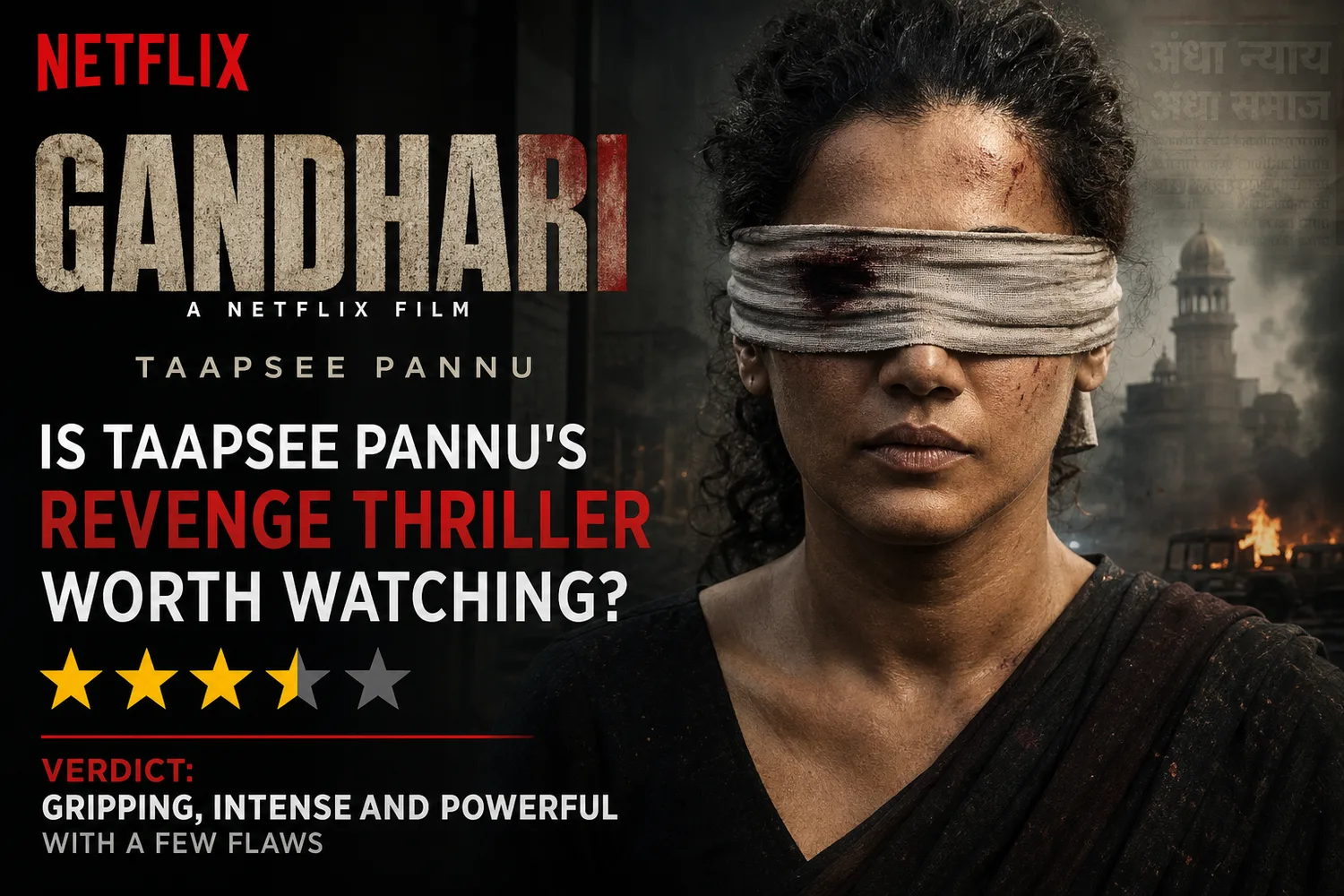
The story follows Bani, a mother who loses her young daughter at a train station in the fictional town of Joypurra. In the desperate chaos of pursuing the kidnapper, Bani suffers a violent attack that leaves her temporarily blind. Rather than being sidelined by that injury, she pushes forward, filing a police complaint that gradually uncovers something far larger and more disturbing than a single kidnapping: a sex trafficking network operating under the name "The Blackhole," responsible for abducting and moving children, including her own daughter, toward being trafficked abroad.
As Bani's investigation deepens, the film frames her journey as a genuine transformation, from a grieving, temporarily disabled mother into a formidable, vigilante-coded force determined to rescue her daughter and the network's other victims before it's too late. The title itself draws directly from Hindu mythology, referencing Gandhari, the blindfolded queen from the Mahabharata whose choice to voluntarily blind herself out of solidarity with her blind husband has long been interpreted as a complex symbol of both devotion and willful blindness to injustice, a mythological resonance that the film's plot (a mother's literal, injury-induced blindness becoming intertwined with her fight against a hidden evil) leans on directly.
Who's in the cast?
Taapsee Pannu has built a distinctive career niche in exactly this kind of socially conscious, issue-driven thriller, having starred in several prior films built around women confronting institutional injustice and violence (Pink and Thappad being two of the most acclaimed examples from earlier in her career). That established reputation makes her a logical, credible lead for a story like Gandhari's, an actress audiences already associate with exactly this specific brand of righteous, morally serious confrontation cinema.
- Taapsee Pannu as Bani
- Ishwak Singh as Gokul
- Chhaya Kadam as Uma Didi
- Swastika Mukherjee as Churni Didi
- Mita Vashisht as Jhunu Amba
- Jatin Sarna as Kabir
- Prashant Narayanan as Dada
- Chandan Roy as Somesh
Who's behind the film creatively?
Devashish Makhija directs, working from a screenplay written by Kanika Dhillon, who also produced the film. Dhillon has become one of the more prominent screenwriters in contemporary Hindi cinema, known for tackling difficult, socially resonant material across her filmography. Cinematographer Amit Roy and a composing team that includes Shor Police, Clinton Cerejo, and Bianca Gomes round out the film's core creative crew.
Where and when was the film made?
Principal photography took place from December 18, 2024 to March 17, 2025, across locations in Mumbai and Maharashtra. The film was first announced back in September 2024, and Kathha Pictures produced the project for Netflix distribution, with the film releasing in Hindi, Tamil, Telugu, and English audio tracks to reach as broad an audience as possible across Netflix's Indian and international subscriber base.
How was Gandhari received critically?
Not particularly well, unfortunately, despite the clearly sincere intentions behind the project. The film sits at just 23% on Rotten Tomatoes from available critic reviews, with a 4.5 out of 10 average rating. Critics specifically flagged tonal inconsistency and narrative structure issues, with the film described in some reviews as "convoluted" and as suffering from what one review characterized as being "a tonal mess."
Why do socially conscious revenge thrillers like this one so often struggle with tone?
This is worth examining honestly, because it's a recurring pattern across this specific subgenre, not just this individual film. Stories built around real, deeply serious social issues (child trafficking here specifically) carry an inherent tension between honoring the genuine gravity and horror of that subject matter and delivering the kind of propulsive, satisfying genre thrills that a revenge-thriller structure typically promises audiences. Lean too far into grim realism and you risk a film that feels punishing or exploitative of its subject matter without offering audiences the cathartic payoff the genre's structure implicitly promises; lean too far into stylized, empowering vigilante-thriller catharsis and you risk trivializing or sensationalizing a horrific real-world issue for entertainment purposes.
That's precisely the tightrope a film like Gandhari has to walk, and based on the specific critical language used, "tonal mess" and "convoluted," it sounds like the finished film may not have found a consistent enough register to fully satisfy either the social-realist or the genre-thriller side of that equation, ending up caught somewhere uncomfortably between the two rather than fully committing to either approach.
How does this fit into the broader landscape of Indian vigilante-mother thrillers?
Gandhari isn't operating in a vacuum; stories centered on mothers transformed into formidable, vigilante-coded forces by violence against their children have become a recognizable and reliably popular structure across recent Indian cinema and streaming content specifically, tapping into deep cultural resonance around motherhood, protection, and righteous vengeance against institutional failure or criminal predation. When executed well, that structure can produce powerful, cathartic cinema; when the execution stumbles on pacing, tone, or narrative clarity, as critics suggest happened here, the same structure can instead feel like a missed opportunity relative to its important subject matter.
My honest take on Gandhari
I think this is a well-intentioned film that appears to have stumbled on execution rather than ambition, and I want to be fair about separating those two things when evaluating it. Taking on child trafficking as subject matter requires real courage and a genuine sense of social responsibility from a filmmaking team, this isn't comfortable, easily marketable content, and Kanika Dhillon's track record of engaging with difficult, socially resonant material suggests the sincerity behind this project is genuine rather than opportunistic.
Where I think the film likely struggled, based on the specific critical feedback about tone and narrative coherence, is in the difficult structural work of building a story that honors both the visceral, mythologically resonant symbolism of a blinded mother (echoing Gandhari's own story from the Mahabharata) and the grounded, procedural mechanics of actually uncovering and dismantling a criminal trafficking network. Those are two quite different narrative modes, one operating in a register of heightened, almost allegorical symbolism, the other requiring grounded investigative plausibility, and successfully blending them within a single two-hour film is a difficult writing challenge that a lot of similarly ambitious social-issue thrillers have struggled with before this one.
Taapsee Pannu's involvement gives me real confidence in at least the performance side of the equation; she's consistently proven capable of carrying exactly this kind of emotionally demanding, morally serious material with genuine conviction, even when the films surrounding her performances haven't always fully matched her commitment. If the film's core weaknesses are structural and tonal rather than rooted in weak central performances, that's actually a somewhat more forgivable kind of stumble, the kind that reflects an overly ambitious creative swing rather than a fundamentally hollow or cynical production.
I'd still recommend approaching this one with tempered expectations given the critical consensus, but for viewers specifically drawn to socially conscious Indian thrillers and to Taapsee Pannu's specific body of work in this space, there's likely still real value here, even within a film that critics broadly agree didn't fully realize its ambitions.
Do you need any specific cultural or mythological context to understand the title?
Not strictly necessary to follow the plot, but understanding the mythological reference, Gandhari from the Mahabharata choosing blindness as an act of solidarity and devotion, adds a meaningful additional layer to how the film frames its protagonist's own journey through literal and metaphorical blindness toward eventual clarity and action.
Frequently asked questions
When did Gandhari release? September 3, 2026, on Netflix.
Who stars in Gandhari? Taapsee Pannu as Bani, alongside Ishwak Singh, Chhaya Kadam, and Swastika Mukherjee.
Who directs the film? Devashish Makhija, from a screenplay by Kanika Dhillon.
What is the film's Rotten Tomatoes score? 23%, with a 4.5 out of 10 average critic rating.
What is the plot about? A mother, blinded during her daughter's kidnapping, uncovers and confronts a child trafficking network called "The Blackhole."
Where was the film shot? Mumbai and Maharashtra, from December 2024 to March 2025.
What languages is the film available in? Hindi, Tamil, Telugu, and English.
What does the title "Gandhari" reference? The blindfolded queen from the Hindu epic the Mahabharata.
Is this connected to any other Taapsee Pannu films? Not directly, though it continues her established pattern of starring in socially conscious thrillers like Pink and Thappad.
What was the main critical complaint about the film? Tonal inconsistency and a convoluted narrative structure.
Looking for your next intense thriller pick?
If morally serious, issue-driven thrillers are your thing, our movie recommendation quiz can help you find your next watch tonight.