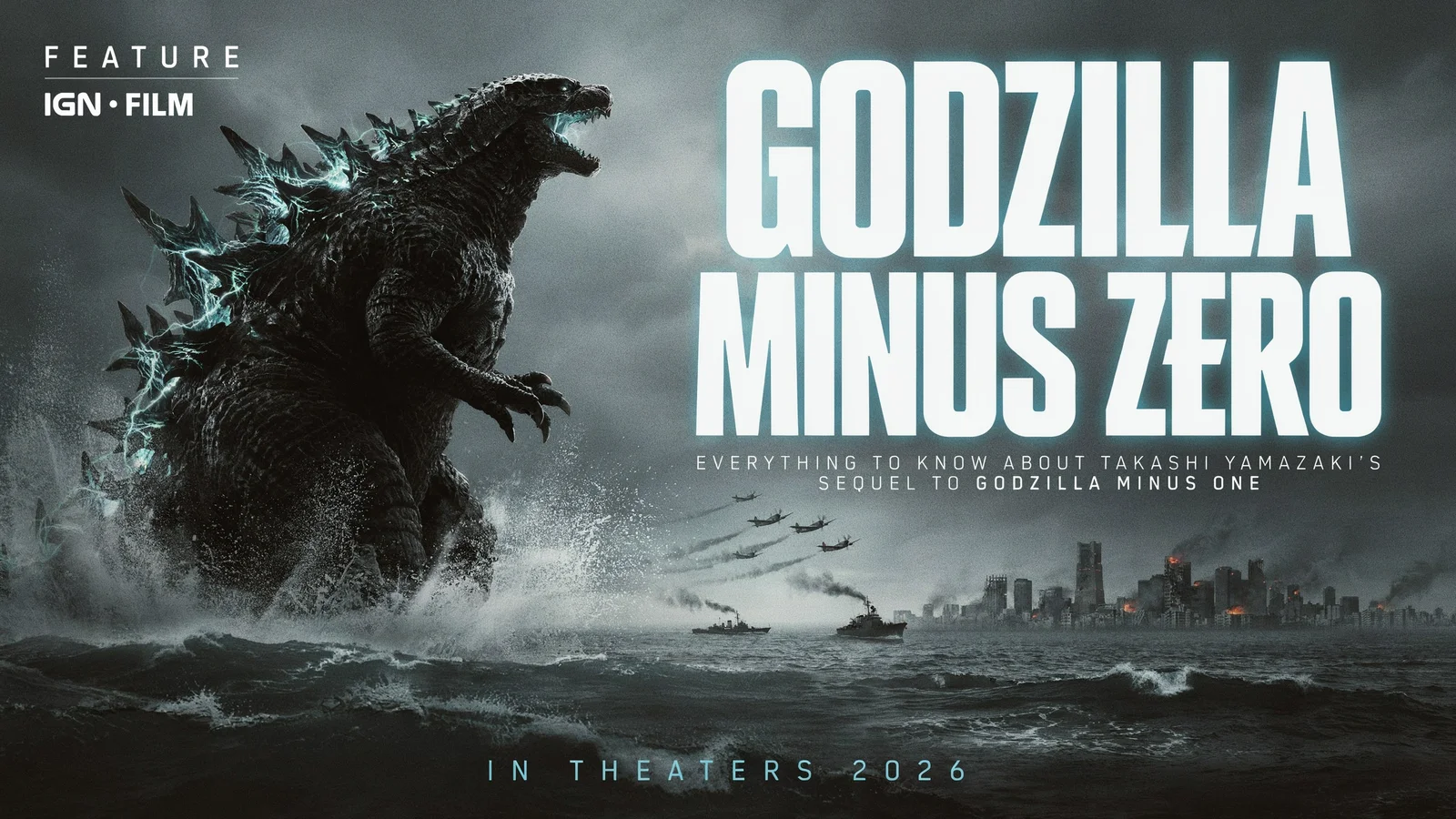
Godzilla Minus Zero: Everything to Know About Takashi Yamazaki's Sequel to Godzilla Minus One
TL;DR — Godzilla Minus Zero is writer, director and visual effects supervisor Takashi Yamazaki's direct sequel to Godzilla Minus One, the 2023 film that won the Oscar for Best Visual Effects on a budget Yamazaki has put at somewhere within $10 to $15 million. The sequel is set in 1949, two years after the first film, and continues the story of Koichi Shikishima (Ryunosuke Kamiki), his wife Noriko (Minami Hamabe) and their adopted daughter Akiko (Sae Nagatani). It has its world premiere as a Spotlight Gala at the 64th New York Film Festival on September 26, 2026, opens in Japan on November 3, 2026 (Godzilla Day, the 72nd anniversary of the 1954 original), and opens wide in North America through GKIDS on November 6, 2026, the first near-simultaneous Japan and North America launch for a Japanese Godzilla film. It runs 135 minutes, is the first Japanese production filmed for IMAX, and carries an R rating in the U.S. for "some violent content/bloody images," a first for the franchise. The September 8 trailer confirms Godzilla survived and ends on a roar that many outlets have read as King Ghidorah. Catch up with Minus One first, then the 1954 original if you have time.
Get movie picks based on this article
Six weeks is a long wait for Minus Zero. Get a pick made for your mood while you count down.
Get movie picksTell us your mood. We'll do the picking.
8 quick questions. Real movie picks from real catalogs — not ads. Free, no sign-up.
Take the quizWhat is Godzilla Minus Zero?
Godzilla Minus Zero is the next chapter in the Japanese Godzilla series produced by Toho, and it is a true continuation rather than a reboot. When Takashi Yamazaki introduced the first footage at CinemaCon in Las Vegas on April 14, 2026, he was blunt about it, telling the audience, as reported by The Hollywood Reporter: "This film will be a direct sequel to Godzilla Minus One. It will continue to follow the story of the Shikishima family." That sentence matters more than it might seem. Toho's Godzilla films have historically reset their continuity every few entries, and Yamazaki's decision to carry the same characters forward is itself a statement about what he thinks made Minus One work: not just the monster, but the people living underneath it.
Yamazaki once again wears three hats. He wrote the screenplay, directed the film and supervised the visual effects, which were produced by Shirogumi Inc., the Tokyo effects house where he has worked since 1986. The film is produced by Toho Studios and ROBOT, with music by Naoki Sato, who also scored Minus One. Toho distributes in Japan and GKIDS handles North America.
According to the official synopsis released by Toho and GKIDS, the film picks up after Japan has spent two painful years rebuilding: "War reduced Japan to zero, and Godzilla plunged it into minus. Two years have passed since then, and the country has faced agonizing struggles to achieve recovery and finally reclaim its daily life. Just as humanity managed to cling to a hard-won peace, a new threat strikes, crushing hope in an instant. There is no third time. Everything ends here."
That last line is the one that caught my attention the first time I read it. "There is no third time. Everything ends here" is not the phrasing of a studio setting up a long-running franchise. It reads like a promise that this story, the Shikishima story, has an ending, and that Minus Zero is it. I will come back to that in my own take, but it is worth holding in mind as you read the rest of what has been confirmed.
When does Godzilla Minus Zero come out?
The dates are now locked, and they are unusually close together across the Pacific. Here is the confirmed rollout as announced by Toho, GKIDS and the festivals involved.
The world premiere is Saturday, September 26, 2026, at 6:00 p.m. at Alice Tully Hall in New York, as a Spotlight Gala of the 64th New York Film Festival, which runs from September 25 to October 12. Film at Lincoln Center's listing says the gala includes a Q&A with Yamazaki, Ryunosuke Kamiki and Minami Hamabe, with additional festival screenings on September 27 and September 30. The screenings are presented in Dolby Cinema at Alice Tully Hall, in Japanese with English subtitles.
The film then crosses to the United Kingdom, where the BFI London Film Festival has scheduled screenings on Wednesday, October 14 and Friday, October 16, both at 5:30 p.m. Back home in Japan, the 39th Tokyo International Film Festival, which runs from October 26 to November 4, 2026, has named Godzilla Minus Zero its Centerpiece selection. The festival's programming director described it as "a true sequel to Godzilla Minus One" that "brings a powerful new interpretation of Godzilla, delivering a level of surprise that far exceeds expectations."
The theatrical release in Japan is Tuesday, November 3, 2026. That date is not random. November 3 is Godzilla Day, the anniversary of the original Godzilla's nationwide Japanese release in 1954, and GKIDS noted that 2026 marks the 72nd anniversary. Minus One also opened in Japan on November 3, back in 2023.
The North American wide theatrical release is Friday, November 6, 2026, through GKIDS. According to GKIDS, this is the first time a Japan-produced Godzilla film has had a simultaneous rollout in Japan and North America. For context, Minus One opened in Japan on November 3, 2023, and in the U.S. on December 1, 2023, a gap of about four weeks. Closing that gap to three days is a sign of how much the American audience now matters to Toho.
Other territories follow quickly. GKIDS said in July that the film will open the same week across Latin America, Europe, Asia, the Middle East, Australia and New Zealand, and the fan encyclopedia Wikizilla tracks further dates later in November for markets such as Italy.
Toho has also been leaning into American promotion in a way that would have been hard to imagine a few years ago. Tonight, September 24, 2026, the Los Angeles Dodgers are holding Godzilla Minus Zero Night at Dodger Stadium for their regular-season home finale against the San Diego Padres. The team's press release promises a Godzilla Minus Zero bobblehead for the first 40,000 fans and a Godzilla-themed drone show after the game, and Kaiju United reported that Ryunosuke Kamiki is set to throw the ceremonial first pitch. Keiji Ota, whose title at Toho is literally Chief Godzilla Officer, said in the Dodgers' announcement that "Godzilla's overwhelming presence and monumental scale will fuse with the dynamic energy of the Dodgers." A Japanese monster movie getting a baseball night in Los Angeles six weeks before release tells you everything about how the Minus One effect changed the business.
How long is Godzilla Minus Zero, and is it really rated R?
Godzilla Minus Zero runs 135 minutes, according to both the New York Film Festival and BFI London Film Festival listings. That makes it noticeably longer than Minus One and, by Wikizilla's count, the longest Japanese Godzilla film to date. Yamazaki clearly has more story to tell, and more set pieces to stage, than he did last time.
The rating news broke this week. The Motion Picture Association has rated the film R for "some violent content/bloody images," as reported by World of Reel and iHorror on September 23. Multiple outlets have described it as the first R-rated film in the franchise's more than 70-year history. As iHorror pointed out, the descriptor mentions nothing about language, nudity or drug use, which suggests the rating comes purely from how graphic the destruction and injuries are. The BFI's listing carries a similar content warning for "scenes of graphic violence or injury." In Japan, Wikizilla lists the film's rating as G.
If you are planning a family outing, take that seriously. Minus One was already intense, with scenes of people being crushed, drowned and caught in the aftermath of Godzilla's atomic breath. An R rating for the sequel suggests Yamazaki has not softened anything, and may have pushed further. Parents of younger kids who loved Minus One on Netflix should probably watch this one first before deciding.
Is Godzilla Minus Zero filmed for IMAX?
Yes, and this is one of the more genuinely historic details about the production. Toho and GKIDS have confirmed that Godzilla Minus Zero is the first Japanese production shot for IMAX, filmed with high-definition digital cameras certified by IMAX and "optimized in sound and imagery unique to IMAX screens." Anime News Network reported that it is the first Japanese film to meet the standard to advertise itself as "Filmed for IMAX."
No Film School's breakdown of the full trailer highlights a shot of a seaplane skimming across the water as the frame expands into IMAX's taller 1.43:1 aspect ratio. That expanded-ratio moment is precisely the kind of thing that justifies seeing a film like this on the biggest screen you can reach. Wikizilla's production notes say filming took place in Ibaraki Prefecture in Japan, with additional international location work in New Zealand and Norway in late 2025, and Wikipedia lists principal photography as running from August to December 2025.
My advice is simple: if there is an IMAX screen within reasonable driving distance of you, book it early. Minus One became a word-of-mouth hit partly because audiences told each other to see it big, and this time the filmmakers have actually shot for that format from the ground up.
Who is in the cast of Godzilla Minus Zero?
Most of the core Minus One ensemble is back, alongside several notable additions. The official cast, as confirmed by Toho and GKIDS across the July and September announcements, is below.
Returning from Godzilla Minus One: - Ryunosuke Kamiki as Koichi Shikishima, the former kamikaze pilot at the center of the story - Minami Hamabe as Noriko Shikishima, now Koichi's wife - Sae Nagatani as Akiko, the couple's adopted daughter - Hidetaka Yoshioka as Kenji Noda, the former naval engineer, now listed as director of a large-scale disaster response bureau - Yuki Yamada as Shiro Mizushima, the young crewmate from the minesweeper Shinsei Maru - Kuranosuke Sasaki as Seiji Akitsu, captain of the Shinsei Maru - Sakura Ando as Sumiko Ota, the Shikishimas' neighbor, now listed as head of an orphanage - Miou Tanaka as Tatsuo Hotta, the former captain of the destroyer Yukikaze - Motosuke Iida as Akio Itagaki
New to the series: - Min Tanaka as Kanji Murakami, described by GKIDS as a "war-scarred biologist" - Masami Nagasawa as Makoto Aoyama, a weather forecaster - Jun Kunimura as Dr. Ogata - Ko Maehara as Akira Hagiwara, Professor Murakami's assistant - Kenji Misuhashi, Eita Okuno and Kai Inowaki in as-yet-undescribed roles
A few things jump out from that list. The first is that Noriko's surname has changed. In Minus One she was Noriko Oishi, living with Koichi but not married to him, and the sequel's materials now list her as Noriko Shikishima. The BFI's synopsis explicitly describes the family as "pilot Koichi, his wife Noriko, and adoptive daughter Akiko." That is a small detail, but after everything those characters survived, it lands with real warmth.
The second is Noda's new job title. Wikipedia lists Yoshioka's character as director of a Large-Scale Disaster Response Bureau, which suggests that postwar Japan has built some kind of institutional machinery in response to the last attack. Minus One was defined by the absence of a functioning government response, with civilians and veterans forced to organize their own operation, as the government kept the threat quiet. If the state now has a Godzilla desk, that alone changes the dramatic texture.
The third is the arrival of Min Tanaka as a biologist. Giving the sequel a scientist character with his own war trauma hints that the film will spend more time trying to understand what Godzilla is. A new biologist character is also a nod, whether intentional or not, to the scientists who have anchored Godzilla films since Dr. Serizawa and his Oxygen Destroyer in 1954.
One name you will notice is missing from the official lists is Munetaka Aoki, who played the mechanic Sosaku Tachibana in Minus One. Nothing has been announced about Tachibana either way, and I would not read too much into that absence until people have actually seen the film.
What do we actually know about the plot?
Less than you might think, and I respect Toho for that. The studio has been disciplined about keeping story specifics out of the marketing, and most of what we know comes from the official synopsis, the trailers and a handful of Yamazaki's own comments. Here is what has been confirmed, and I will flag clearly where confirmation ends and fan interpretation begins.
The setting is 1949, two years after the events of Minus One. The Shikishima family is trying to live a normal life. The BFI's synopsis adds one ominous line that is not in the U.S. materials: "Meanwhile, at the bottom of the sea, something is stirring."
Godzilla is back. GKIDS' September 8 announcement for the full trailer says outright that it "confirms Godzilla's survival" and showcases "the latest kaiju extermination operation." No Film School's scene-by-scene breakdown identifies that operation by name as Operation Narukami, and notes a scene in which Masami Nagasawa's character, Ms. Aoyama, proposes a "Plan B" that receives military approval. Wikizilla notes that Narukami, a name associated with the Japanese thunder god, continues a pattern of mythological or poetic operation names in modern Toho films, following Minus One's Operation Wadatsumi and Shin Godzilla's Operation Yashiori.
The story goes international. The first teaser, shown at CinemaCon and released online in April, ends with Godzilla advancing through New York City toward the Statue of Liberty. That image generated enormous coverage, and Yamazaki explained the inspiration in an interview with Gold Derby, as quoted by Bloody Disgusting: "I was thinking of Cloverfield. The scene when the head of the Statue of Liberty comes flying towards you left a huge impression when I saw it. I wanted to capture that same kind of emotion here." He went further, adding: "When people find out what Godzilla is trying to do and what its motive is in that scene, everyone is going to be floored."
That quote is fascinating to me, because "motive" is not a word you usually attach to Godzilla. In Minus One, Godzilla was essentially a force of nature with a grudge, an avenging spirit rather than a character. Yamazaki is suggesting that the New York sequence has a reason behind it that the audience will understand in context. I have no idea what that reason is, and neither does anyone else outside the production.
The teaser also includes a line of dialogue, reported by The Hollywood Reporter: "If their operation fails, maybe we'll finally get to use it." The obvious reading, in a film set in 1949 in a world where the United States had already used atomic weapons in war, is that someone is talking about a weapon of last resort. But that is interpretation, not confirmation, and the film has not said who "they" or "we" are.
Yamazaki has also framed the emotional stakes in unmistakably dark terms. At CinemaCon he told the audience, per The Hollywood Reporter: "In this new film, an even deeper despair will descend upon Japan and the Shikishima family. When faced with overwhelming and inescapable force, how do people fight back?" And in his statement for the New York premiere, quoted by the Motion Picture Association's publication The Credits, he said he was "filled with both awe and excitement to see how far the power of Japan's Godzilla can terrify audiences around the world, and whether they will resonate with what lies beyond that fear."
That phrase, "what lies beyond that fear," is the closest thing to a thesis statement Yamazaki has offered. Minus One was about a man who could not forgive himself learning that surviving is not a failure. My guess is that Minus Zero is about what a family, and a country, owes to the future once it has survived. But that is my guess, and I want to be clear it is only that.
Is King Ghidorah in Godzilla Minus Zero?
This is the question dominating fan discussion right now, and the honest answer is: very probably, but it depends on how strict you want to be about the word "confirmed."
The full trailer, released September 8, ends with a distinctive cry heard over a shot that No Film School describes as Godzilla's body falling from the sky. Outlets including ComicBookMovie, Screen Rant and CBR have reported that the trailer reveals King Ghidorah, the golden three-headed dragon, as the sequel's second monster, and Wikizilla now lists King Ghidorah among the film's monsters. Nerdist was more careful, noting that fans believe Ghidorah appears based on the roar heard at the end of the trailer, rather than any clear on-screen shot. No Film School likewise filed the Ghidorah reading under speculation. As of today, I have not seen Toho or GKIDS name the creature in their own press materials.
So the most accurate way to put it is this: the trailer ends on a sound that the fan community and several entertainment outlets have identified as King Ghidorah's signature cry, and nobody at Toho has done anything to discourage that reading. If it does turn out to be Ghidorah, it would be the monster's first appearance in a Japanese live-action Godzilla film since Shusuke Kaneko's Godzilla, Mothra and King Ghidorah: Giant Monsters All-Out Attack in 2001, according to Wikizilla.
There is a lovely personal thread here, too. King Ghidorah made its debut in Ishiro Honda's Ghidorah, the Three-Headed Monster in December 1964, a film that includes a sequence in which the three-headed space dragon attacks the city of Matsumoto in Nagano Prefecture. Takashi Yamazaki was born in Matsumoto in June 1964. Wikizilla reports that Ghidorah is his favorite kaiju and that the 1964 film was his first kaiju movie. Whether or not that childhood memory shaped his choice, it is the kind of detail that makes the prospect of a Yamazaki Ghidorah feel less like franchise box-ticking and more like a filmmaker finally getting to play with the monster that frightened him as a boy.
It also matters thematically. Kaneko's 2001 film, which Yamazaki has cited as an influence on Minus One according to Wikipedia, reimagined Godzilla as a creature possessed by the souls of those killed in the Pacific War and cast Ghidorah as one of Japan's ancient guardian monsters. If Yamazaki is borrowing any of that mythology, and I stress the "if," the dynamic between the two monsters could be far more interesting than a simple heavyweight bout.
Why was Godzilla Minus One such a phenomenon?
To understand why Minus Zero is trending in the U.S. months before release, you have to remember just how unlikely Minus One's success was.
It was made cheaply. Yamazaki has said the budget was "within $10 to 15 million," declining to name an exact figure because, as he put it, "everyone's gonna want me to make a movie for that number." Wikipedia notes that the $10 million figure appears most often in coverage. For comparison, a single Hollywood monster movie routinely costs many times that. According to Wikipedia, 35 artists at Shirogumi's studio in Chofu created all 610 visual effects shots over roughly eight months, with between a quarter and a third of the total budget going to effects.
It won an Oscar nobody expected. At the 96th Academy Awards, Godzilla Minus One won Best Visual Effects, beating far more expensive Hollywood productions. It was the first Godzilla film ever nominated for an Academy Award, the first Japanese film nominated in that category, and, per Wikipedia, the first non-English-language film to win it; GKIDS describes it as the first Asian film to receive that honor. Yamazaki became only the second director to win the visual effects Oscar, after Stanley Kubrick. Wikipedia also notes that Kiyoko Shibuya, who directed the film's visual effects work under Yamazaki, became the first woman of color to win in the category.
It made real money. Minus One grossed about $116 million worldwide, including roughly $57.1 million in the United States and Canada and around $48.2 million in Japan. Film at Lincoln Center notes that it ranks as the third highest-grossing live-action foreign-language film in U.S. box office history. That is an extraordinary result for a subtitled, period-set monster drama with no American stars.
Critics adored it. Minus One holds a 99 percent score on Rotten Tomatoes from 213 reviews, with a consensus that reads: "With engaging human stories anchoring the action, Godzilla Minus One is one kaiju movie that remains truly compelling between the scenes of mass destruction." At home, it won eight Japan Academy Film Prizes from twelve nominations, including Best Picture, Best Screenplay and Best Supporting Actress for Sakura Ando.
And it kept finding audiences. Toho released a black-and-white version, Godzilla Minus One/Minus Color, in Japan in January 2024 and briefly in the U.S. soon after. The film then arrived on Netflix worldwide on June 1, 2024, followed by the black-and-white version on August 1, which introduced it to millions of people who had never bought a ticket for a Godzilla movie in their lives.
But numbers do not explain why people cried at a Godzilla film, and they did, in droves. The real reason Minus One became a phenomenon is its story. Koichi Shikishima is a kamikaze pilot who, in 1945, ends up at a military base on Odo Island rather than completing his mission. When Godzilla attacks the base, he freezes and cannot bring himself to fire. He comes home to a Tokyo reduced to ash, carrying a guilt that the film treats with total seriousness. He takes in Noriko, a young woman who is caring for an orphaned baby, and the three of them form a family almost by accident, while Koichi refuses to let himself believe he deserves one.
Everything that follows, from the minesweeping job to the devastating Ginza attack to the civilian-led plan to sink Godzilla, is built around that wound. The film's ultimate argument is not that Koichi must die to redeem himself, which is what the war taught his generation, but that he must choose to live. As film analysis, it is a quietly radical inversion of the war-sacrifice narrative, and it gives the climax an emotional charge that no amount of visual effects spending could buy.
That is what people mean when they say Minus One made them care about the humans in a Godzilla movie. The monster was terrifying, but the reason audiences stayed with it was Koichi.
Spoiler warning: how did Godzilla Minus One end, and what did it set up?
Major spoilers for Godzilla Minus One follow. If you have not seen it, skip to the next section, watch the film, and come back.
In the film's climax, former naval engineer Kenji Noda leads a plan, Operation Wadatsumi, to sink Godzilla into deep water using Freon tanks and sudden decompression. When that is not enough, Koichi flies a Kyushu J7W Shinden, a prototype fighter packed with explosives, straight into Godzilla's mouth. The blast destroys the monster, and what is left of it collapses into the sea. For a moment, it looks like Koichi has made the kamikaze sacrifice he could not make in 1945. Then a parachute opens. He has survived by ejection seat, choosing life at the last possible second.
There is more. During the Ginza attack earlier in the film, Noriko is lost in the destruction and presumed dead. In the final scenes, Koichi learns she survived, and reunites with her in a hospital. It is a tearful, earned ending. But the camera lingers on a detail: a dark mark creeping up the side of Noriko's neck. And in the very last shot, a fragment of Godzilla's flesh sinks through the ocean and begins to regenerate.
Both details were deliberate hooks, and both are clearly relevant to Minus Zero.
The regenerating flesh is the simpler one. Godzilla survived, and the sequel's September trailer confirms it. The BFI's "at the bottom of the sea, something is stirring" is almost a direct callback to that final image.
Noriko's neck is where things get more interesting. For years fans debated whether the mark was a bruise, radiation exposure, or something stranger. Netflix's Tudum reported that at Godzilla Fest Osaka, Yamazaki confirmed the mark is made up of Godzilla's cells. He did not say what that means for her. In an interview with Empire, quoted by The Direct, Yamazaki reflected on the ending in a way that now reads like a preview: "I would certainly like to see what the sequel would look like... I know that Shikishima's war seems over, and we've reached this state of peace and calm, but perhaps [it's the] calm before the storm, and the characters have not yet been forgiven for what has been imposed upon them."
"The characters have not yet been forgiven." Put that beside the Minus Zero synopsis ("a new threat strikes, crushing hope in an instant") and Yamazaki's CinemaCon promise of "an even deeper despair" for the Shikishima family, and a picture forms. I am not going to pretend I know how Noriko's condition factors into the new film. No official material has addressed it. But it would be very surprising if a director who planted a detail that specific, then confirmed what it was made of, did not intend to pay it off.
There is one more piece of the ending worth remembering. Minus One's resolution was fundamentally about citizens, veterans and engineers stepping in because the official channels had failed them. The new film appears to have put some of those same people inside official structures, with Noda heading a disaster bureau. How the sequel handles that shift, from a grassroots effort to an institutional one, is one of the things I am most curious about.
End of spoilers.
Who is Takashi Yamazaki, and what makes his approach different?
Yamazaki is not a monster-movie specialist who happened to get lucky. He is one of Japan's most commercially successful filmmakers, and his path to Godzilla took decades.
Born in Matsumoto, Nagano, in 1964, he joined the visual effects studio Shirogumi in 1986 after graduating from the Asagaya College of Art and Design. His directing career began with the science-fiction film Juvenile in 2000 and Returner in 2002, but his breakthrough came with Always: Sunset on Third Street in 2005, which grew into a three-film series. The second entry, Always: Sunset on Third Street 2 in 2007, features a Godzilla dream sequence, years before Yamazaki was handed the real thing.
From there his filmography ranges widely: Space Battleship Yamato in 2010, the war drama The Eternal Zero in 2013, the two-part Parasyte adaptation in 2014 and 2015, the computer-animated Stand by Me Doraemon films, and Lupin III: The First in 2019. He also directed Godzilla the Ride, an attraction at the Seibu-en amusement park, in 2021. That range is the key to understanding him. He is equally comfortable with sentimental family drama, historical recreation, and effects-heavy spectacle, and Minus One was essentially all three at once.
Several things distinguish his approach to Godzilla specifically.
First, he treats the postwar period as a living world rather than a backdrop. The ruins and the rebuilding carry as much weight as the monster does. Minus One's Ginza was not just a place to smash; it was a place the audience had just watched people start to hope in.
Second, he frames Godzilla as something closer to a god than an animal. Yamazaki has described Godzilla as both monster and god, drawing on the Shinto idea of a tatari-gami, a vengeful or cursing deity. Wikipedia's account of Minus One's themes notes his description of the creature as half-monster, half-god. That is why his Godzilla feels less like a creature with a territory and more like a judgment.
Third, he builds his set pieces around human perspective. The most frightening moments in Minus One are staged at ground level: a small minesweeper crew alone at sea, a crowd running down a city street. Wikipedia lists his stated influences as including Steven Spielberg's Jaws and War of the Worlds, Bong Joon-ho's The Host, Hayao Miyazaki's films, the original 1954 Godzilla and Kaneko's 2001 film. You can see the Spielberg in particular: the monster is scariest when we experience it as someone who cannot escape.
Fourth, he controls the effects himself. Because Yamazaki comes from Shirogumi and supervises the visual effects personally, there is no gap between the person imagining the shot and the person building it. In the Gold Derby interview he said of the Statue of Liberty image: "I decided I wanted that specific composition of the shot quite early on in production. I had already imagined what that was going to look like, and that's a very important element of the larger story." That is a director who designs the story and the spectacle as one thing, which is precisely why Minus One's effects never felt like interruptions.
And fifth, he writes for tears without apology. Some Western critics have called Yamazaki's emotional register melodramatic, and it is. But it is sincere melodrama, and in a genre that often hides behind irony, sincerity turned out to be the rarest effect of all.
For Minus Zero, the budget is bigger. According to Toho Kingdom and Wikizilla, Yamazaki said at the Visual Effects Society Awards in February 2025 that the new film's budget would exceed Minus One's, though no figure has been disclosed. He has also been skeptical of shortcuts: Toho Kingdom reported that at the same event he said AI is "not at the point where it can... take center stage and generate what humans can." The question with any sequel to an underdog success is whether more money dilutes what made the original special. Yamazaki keeping all three of his hats on is the best reassurance available.
What does the title "Minus Zero" mean?
Yamazaki's titles are meant to be read carefully. At a 2023 press conference quoted by Netflix's Tudum, he explained Minus One's title this way: "The biggest [meaning] is how people rise up from a postwar Japan that is at zero, and then Godzilla arrives, making the situation even worse and more tragic." Wikipedia adds his description of Godzilla's destruction as moving Japan from a "post-war zero situation" to a "minus."
The Minus Zero synopsis picks up exactly where that logic left off. "War reduced Japan to zero, and Godzilla plunged it into minus. Two years have passed since then, and the country has faced agonizing struggles to achieve recovery." In other words, by 1949 Japan has clawed its way back up toward zero. And then something new arrives.
The Japanese title, as listed by Film at Lincoln Center, is ゴジラ-0.0, which reads as "Godzilla minus zero point zero." Mathematically, minus zero is still zero, which is an interesting paradox for a title: it implies both a return to the starting line and a negative sign hanging over it, a recovery that is somehow still in debt. Wikizilla also lists a tagline that frames the film in terms of crime and punishment and insists that returning to zero "is not an option," though I have not seen that line in the English-language press materials.
I want to be careful not to over-interpret before seeing the film. But combined with "There is no third time. Everything ends here," the title suggests Yamazaki is closing a loop rather than opening a franchise. Whether "zero" ultimately means a clean slate or total annihilation is presumably the question the film exists to answer.
How is Godzilla Minus Zero different from Legendary's MonsterVerse?
If you are an American viewer, there is a good chance your recent Godzilla experience comes from Legendary Pictures' MonsterVerse rather than from Toho. The two are completely separate continuities, and they are trying to do very different things.
The MonsterVerse began with Gareth Edwards' Godzilla in 2014, followed by Kong: Skull Island (2017), Godzilla: King of the Monsters (2019), Godzilla vs. Kong (2021) and Godzilla x Kong: The New Empire (2024), plus the Apple TV series Monarch: Legacy of Monsters, whose second season ran from February to May 2026, and the Netflix animated series Skull Island. The next film, Godzilla x Kong: Supernova, directed by Grant Sputore, is dated for March 26, 2027. According to Wikipedia, the franchise has grossed about $2.5 billion worldwide at the box office.
There is a business link between the two that explains the release calendar. Per Wikipedia's account of the Legendary deal, Toho is contractually prohibited from releasing its own Godzilla films in the same year that Legendary releases one. That is part of why Toho's Japanese Godzilla films have tended to land in years without an American one, and why Minus Zero is arriving in 2026 with Supernova following in 2027. It is also worth knowing that Toho is handling Supernova's release in Japan, so the companies are partners, not rivals.
Creatively, though, the differences are stark.
In the MonsterVerse, Godzilla is broadly a protagonist. Since King of the Monsters, and especially in the Kong crossovers, he has been presented as an apex creature who restores balance, fights other Titans, and, however destructively, ends up on humanity's side. The films lean into large-scale monster-versus-monster action, color, spectacle and a sense of fun. Human characters often exist to explain what the monsters are doing.
In Yamazaki's films, Godzilla is unambiguously a threat. He is not misunderstood and he is not a protector. The films are period dramas set in postwar Japan, the human characters carry the emotional story, and the monster functions as a manifestation of trauma, guilt and the horror of the atomic age. This is much closer to the spirit of Ishiro Honda's 1954 original, which was directly inspired by the Lucky Dragon No. 5 incident, when a Japanese fishing boat was exposed to fallout from an American hydrogen bomb test at Bikini Atoll. As the original's producers put it, according to Wikipedia: "The theme of the film, from the beginning, was the terror of the bomb." Dennis Lim, artistic director of the New York Film Festival, captured the distinction well when he said Yamazaki is "returning to its postwar roots to locate a haunting, primal terror."
The scale of production is different too. Minus One cost a fraction of a typical MonsterVerse film, and its effects were built by a small team whose director was also their supervisor. That constraint shaped the style: fewer, more carefully chosen monster shots, often from human eye level, with enormous attention to how destruction feels rather than how much of it there is.
There is also a third Toho tradition worth knowing about: Hideaki Anno and Shinji Higuchi's Shin Godzilla (2016). It was a contemporary political satire about bureaucratic paralysis in a crisis, inspired by the 2011 Tohoku earthquake, tsunami and Fukushima disaster, and it won seven Japan Academy Film Prizes including Picture of the Year. Shin Godzilla was the highest-grossing Japanese-produced Godzilla film until Minus One passed it. Where Anno's film is cold, procedural and satirical, Yamazaki's is warm, character-driven and openly emotional. Both are Toho, both treat Godzilla as a catastrophe, and both are excellent, but they feel like they come from different planets.
Neither approach is "correct." I love a good MonsterVerse brawl on a Friday night. But if what you want from Godzilla is dread, grief and a story that stays with you after the lights come up, the Toho films, and Yamazaki's in particular, are where you will find it.
How should I catch up before Godzilla Minus Zero comes out?
You have about six weeks until November 6, which is plenty of time. Here is how I would approach it, depending on how deep you want to go.
The essential: Godzilla Minus One (2023). This is the only film you truly need. Minus Zero is a direct sequel that follows the same family, so watching Minus One is not optional homework; it is the first half of the story. It has been on Netflix since June 2024, though streaming availability can change by region, so check before you settle in. If you have already seen it, I would still rewatch it in the week before release, paying particular attention to the final ten minutes, Noriko's neck, and the last shot of the ocean floor.
The optional variant: Godzilla Minus One/Minus Color. The black-and-white version is not a different cut in terms of story, but it changes the mood dramatically and makes the film feel like a direct descendant of the 1954 original. It is worth seeing for a rewatch if you have already seen the color version.
The foundation: Godzilla (1954). Ishiro Honda's original, with special effects by Eiji Tsuburaya and a score by Akira Ifukube, opened in Japan on November 3, 1954, the date Minus Zero is honoring. Minus One is set in 1945 to 1947, which makes it a kind of spiritual prequel to the 1954 film, and Minus Zero's 1949 setting keeps us in that same world. Watch the original Japanese version rather than the 1956 American re-edit Godzilla, King of the Monsters!, which inserted Raymond Burr into the footage. The Japanese cut is darker, more mournful, and much closer to what Yamazaki is doing.
The Ghidorah primer: Ghidorah, the Three-Headed Monster (1964). If the trailer's final roar means what most people think it means, this is the film that introduced King Ghidorah, with Godzilla, Rodan and Mothra teaming up against it. It is also the film in which Ghidorah attacks Matsumoto, Yamazaki's hometown. It is a very different, much lighter film than Minus One, and it is where Godzilla starts turning from menace to hero, so enjoy it as a piece of history.
The deep cut: Godzilla, Mothra and King Ghidorah: Giant Monsters All-Out Attack (2001). Shusuke Kaneko's film is one of the most admired entries of Toho's Millennium era and a cited influence on Minus One. Its version of Godzilla as a vengeful spirit of the war dead is arguably the closest precursor to Yamazaki's thinking, and it features the most recent Japanese live-action King Ghidorah before this year.
The contrast: Shin Godzilla (2016). Watch this to see a completely different modern Toho philosophy. It is a brilliant, chilly satire, and pairing it with Minus One is a fascinating double feature about how Japan's cinema processes national disaster.
The Statue of Liberty reference: Cloverfield (2008). Yamazaki said directly that the teaser's New York imagery was inspired by Cloverfield's opening, in which the head of the Statue of Liberty crashes into a Manhattan street. It is a short, lean found-footage film and a fun way to see the specific image he was riffing on.
The skip-if-busy: the MonsterVerse. None of the Legendary films connect to Minus Zero in any way. Watch them if you enjoy them, but do not treat them as preparation.
If you only have one evening, watch Minus One. If you have two, add the 1954 original. If you have a weekend, add Ghidorah and GMK and you will arrive at the theater with the full context of what Yamazaki appears to be building on.
What should I watch for when the first reactions arrive?
As I write this on September 24, the world premiere is two days away, and no reviews or festival reactions have been published. That will change quickly after Saturday night at Alice Tully Hall, and again after the London screenings on October 14 and 16. Here is what I will personally be looking for in the first wave of reactions, and what I would suggest you look for too.
The first is how the human story lands. Minus One's reputation rests on its emotional core. The biggest risk for any sequel to a character-driven hit is that the characters become a delivery system for bigger set pieces. If early reactions talk more about the family than about the monsters, that is a very good sign.
The second is whether the New York sequence feels organic. An American setting is new territory for Yamazaki, and Wikizilla notes it is the first mainline Toho Godzilla film to feature U.S. locations since Destroy All Monsters in 1968. Yamazaki has promised that Godzilla's motive in that scene will "floor" people. Reactions will tell us whether that promise is kept or whether the sequence feels like a crowd-pleasing detour.
The third is how the R-rated violence is used. An R rating could mean the film is more harrowing in a way that deepens its themes, or it could mean something more gratuitous. The Toho films have always used horror to make a point, and I will be curious whether critics feel the extra intensity is doing work.
The fourth is the IMAX photography. Reviews from people who see it in proper IMAX will tell us whether the expanded-ratio material is used sparingly for effect or throughout, and how much the format adds.
And the last, obviously, is whether critics describe the second monster by name. Festival reviewers tend to be restrained about spoilers, but the question of whether King Ghidorah is really in the film will probably be answered, one way or another, within hours of the premiere. If you want to go in completely fresh, this is the week to start muting keywords.
My honest take on Godzilla Minus Zero
I will admit something up front: when Minus One took off, I assumed the sequel would be a mistake. Not because Yamazaki couldn't make one, but because the first film's ending felt so complete. Koichi chose to live. Noriko came back. The family was whole. The regenerating flesh and the mark on Noriko's neck seemed like the kind of ominous final beat studios insist on to keep a franchise door open, and I half-expected them to lead to a bigger, louder, emptier movie.
Everything I have seen and read since has changed my mind, and I want to explain specifically why.
First, the synopsis is telling me this is an ending, not an expansion. "There is no third time. Everything ends here" is a remarkable thing to put in the official marketing copy for a sequel to a film that grossed $116 million on a budget of around $10 to $15 million. Any other studio would have been planning a trilogy by now. Yamazaki appears to be building a two-part story with a defined conclusion, and I trust storytellers who know where their story stops.
Second, Yamazaki's own quotes keep pointing inward. When he talks about the sequel, he does not talk about bigger monsters or more destruction. He talks about "an even deeper despair" for the Shikishima family, about characters who "have not yet been forgiven," about "what lies beyond that fear." That is the vocabulary of a dramatist, not a franchise manager. Even his explanation of the Statue of Liberty shot was about Godzilla's motive and the "larger story," not the spectacle itself.
Third, the returning cast list is almost exactly what I would want. Kamiki and Hamabe are the heart of the story, and Sakura Ando's Sumiko, Yuki Yamada's Mizushima and Hidetaka Yoshioka's Noda were the supporting players who made Minus One feel like a community rather than a hero's journey. Bringing them all back suggests Yamazaki values the ensemble as much as the audience did. Adding Min Tanaka as a war-scarred scientist is a genuinely exciting choice, and Masami Nagasawa's weather forecaster proposing a "Plan B" sounds like exactly the kind of practical, civilian-level heroism the first film celebrated.
Fourth, the IMAX decision tells me the craft ambitions are real. Shooting a Japanese production for IMAX for the first time is expensive and technically demanding. You do not do it if you are coasting.
My reservations are real, though, and I would be doing you a disservice if I pretended otherwise.
The move to New York is the one that worries me most. Part of what made Minus One so powerful was how local it felt: a single neighborhood, a single family, a single ruined city. International scope can easily thin that out. Yamazaki's Cloverfield comments suggest he has a specific reason for the scene, and I am inclined to give him the benefit of the doubt, but it is the element I will be watching most closely.
I am also cautious about King Ghidorah, if that is indeed what the trailer is teasing. Ghidorah is a spectacular monster, but it comes with sixty years of cosmic, alien, heavyweight-bout baggage. Minus One's power came from Godzilla being the only thing in the frame, an unstoppable judgment with no rival. Introducing a second monster risks turning dread into a fight card. The best-case scenario is that Yamazaki uses Ghidorah the way Kaneko did, as something mythic and meaningful rather than simply a bigger opponent, and his personal history with the monster gives me some hope he will.
And the R rating makes me a little wary, not because violence is a problem in itself, but because Minus One's most devastating moments were rarely its bloodiest. Restraint was part of its power. I hope the sequel remembers that.
Weighing all of that, here is where I land: Godzilla Minus Zero is my most anticipated theatrical release of the fall. Not because I am certain it will match Minus One, but because every confirmed detail points to a filmmaker who understood exactly why the first film mattered and is trying to finish that story honestly rather than simply bigger. The track record of the people involved, the discipline of the marketing, and the words Yamazaki keeps choosing all point the same direction.
If you loved Minus One, see this in IMAX on opening weekend, and try to avoid spoilers until then. If you have never seen a Godzilla film and wonder what the fuss is about, watch Minus One on Netflix this week. Then decide. My bet is that you will be buying a ticket for November 6.
Frequently asked questions
When does Godzilla Minus Zero come out? It opens in Japan on November 3, 2026, and in North American theaters on November 6, 2026, through GKIDS. Its world premiere is September 26, 2026, at the New York Film Festival.
Is Godzilla Minus Zero a direct sequel to Godzilla Minus One? Yes. Takashi Yamazaki has confirmed it is a direct sequel that continues the story of the Shikishima family, set in 1949, two years after the first film.
Do I need to watch Godzilla Minus One first? Yes. Minus Zero follows the same characters and picks up threads from Minus One's ending, so watching the first film is essential.
Who is in the cast of Godzilla Minus Zero? Ryunosuke Kamiki and Minami Hamabe return as Koichi and Noriko Shikishima, alongside Sae Nagatani, Hidetaka Yoshioka, Yuki Yamada, Kuranosuke Sasaki, Sakura Ando and Miou Tanaka. New additions include Min Tanaka, Masami Nagasawa and Jun Kunimura.
Is King Ghidorah in Godzilla Minus Zero? Probably. The September 8 trailer ends with a roar that several outlets and fan sites identify as King Ghidorah's, but Toho has not named the creature in its official press materials.
Why is Godzilla Minus Zero rated R? The MPA rated it R for "some violent content/bloody images." It is reported to be the first R-rated film in the Godzilla franchise.
How long is Godzilla Minus Zero? The film runs 135 minutes, according to the New York and London film festival listings.
Is Godzilla Minus Zero playing in IMAX? Yes. It is the first Japanese production filmed for IMAX, shot with IMAX-certified digital cameras and optimized for IMAX screens.
Is Godzilla Minus Zero part of the MonsterVerse? No. It is a Toho production with its own continuity. Legendary's MonsterVerse continues separately with Godzilla x Kong: Supernova on March 26, 2027.
Where can I watch Godzilla Minus One before the sequel? Godzilla Minus One arrived on Netflix worldwide in June 2024, with the black-and-white Minus Color version added that August. Check your region, as streaming availability can change.
Want something to watch tonight while you count down to November?
Take our mood based movie quiz at https://www.suggestionlabs.com/quiz/movies and find your next pick in under a minute.