The Great British Bake Off 2026: Nigella Lawson, the New Bakers, Why Prue Left and How to Watch
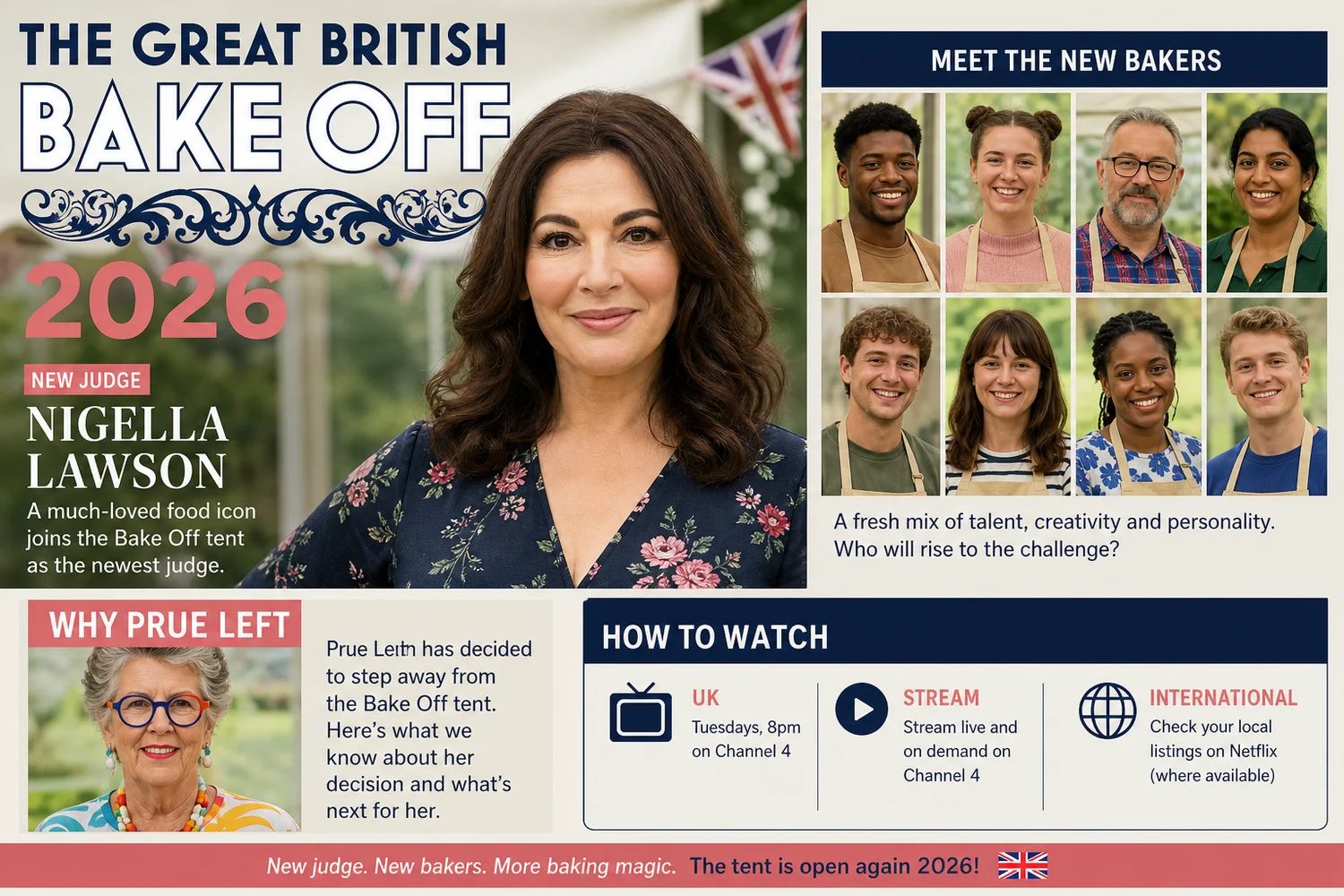
TL;DR — The Great British Bake Off returned for its 17th series on Tuesday 22 September 2026 at 8pm on Channel 4, with Nigella Lawson joining Paul Hollywood on the judging panel and Noel Fielding and Alison Hammond back as hosts. Nigella replaces Dame Prue Leith, who announced on 21 January 2026 that she was stepping down after nine series, saying on Instagram that "now feels like the right time to step back (I'm 86 for goodness sake!)" and that she wanted to spend summers enjoying her garden. Nigella was confirmed on 26 January. Twelve bakers aged 21 to 67 entered the tent: Clara, Connie, Danni, Gabe, Gary, Mo, Molly, Moyin, Nikki, Shannon, Tom and Yannis. The opening Cake Week featured a signature inspired by Nigella's chocolate Guinness cake, a coffee and walnut technical set with only a picture and an ingredient list, and a cake self-portrait showstopper. Law student Mo, the youngest baker, was named the first Star Baker, and nobody was eliminated. Shannon left the tent during the showstopper after feeling unwell and later said it was "very minor," and she has said on social media that she expects to be back for week two. New episodes air Tuesdays at 8pm on Channel 4, with the companion show Second Helpings afterwards. In the US, the series streams on Netflix as The Great British Baking Show: Collection 14, from Friday 25 September with new episodes every Friday. Early reviews of Nigella's debut have been warm, including five stars from both The Guardian and The Telegraph.
Get series picks based on this article
Want more comfort TV while you wait for next Tuesday? Get a pick made for your mood right now.
Get series picksTell us your mood. We'll do the picking.
8 quick questions. Real series picks from real catalogs — not ads. Free, no sign-up.
Take the quizWhat is happening with The Great British Bake Off in 2026?
Every September, a certain part of the British public quietly rearranges its Tuesday evenings around a white tent in a field full of bunting, and this year the ritual came with a genuine headline attached. The Great British Bake Off is back for its 17th series, and for the first time since 2017 there is a new face at the judges' table. Nigella Lawson, the food writer and broadcaster who has been shaping how Britain thinks about home cooking since the late 1990s, has taken the seat previously held by Dame Prue Leith, sitting alongside Paul Hollywood, who has now judged every single series of the show since it began on BBC Two in 2010.
That change alone would have been enough to make this the most searched-about UK television story of the week. Add in a genuinely eventful first episode, a baker leaving the tent mid-showstopper, a technical challenge with no written method at all, and a week where nobody was sent home, and you have a launch that has given people a lot to talk about. It also arrives with a brand new companion show, Second Helpings, hosted by comedians Jon Richardson and Judi Love, which has replaced the long-running An Extra Slice.
I want to walk through all of it properly: when and where to watch in the UK and the US, what Prue actually said about leaving, who Nigella is if you only know her as a name, who this year's twelve bakers are, what really happened in Cake Week, and why a show about people making cakes in a field has managed to stay one of the most comforting things on television for sixteen years. I'll also tell you, honestly, what I think Nigella changes and what I hope she doesn't.
What time is Bake Off on tonight, and where can I watch it in the UK?
The Great British Bake Off 2026 airs on Tuesdays at 8pm on Channel 4. The series premiered on Tuesday 22 September 2026, and episode two, Biscuit Week, is listed for Tuesday 29 September at 8pm on Channel 4. If you follow the usual Bake Off pattern of one episode a week, the series will run through the autumn and finish with a final in late October or November, although Channel 4 has not published every date in advance, so it is worth checking the listings week by week rather than trusting a calendar someone made on social media.
If you miss the live broadcast, episodes are available afterwards on Channel 4's streaming service. For viewers who use British Sign Language, Channel 4 has also been running a BSL-signed version on 4Seven at the same 8pm slot, according to The Scotsman's week one guide, with a signed repeat later in the week on Channel 4 itself. That is a small detail, but it is the kind of thing that genuinely matters to people who want to watch along with everyone else rather than days later.
On the same night, after the main episode, Channel 4 airs Second Helpings. In week one it debuted at 10:35pm. It is hosted by Jon Richardson and Judi Love and, in Channel 4's framing, offers "exclusive behind-the-scenes stories, revelations and more" with the judges, presenters and celebrity guests picking over the episode. If you were one of the many people typing "why did Shannon leave Bake Off" into a search bar on Tuesday night, Second Helpings is where the most useful answer actually came from, because Shannon herself appeared on it. More on that below.
How can US viewers watch it on Netflix?
In the United States and Canada, the show is known as The Great British Baking Show, because "Bake-Off" is a registered trademark of Pillsbury in the US. Netflix is its American streaming home, and it releases the Channel 4 series in numbered "Collections" that do not match the UK series numbers. The 2026 series, which is series 17 in the UK, is Collection 14 on Netflix.
According to Netflix's own Tudum site and Reader's Digest, Collection 14 premieres on Netflix in the US on Friday 25 September 2026, three days after the UK debut, with new episodes arriving every Friday through to the final. That weekly drop is how Netflix has handled the show for several years now, and it keeps American fans only a few days behind the British conversation, which is close enough to avoid most spoilers if you are careful with your social feeds on a Tuesday night.
If you are outside both the UK and the US, availability depends on local broadcast rights, which vary by country. I would not assume Netflix has it where you are without checking, since the rights situation for Bake Off has always been a patchwork.
Why did Prue Leith leave Bake Off?
This is the question I have seen asked most often, and it is also the one where it matters most to stick to what was actually said. The short answer is that Prue Leith chose to step back, and she explained why in her own words.
On 21 January 2026, Prue announced on Instagram that she was leaving the show. Her statement, as reported by Salon, RTÉ and the official Bake Off website, read in part: "Bake Off has been a fabulous part of my life for the last nine years, I have genuinely loved it and I'm sure I'll miss working with my fellow judges Paul, Alison and Noel and the teams at Love Productions and Channel 4." She went on: "Now feels like the right time to step back (I'm 86 for goodness sake!), there's so much I'd like to do, not least spend summers enjoying my garden." And she ended with a line that feels very Prue: "Whoever joins the team, I'm sure they'll love it as much as I have. I feel very lucky to have been part of it."
That is the whole explanation, and I think it deserves to be taken at face value. She was 86, she had judged nine series and, according to the show's own announcement, more than 400 challenges, and she wanted her summers back. Bake Off films across the summer months, over many weekends, in a tent that can get famously hot. Wanting to spend that time in your own garden instead is about as reasonable a retirement plan as anyone has ever announced.
Channel 4 and the production company were gracious in return. Ian Katz, Channel 4's Chief Content Officer, described her as "a joyous presence in the tent" and said the show would "miss her wry, gentle judgement." Love Productions called her "a brilliant judge on Bake Off and a much-loved presence in the tent for nearly a decade."
There is one slightly poignant footnote. In January, before Prue's announcement, Bake Off had revealed that the 2026 series would include its first-ever Audience Choice Week, with viewers invited to suggest signature, technical or showstopper ideas. Paul Hollywood said at the time, "For the first time ever, Prue and I are going to be sharing the reins for this Audience Choice week," and Prue said she was "really looking forward to Bake Off's very first Audience Choice Week." That plan was announced while Prue was still on the team, so how the week will be presented now that Nigella has taken over has not, as far as I can find, been confirmed. It is one to watch for later in the run.
Who is Nigella Lawson, and why is she such a big deal for Bake Off?
If you are under a certain age or outside the UK, you may know Nigella mainly as a name or a voice. But her place in British food culture is enormous, and it helps explain why her casting landed the way it did.
Nigella Lawson was born on 6 January 1960 in Wandsworth, London. Before she was a cook on television, she was a writer. She started at The Spectator in her early twenties, writing book reviews and later becoming its restaurant critic, and at 26 she became deputy literary editor of The Sunday Times. She went on to write for a long list of papers and magazines. That background matters, because it is the reason her food writing reads the way it does: she writes about appetite, pleasure and the emotional life of cooking with the ease of someone who spent years around books first.
Her first cookbook, How to Eat, came out in 1998. Her second, How to Be a Domestic Goddess, published in 2000, is the one that matters most for Bake Off purposes, because it is essentially a book about baking, written for home cooks rather than professionals, and it won her Author of the Year at the British Book Awards. After that came Nigella Bites, Forever Summer, Feast, Nigella Express, Nigella Kitchen, Nigellissima, Simply Nigella, At My Table and Cook, Eat, Repeat, most of them paired with television series. Her first TV show, Nigella Bites, actually aired on Channel 4 between 1999 and 2001, which makes her arrival on Bake Off a kind of homecoming for the channel. She has also judged before, on the cooking competition The Taste in 2013 and 2014, so sitting behind a table and assessing other people's food is not new to her.
When Channel 4 and Love Productions announced her on 26 January 2026, her reaction was charmingly flustered: "I'm uncharacteristically rather lost for words right now!" She acknowledged the weight of the role directly: "Of course, it's daunting to be following in the footsteps of Prue Leith and Mary Berry before her, great dames both, but I'm also bubbling with excitement." She also said, "It's a huge honour to be entrusted with it. I'm just thrilled to be joining the team."
Prue, for her part, gave the appointment her blessing almost immediately. "I was so hoping it would be Nigella! Brilliant choice," she said, before describing her successor as "sassy, fun and she knows her onions", adding that she also knows her croissants, cake and crumble. It is hard to imagine a warmer handover between two judges, and I think that generosity set the tone for how audiences received Nigella in September.
Ian Katz at Channel 4 called the pairing "the marriage of two great British icons: Bake Off and Nigella," and said she would bring "warmth, expertise and sophistication to the tent." Ralph Lee, the CEO of Love Productions, described her as "one of the most influential and beloved voices in food."
In interviews around the launch, reported by The Jewish Chronicle, Nigella explained why she said yes. "I wanted to do something a bit different. I've written many books, which I adore, but it means spending a lot of time alone. I was keen to be part of something bigger, part of a team." She added: "When I was approached about Bake Off, I instinctively thought: 'That would be lovely.' It almost feels too good to be true that you can enjoy something this much and call it work." I find that genuinely touching. For all the glamour people associate with her, this is someone describing the loneliness of writing and the appeal of a shared project, which happens to be exactly what Bake Off is for its bakers too.
Who are the Great British Bake Off 2026 contestants?
Channel 4 introduced twelve bakers for series 17, ranging in age from 21 to 67. I am only including the names, ages, jobs, home areas and baking details that Channel 4 and the show itself chose to publish, because these are private people who signed up to bake, not to be profiled. Here is the class of 2026:
- Clara, 24, marketing graduate from Hertfordshire
- Connie, 63, NHS hospital discharge lead from London
- Danni, 25, HGV service centre administrator from Dorset
- Gabe, 32, artist and drag king from the West Midlands
- Gary, 67, retired garment technologist from Nottinghamshire
- Mo, 21, law student from the West Midlands
- Molly, 31, accessibility coordinator from London
- Moyin, 22, political economy student from Essex
- Nikki, 50, advertising post-producer from London
- Shannon, 29, project planner and scheduler from Gloucestershire
- Tom, 25, hairdresser from West Yorkshire
- Yannis, 28, paediatric doctor from London
What I love about this line-up, reading through the official profiles, is how clearly each baker's personality comes through in how they describe their own food.
Clara moved to the UK from Portugal at 18, and she likes colourful designs, fresh and fruity flavours and recreating Portuguese classics such as tarte de nata. Her baking philosophy, as she put it, is that "the first bite of a bake is always with the eyes," which is about as Bake Off a sentence as has ever been written. She also describes herself as a "fantasy girly," which I suspect will show up in a showstopper at some point.
Connie is known as "the Cake Lady" and has been baking for more than twenty years. Her speciality is hearty carrot cake with rum-soaked fruit, lemon and lavender, and her profile says she keeps a jar of fruit permanently soaking in rum, wine and cinnamon, ready to go. That is the kind of detail that tells you someone bakes for people, constantly and generously.
Danni is the experimenter of the group. Her profile describes her combining foraged ingredients such as magnolia, chestnut and dandelion with flavours like ube and red bean paste. Outside the kitchen her interests include anime doodling, web design and soldering Commodore 64 motherboards, and she has restored an old VCR. I have a soft spot for bakers like this, the ones who treat the tent as a lab, because they produce the bakes you actually remember.
Gabe's story might be my favourite of the lot, because it loops right back to the show itself. According to Channel 4, Gabe discovered baking after watching the original series of Bake Off at 13. Their style is described as "gorgeous but very homemade," with a love of savoury, meat-filled bakes and a meringue obsession. Gabe performs in drag as Blü Romantic and has a background in costume design, which suggests the showstoppers could be something special.
Gary is the most senior baker in the tent and, remarkably, only discovered baking around five years ago through a cookbook he found in a gift shop. His style is described as traditional but creative, with an emphasis on presentation and bold citrus flavours. He lives on a smallholding with an impressive menagerie that includes sheep, horses, chickens, pygmy goats and Shetland ponies.
Mo, at 21 the youngest baker in the tent, describes himself as "chaotic and random." His origin story starts with pretending to cook with Play-Doh at three and discovering mug cakes at nine, before graduating from boxed mixes to far more ambitious bakes. His style blends Asian flavours with British classics. As you will see below, it has already paid off.
Molly learned from her grandmother and has been baking for more than twenty-five years, favouring traditional bakes with hazelnut, fresh fruit and mint. Her profile also mentions a love of musical theatre, Formula 1, and a cross-stitch project of a Rivendell landscape made up of 350,000 stitches, which tells you a great deal about her patience.
Moyin started baking at five with her mother and had mastered macaronage by 14. Her style is described as fun and precise, with influences from her Nigerian heritage, including grains of paradise and groundnuts. She is also an under-20 county champion in the 100m sprint, which may come in handy when the clock is running down.
Nikki started baking at seven with her mother and treats it as therapy. She has one of my favourite details in any Bake Off profile: she bakes to "nostalgic R&B for tried and tested desserts and classical music to bring in the moment of calm needed for experimentation." She also completed a 100-mile walk to raise money for charity.
Shannon was taught by her grandmother and calls her style "whimsical, quirky and rustic." She hopes to bring "a little forest magic" to the tent, grows her own ingredients, and has a tortoise called Tyrone. She also, according to Channel 4, once rode a horse through a drive-thru.
Tom calls himself a "Northern Diva." He started baking at six at his nan's house and mastered brandy snaps before he turned ten. His salon colleagues act as his taste testers, particularly for his "famous salted caramel brownies."
Yannis was born in Vienna and moved to London at 11. His first baking memory is making Bhapa Pitha with his grandmother, and his profile says he is on a mission of "challenging the stigma that Bangladeshi men don't belong in the kitchen, one pastry at a time." He also learned English partly by watching Bake Off, which is one of the loveliest facts I have ever read about this programme.
What happened in the first episode of Bake Off 2026?
Week one was Cake Week, which is traditional, and according to Great British Chefs its challenges were reportedly set by Nigella herself. Whether or not every detail came from her, her fingerprints were all over it.
The signature challenge asked the bakers to put their own spin on a chocolate stout cake, inspired by Nigella's much-loved chocolate Guinness cake. It is a smart opener: a recipe many home bakers already know, which means the real test is what each person does to make it theirs. Tom, for example, made a tipsy cherry chocolate stout cake. The Yorkshire Post reported that Nigella liked the flavours but felt he had used too much bicarbonate of soda. It was also the round where the drama started early. Molly's cake fell to the floor, and she had to start again with limited time left, which is every home baker's nightmare played out in front of the nation. The Tyla round-up of the episode noted that it was a week of dropped, collapsed and binned cakes, and that some viewers described the debut as chaotic, while many more rushed to defend Nigella and the bakers.
The technical challenge was a coffee and walnut cake, and this is where Nigella's influence was most obvious. Instead of the usual stripped-back written method, the bakers were given an illustrated picture of the finished cake and the ingredients, with no measurements and no instructions. That is a genuine twist on a format that has barely changed in sixteen years. Technicals have always been about reading between the lines of a sparse recipe, but here there were no lines at all. You had to know, from experience and instinct, roughly how a coffee and walnut cake comes together. The Yorkshire Post reported that Nigella described Tom's version as her dream cake, which, after the bicarb note in the signature, must have felt like a lovely turnaround.
The showstopper asked for a self-portrait made out of cake, which is exactly the sort of brief that produces both the best and the most endearingly wonky moments of any series. Danni's cake collapsed, leaving only a small portion for the judges to taste, according to The Scotsman.
At the end of the episode, Mo, the youngest baker in the tent, was named the series' first Star Baker. And, unusually, nobody was eliminated. The Scotsman and The Yorkshire Post both reported that all of the bakers go through to week two.
Nigella summed up the day with a line that captures her whole approach to the job: "I'm full of cake and hope and expectation. The standard is incredibly high."
Why did Shannon leave Bake Off, and is she coming back?
This is the other big search this week, so let me be clear and careful, because it involves a real person's wellbeing.
During the showstopper in episode one, with roughly an hour still on the clock, Shannon had to leave the tent. Alison Hammond told viewers: "Unwell, Shannon has had to head home." That was the extent of what the show said on air, and for a lot of viewers it was a worrying moment.
The good news came from Shannon herself. Appearing on Second Helpings the same night, as reported by TV Guide UK, she said: "It was very minor and I had to have a little check up. I was all clear, it was all good." She has also posted on Instagram suggesting she will be back, referencing a teaser clip. I want to be careful with this one, since I have not been able to independently confirm her return beyond her own social posts, so treat "she's back for week two" as what she herself has said rather than something Channel 4 has separately confirmed.
So, to answer the question directly: Shannon left the tent during the week one showstopper because she felt unwell, she has said it was minor and that she was given the all clear, and she has indicated on social media that she expects to return. I am not going to speculate beyond what she has chosen to share, and I would gently encourage everyone else not to either. The nicest version of this story is one where someone comes back to finish what she started, and after her profile's promise of "a little forest magic," I am looking forward to seeing what she brings to Biscuit Week if she does.
What's coming up in week two?
Episode two is Biscuit Week, listed for Tuesday 29 September at 8pm on Channel 4. The official listing describes it like this: "It's Biscuit Week and there's a trip Stateside for the bakers in the Signature as they make American-style cookies. In the Technical, it's a journey of a different kind as they travel back in time for a nostalgic classic. But nothing is quite as it seems and they must rely on their taste alone to recreate this beloved bake. And in the Showstopper, a visually striking biscuit mosaic tests the bakers' artistic flair and also gives them the chance to create something that's close to their hearts."
That technical description is interesting. "They must rely on their taste alone" suggests that, for the second week running, the technical is being pushed away from written instructions and toward the bakers' instincts and palates. If that becomes a pattern, it is one of the more meaningful changes the show has made to its format in years, and it fits Nigella's whole philosophy of cooking as something you feel your way into rather than follow like a manual.
With twelve bakers and no elimination in week one, I would expect the usual rhythm to reassert itself quickly. Someone will almost certainly leave at the end of Biscuit Week, and the pressure on the bakers who struggled in Cake Week will be real.
How will Nigella change the judging dynamic with Paul Hollywood?
Every Bake Off judging pair has had its own chemistry, and the pleasure of the show has always been partly about watching two very different sensibilities assess the same slice of cake.
With Mary Berry and Paul Hollywood, the dynamic was the gracious, exacting home-baking matriarch alongside the technically obsessive artisan baker. With Prue and Paul, it became something slightly more playful: Prue brought decades of restaurant and professional food experience, from her Michelin-starred Leith's restaurant in Notting Hill to founding Leith's School of Food and Wine in 1975 and eleven years judging Great British Menu, and Channel 4's own tribute singled out her "wry, gentle judgement."
Nigella brings something different again, and early reviews picked up on it immediately. The Guardian's five-star review said: "She moves through Bake Off dispensing words of wisdom, generous praise and gentle criticism, just as confident as Leith but a much quieter, more soothing presence that works perfectly with Alison Hammond's ebullience and Paul Hollywood's teacher-ish vibe." I think that is a really sharp reading. The tent now has a clear division of energy: Alison's big laugh, Noel's surreal whimsy, Paul's precise technical scrutiny and Nigella's calm, sensory, pleasure-first judgement.
The Telegraph, also awarding five stars, wrote: "She brings glamour, intelligence and poise. And, of course, a hefty dollop of innuendo." Anyone who has watched Nigella's own shows will recognise that; she describes food in terms of how it feels to eat, and it is hard to do that on television without the odd line that makes people smile. The Independent noted that she "presents a good, sympathetic ear for contestants," and Radio Times gave her four stars, saying she "makes a strong debut in the tent." The Times, according to Yahoo's round-up, called her the "icing on the cake" and said the series was in "safe hands."
The practical difference, I suspect, will be in what gets rewarded. Paul's instincts are about technique: proving, lamination, bake, structure, the perfect crumb. Nigella's instincts, based on everything she has written for nearly three decades, are about flavour and pleasure, whether something tastes the way it promises to, and whether you want another bite. Those two priorities overlap a lot, but where they diverge is exactly where the interesting judging conversations will happen. A slightly rustic bake that tastes extraordinary may get a warmer reception from Nigella than it would have from a more technique-first panel, and I suspect the bakers who cook from the gut rather than the rulebook, people like Danni, Shannon and Connie based on their profiles, could benefit.
There was even a small, very human debate in week one about how she tastes. Tyla's round-up of viewer reactions noted that some people found her tasting style unusual, while plenty of others loved that she takes proper-sized bites rather than dainty forkfuls. One fan quoted in that piece said they were "obsessed with how Nigella is almost shovelling the cake into her mouth." Honestly, as someone who has always suspected judges cannot really assess a cake from a crumb, I am with the big-bite camp.
Who has judged and hosted Bake Off over the years?
It helps to see Nigella's arrival as part of a longer story, because Bake Off has been through several line-up changes and survived every one of them.
The show was developed by Love Productions, co-founded by producer Anna Beattie, who, according to the show's history, loved "that idea of village fetes and an old-fashioned baking competition with people who only wanted to bake a good cake." It took the company four years to find a home for it before BBC Two picked it up, and the first series aired in August 2010 with ten bakers, judges Mary Berry and Paul Hollywood, and presenters Mel Giedroyc and Sue Perkins. The first winner was Edd Kimber.
That original line-up lasted for seven series. The show moved from BBC Two to BBC One in 2014 as its audience grew, and by series 7 in 2016, its final BBC run, it was averaging 13.56 million viewers, a staggering number for any programme, let alone a gentle baking competition. Along the way it produced some of the best-loved moments in British television, including Nadiya Hussain's win in series 6 in 2015, and it won BAFTAs in 2012, 2013 and 2016.
In September 2016, Love Productions signed a three-year deal with Channel 4 after negotiations with the BBC broke down. Mel and Sue announced they would not be moving with the show, and Mary Berry announced her departure too. Paul Hollywood was the only one of the original four to make the move. For a moment, a lot of people genuinely wondered whether Bake Off could survive without its original cast.
It did. From series 8 in 2017, Prue Leith joined Paul as judge, with Noel Fielding and Sandi Toksvig as hosts. Sandi stepped down after three series, and Matt Lucas joined Noel from series 11 in 2020, which was the pandemic series filmed in a biosecure bubble at Down Hall in Hertfordshire and which drew an average of more than ten million viewers. Matt announced his departure in December 2022, and Alison Hammond was confirmed as Noel's new co-host in March 2023, joining from series 14. The most recent series, series 16 in 2025, was won by Jasmine Mitchell, a medical student.
So the judging line-up now runs like this: Mary Berry and Paul Hollywood for series 1 to 7 on the BBC, Prue Leith and Paul Hollywood for series 8 to 16 on Channel 4, and Nigella Lawson and Paul Hollywood from series 17. Paul has been the constant thread through all of it, which is quite something when you think about how much else has changed.
What that history tells me is that Bake Off's appeal was never really about any single person. It was about the format, the tone and the people in the tent. Each new face has brought something slightly different, and the show has absorbed them all without losing what makes it itself. That is the best argument for being optimistic about Nigella.
How does Bake Off actually work, if you're new to it?
If this year's headlines have made you curious and you have never actually watched, here is the quick version. Each series starts with twelve amateur bakers, and each episode has a theme, usually including weeks such as cake, biscuits, bread, desserts, pastry and patisserie. Every episode contains three challenges.
The signature challenge asks the bakers to make a tried-and-tested bake of their own, within a brief, so it is their chance to show off their personal style. The technical challenge is set by one of the judges, and every baker makes the same thing from a deliberately sparse recipe, without knowing in advance what it will be. The judges then taste the results blind and rank them from last to first. The showstopper is the big one, a chance to show both skill and imagination, often with elaborate decoration and several components.
At the end of each week, the judges name a Star Baker for the best overall performance, and usually one baker leaves the competition. The last three bakers reach the final. The show has always been filmed in a large marquee in the grounds of an English country estate, and recent series, reportedly including this one, have been made at Welford Park in Berkshire.
Why does Bake Off work so well as comfort TV?
I think about this a lot, because it is basically the question my whole job revolves around: what makes a show feel good to watch, and why do certain programmes become the ones people reach for when they are tired, stressed or just want something kind?
Bake Off works first because the stakes are real but small. The bakers genuinely care, and you care with them, but nobody's life is ruined by a soggy bottom. It gives you the tension of competition without the cruelty that often comes with it. There is no scheming, no manufactured feuds, and no one is edited to be the villain. When a cake falls on the floor, as Molly's did this week, the story the show tells is not one of humiliation but of someone picking herself up and starting again against the clock. That instinct for kindness is baked into the show, and it has been there since the very first series.
It also works because it celebrates competence. There is a deep, specific pleasure in watching someone who is good at something do it well, especially when that something is a practical, everyday skill. Baking is familiar enough that almost everyone understands the basics, but hard enough that watching someone pull off perfect lamination or a flawless sponge is genuinely impressive. You come away feeling slightly more capable yourself, even if you have not turned your oven on in months.
Then there is the rhythm. Bake Off is incredibly predictable in the best way. Signature, technical, showstopper. Star Baker, elimination. A long shot of the tent and the countryside around it, the hosts making silly jokes. That predictability is not a flaw; it is the whole point. Comfort television is partly about knowing the shape of what you are about to watch, so that your brain can relax into it rather than bracing for a twist.
And finally, it works because it is about ordinary people. The bakers are nurses and students, retirees and hairdressers, doctors and project planners. This year's line-up includes a law student who once pretended to cook with Play-Doh, a woman who keeps fruit permanently soaking in rum just in case, a man who discovered baking in a gift-shop cookbook five years ago, and a doctor who learned English partly by watching this very show. You spend ten weeks getting to know them, and by the final you care about all of them. That is a rare feeling on television now, and it is precious.
If you want something with the same warm, low-stakes, competence-and-kindness energy, it is worth remembering that Bake Off essentially created a genre. Its format has been sold around the world, with local versions in many countries, and it inspired a whole wave of gentle craft and cooking competitions. When a friend asks me for "something like Bake Off," what they usually mean is a show where the people are nice to each other, the tension is gentle and you learn something along the way.
Is Bake Off 2026 good for families and younger viewers?
Yes, and that has always been part of its charm. Bake Off is one of the few big mainstream shows that genuinely works across generations. Grandparents who remember Mary Berry's first cookbooks, parents who grew up with Nigella's early TV shows, and teenagers who know Noel Fielding from other things can all sit on the same sofa and enjoy the same hour.
The humour is gentle, the conflict is minimal and the bakers are overwhelmingly supportive of one another. There is the occasional double entendre, which the show has always enjoyed and which The Telegraph cheerfully noted Nigella has leaned into, but it is the kind of thing that goes over younger heads and gets a knowing laugh from the adults. For families looking for a weekly shared ritual that does not involve anyone arguing over the remote, it is hard to beat.
It is also quietly educational. Kids who watch Bake Off tend to pick up a surprising amount of practical food knowledge, from what makes bread rise to why you should not open the oven door too early. Plenty of people who now bake seriously, including one of this year's bakers, Gabe, have said the show is what got them started in the first place.
My honest take on Nigella Lawson's Bake Off
I will admit I went into this series slightly nervous. When a show I love changes a key piece of its cast, my first instinct is protective. Prue was a genuinely great Bake Off judge, and she arrived in a much harder position than Nigella did. In 2017 she had to follow Mary Berry at a moment when a lot of viewers were convinced the show had been ruined by the move to Channel 4. She won them over with warmth, honesty and a willingness to be a bit eccentric, and nine series later she left on her own terms and to affectionate goodbyes. That is a legacy worth respecting, and I do not think Nigella is here to replace it so much as to build on it.
Having watched the first episode and read the early coverage, my honest view is that Nigella is an inspired choice, and that the reasons go beyond name recognition.
First, she is a baker's writer. How to Be a Domestic Goddess was, for a whole generation of British home cooks, the book that made baking feel like a pleasure rather than a test. That is the exact spirit Bake Off was founded on. Anna Beattie's original pitch was about people who "only wanted to bake a good cake," and Nigella has spent more than twenty-five years telling people that a good cake is something you make for joy, not for approval. Putting her in the judging chair is a statement about what the show values.
Second, the technical challenge twist was the most interesting thing to happen to Bake Off's format in years, and I really hope it continues. Giving bakers a picture and an ingredient list, with no measurements or method, tests whether they understand how baking works rather than whether they can decode a riddle. It rewards intuition and experience. If Biscuit Week's "rely on their taste alone" technical is a sign of what is to come, I think this series could produce some of the most revealing technicals in the show's history.
Third, and this is the part I did not expect to feel so strongly about, her presence changes the emotional texture of the tent. The Guardian's description of her as "quieter" and "more soothing" matches what I saw. Paul is at his best when he has someone to bounce off, and with Prue that was often playful sparring. With Nigella, it looks more like a contrast between two ways of loving food: one precise and structural, one sensual and instinctive. That is a genuinely good combination for a show whose audience includes both technically minded bakers and people who just like watching someone eat a lovely slice of cake.
Do I have reservations? A few, and they are small. Nigella's style of description is very much her own, and I can imagine some viewers finding it a bit much across ten weeks, especially if it starts to feel like a signature routine rather than a natural reaction. I also think the show will need to be careful not to let her fame overshadow the bakers, who are, and always should be, the real stars. The first episode handled that well, with the bakers' stories, disasters and triumphs taking centre stage, but it is something I will be keeping an eye on as the series goes on.
I also want to say something about the tone of the week one conversation online. A lot of the searches this week were about Shannon, and I understand why: people were worried. But the way the story resolved, with Shannon reassuring everyone herself and telling fans she expects to return, is exactly the kind of outcome that makes Bake Off feel like it does. It is a show where people come back and finish what they started. I think viewers should give all twelve bakers the same patience and kindness the show gives them. They are amateurs doing something genuinely hard in front of millions of people, and every one of them deserves to be judged on their bakes and nothing else.
Overall, if you are someone who drifted away from Bake Off in recent years, this is the series to come back for. The new judge has given the show a fresh energy without changing what makes it special, the bakers look like a lovely, varied group, and the early format tweaks suggest a production team willing to experiment for the first time in a while. If you have never watched it, start here. It is as good an entry point as any series since the move to Channel 4.
What should I watch if I love Bake Off?
If Bake Off is your comfort show, you probably already know that it pairs beautifully with other gentle, competence-driven programmes. The obvious first step is Nigella's own back catalogue. Her series, from Nigella Bites through to Cook, Eat, Repeat, share the same unhurried warmth, and watching one or two is a good way to understand how she thinks about food before she judges your favourite baker's showstopper.
Beyond that, the best companions to Bake Off tend to be shows that value craft and kindness over conflict: other making and crafting competitions, gentle travel and food documentaries, and cosy scripted series where the drama never tips into cruelty. The common thread is that feeling of settling in with something that will not ask too much of you, but will reward you for paying attention.
The trick, honestly, is matching the show to the mood you are actually in. Some nights you want something as soft as a Victoria sponge; other nights you want the gentle tension of a technical challenge with no instructions. That is exactly what our quiz is designed to help with.
Frequently asked questions
What time is Bake Off on tonight? The Great British Bake Off 2026 airs on Tuesdays at 8pm on Channel 4, with episodes on Channel 4's streaming service afterwards. Episode two, Biscuit Week, is on Tuesday 29 September at 8pm.
Which series of Bake Off is the 2026 one? It is series 17 in the UK, which premiered on Tuesday 22 September 2026. On Netflix in the US it is called The Great British Baking Show: Collection 14.
Why did Prue Leith leave Bake Off? She chose to step back after nine series, saying on Instagram that "now feels like the right time to step back (I'm 86 for goodness sake!)" and that she wanted to spend summers enjoying her garden.
Who replaced Prue Leith on Bake Off? Nigella Lawson, confirmed on 26 January 2026. She judges alongside Paul Hollywood, with Noel Fielding and Alison Hammond hosting.
Who are the Bake Off 2026 contestants? The twelve bakers are Clara, Connie, Danni, Gabe, Gary, Mo, Molly, Moyin, Nikki, Shannon, Tom and Yannis, aged 21 to 67.
Who left Bake Off in week one? Nobody was eliminated in the opening Cake Week, and Mo, the youngest baker, was named the series' first Star Baker.
Why did Shannon leave Bake Off? Shannon left the tent during the week one showstopper because she felt unwell. She later said it was "very minor" and that she was given the all clear, and she has said on social media that she expects to return for week two.
How can I watch Bake Off 2026 in the US? It streams on Netflix as The Great British Baking Show: Collection 14, starting Friday 25 September 2026, with new episodes every Friday.
What is Second Helpings? It is Bake Off's new companion show, hosted by Jon Richardson and Judi Love, which airs on Channel 4 after the main episode and replaces An Extra Slice.
Where is Bake Off 2026 filmed? It has been reported to be filmed at Welford Park in Berkshire, which has hosted several recent series.
Is there an Audience Choice Week in 2026? Bake Off announced its first-ever Audience Choice Week for the 2026 series in January, inviting viewers to suggest challenges. The plan was announced before Prue's departure, so how it will run with Nigella has not yet been detailed.
Looking for your next comfort-watch after Bake Off?
Take our mood based quiz at https://www.suggestionlabs.com/quiz/series and find the series that fits exactly how you feel tonight.