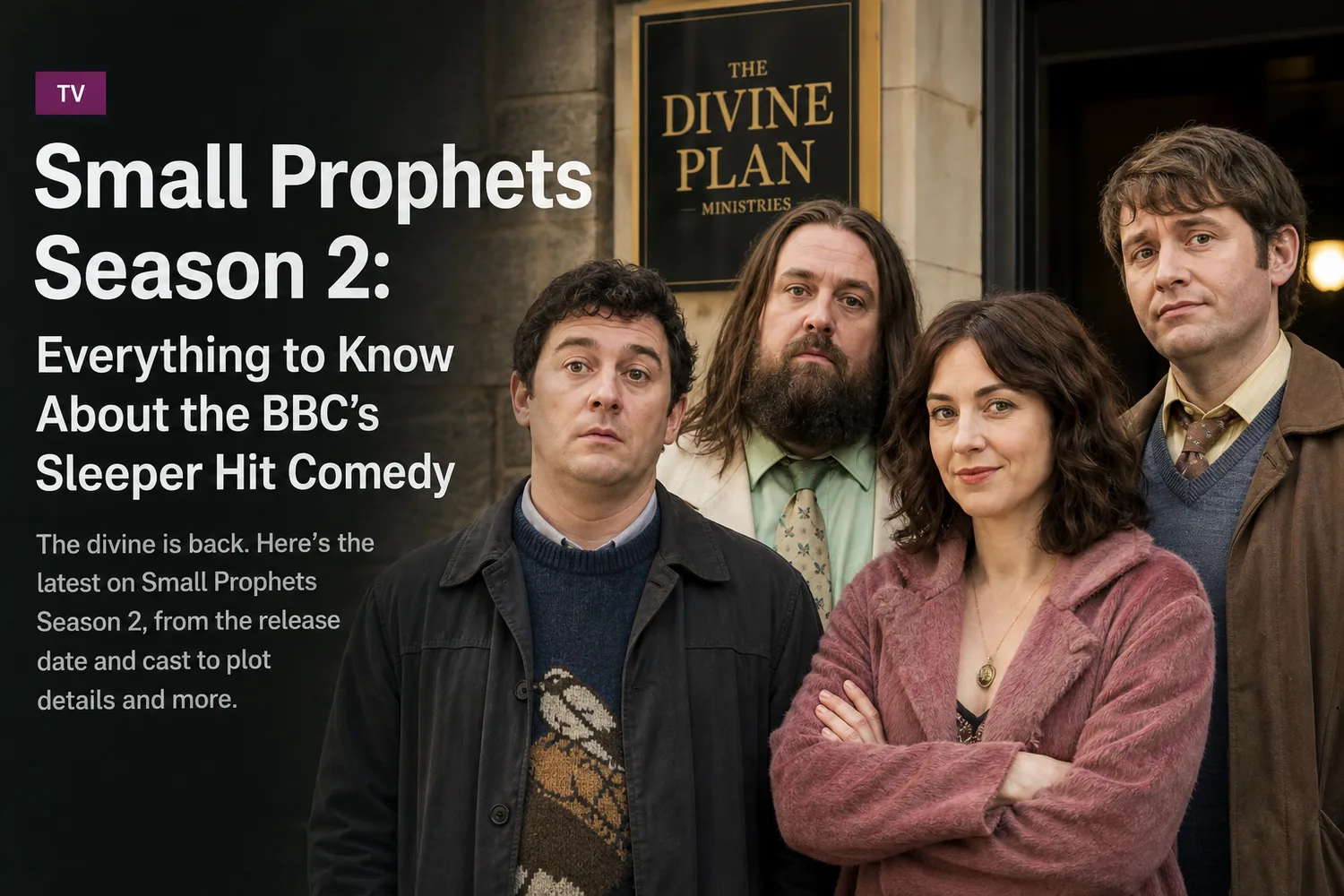
Small Prophets Season 2: Everything to Know About the BBC's Sleeper Hit Comedy
TL;DR — The BBC officially renewed Small Prophets for a second series in September 2026, following a first season that became the biggest new scripted launch of the year on the BBC, pulling in 7.7 million viewers and earning five-star reviews from The Guardian and The Times. Pearce Quigley stars as Michael Sleep, a grieving man who discovers an alchemical recipe for creating tiny, prophecy-granting homunculi in his shed while searching for answers about his missing girlfriend. With Michael Palin, Mackenzie Crook, and a stacked ensemble cast, this is one of the most purely original British comedies in recent memory. Here's everything confirmed, plus my honest opinion on why this deserves considerably more attention than it's gotten.
Get series picks based on this article
Want another wonderfully original comedy with real heart underneath? Skip the search and jump straight to picks built for that.
Get series picksTell us your mood. We'll do the picking.
8 quick questions. Real series picks from real catalogs — not ads. Free, no sign-up.
Take the quizWhat is Small Prophets about?
The show follows Michael Sleep, a man still deeply grieving the disappearance of his girlfriend Clea seven years earlier, an unresolved loss that's clearly shaped his entire subsequent life. While visiting his father Brian in a retirement home, Michael discovers his father's old journal containing instructions for creating homunculi, tiny humanoid creatures with genuine prophetic ability, through a specific alchemical process. Using ingredients gathered according to that old, strange recipe, Michael creates six of these small creatures in his garden shed, driven by the desperate hope that their prophetic powers might finally reveal what actually happened to Clea.
As the homunculi mature and their prophetic abilities develop, Michael's secret, increasingly strange project draws unwanted attention from his nosy neighbors, his difficult boss, and a series of mysterious strangers, all while a parallel subplot follows Clea's brother Roy pursuing a valuable book he believes Clea stole before her disappearance. The season builds toward a startling revelation: Clea is alive, but has no intention of returning, even as the homunculi provide Michael with useful information (accurate lottery numbers) and hint at a larger, still-unexplained mystery involving mysterious calls from Canada.
Who's in the cast?
- Pearce Quigley as Michael Sleep
- Lauren Patel as Kacey, Michael's coworker
- Michael Palin as Brian Sleep, Michael's father
- Paul Kaye as Roy, Clea's brother
- Jon Pointing as Clive, Michael's neighbor
- Mackenzie Crook as Gordon, Michael's boss
- Sophie Willan as Bev, Michael's neighbor
Main cast:
Supporting cast: Ed Kear, Charlotte Mills, Adam Wright, Shola Adewusi, Kathryn Drysdale, and Rhiannon Clements.
This is a remarkable ensemble for what might, on paper, sound like a smaller, more niche British comedy premise. Michael Palin's involvement specifically carries enormous cultural weight given his status as a founding member of Monty Python and one of British comedy's most beloved, enduring figures; his presence lends the show real comedic pedigree and cultural gravitas, and the Telegraph's four-star review singled out his performance specifically. Mackenzie Crook, despite the show carrying his name in a lot of press coverage and search interest, actually plays a supporting role as Michael's boss Gordon on screen rather than the lead, which is worth clarifying for anyone expecting him to be the central character; the lead role of Michael Sleep belongs to Pearce Quigley, whose performance has drawn specific, effusive critical praise. Crook's real role here is behind the camera: he created, wrote, and directed the entire series, so while he isn't the on-screen lead, he's very much the show's creative author.
What made season 1 such a critical success?
Remarkable reviews across the board. The Guardian awarded the show five stars, calling it a "show full of gorgeous surprises" and describing the viewing experience as "pure, pure pleasure." The Times similarly awarded five stars, specifically praising Mackenzie Crook's "joyous storytelling" as the show's writer-director for making viewers "feel strangely and intensely alive." The Daily Telegraph gave four stars, describing the show as "eccentric, funny, sweet, and sad, often all at once," with particular praise for Palin's performance.
Beyond critical acclaim, the show achieved significant commercial success for what might have seemed like a fairly niche, eccentric premise: its six-episode first season, airing February through March 2026, attracted 7.7 million viewers across its 28-day viewing window, making it officially the biggest new scripted launch of the year on the BBC, a remarkable achievement for an original comedy built around such a distinctive, unusual premise. The show also won "best series in the international panorama competition" at Series Mania 2026, with Lauren Patel separately winning Best Actress in the same section, a significant international television festival recognition.
Is there going to be a season 2?
Yes, confirmed in September 2026. The BBC's decision to renew came following season 1's exceptional critical and commercial reception, a strong vote of confidence in a show built around a premise distinctive enough that its broad, mainstream success wasn't necessarily guaranteed in advance.
Why has Small Prophets resonated so strongly with both critics and audiences?
This is worth examining, because the show's specific blend of elements, genuine grief and emotional depth combined with a bizarre, almost magical-realist comedic premise involving tiny prophecy-granting creatures, represents a distinctive tonal combination that British comedy has periodically excelled at but that remains difficult to execute well. The Telegraph's specific characterization, "eccentric, funny, sweet, and sad, often all at once," captures exactly why this kind of tonal blend is so hard to pull off successfully; shows that attempt to combine genuine emotional weight with strange, whimsical comedic premises risk either the comedy undercutting the emotional stakes or the emotional material feeling tonally mismatched with the show's more absurdist comedic elements.
Small Prophets' apparent success at threading that needle, reflected in its critical reception specifically praising its ability to hold both registers simultaneously, "sweet and sad, often all at once," suggests skilled writing and directing that understands how to use its bizarre central premise (alchemical homunculi with prophetic powers) not as pure absurdist comedy for its own sake, but as a genuine vehicle for exploring Michael's grief, obsession, and desperate need for closure regarding Clea's disappearance.
What questions does season 2 need to answer?
Season 1's finale left multiple significant threads unresolved: Clea's specific reasons for staying away despite being confirmed alive, the mysterious calls from Canada hinted at in the finale's final moments, and presumably further exploration of the accurate lottery numbers the homunculi provided, which raises real questions about the exact nature and reliability of their prophetic abilities and what larger implications that power might have for Michael's life going forward. The season 1 finale's explicit "to be continued" framing signals the show was always structured with a longer, multi-season narrative arc in mind rather than telling a fully self-contained single-season story.
My honest take on Small Prophets
I think this is a special, distinctive piece of British comedy, and its remarkable critical reception across multiple major outlets, combined with significant audience viewership, suggests this deserves to be considerably better known than it currently seems to be internationally. The show's core premise, using literal alchemical magic and tiny prophetic creatures as a vehicle for processing grief and unresolved loss, is exactly the kind of original, slightly surreal concept that British comedy has periodically excelled at throughout its history, finding genuine emotional truth through absurdist, fantastical premises rather than more conventional, grounded comedic structures.
Michael Palin's involvement feels particularly meaningful given his own extensive history with exactly this kind of inventive, boundary-pushing British comedy through his Monty Python work; having him lend his considerable comedic credibility and warmth to a newer, distinctively original project like this one feels like a genuine passing of the torch, connecting this new show to a longer lineage of British comedy willing to embrace strange, imaginative premises in service of real emotional and thematic substance. Mackenzie Crook's role as the show's creator, writer, and director is worth underlining too, since his name in the press coverage can read as a cast credit when it's really a creative one; his own eye for melancholy, slightly askew Britishness, familiar from Detectorists, is all over this show's tone.
What strikes me most about the critical reception is how consistently reviewers praised the show's ability to hold genuine sadness and genuine comedy simultaneously, rather than treating them as separate registers the show shifts between scene to scene. That kind of tonal integration, where the whimsy and the grief inform and deepen each other rather than existing in separate compartments, is difficult to achieve and speaks to real confidence and skill from the show's writing and directing team in trusting the material's inherent strangeness to carry real emotional weight rather than undercutting it for easy laughs.
The unresolved mysteries heading into season 2, Clea's reasons for staying away, the mysterious Canada calls, the fuller implications of the homunculi's prophetic abilities, all suggest a show with genuine long-term narrative ambition rather than one that simply got lucky with a strong, self-contained first season concept. Given how strongly season 1 landed with both critics and audiences, I have real confidence the creative team has a genuine plan for deepening and paying off these threads in ways that continue justifying the show's distinctive tonal balancing act.
For anyone who appreciates British comedy willing to take genuine creative risks, blending real emotional substance with bizarre, inventive premises, this is very much worth seeking out, and its critical reception suggests it's already become one of the more significant original comedy successes on British television in recent memory.
Do you need to have watched season 1 first?
Yes, essential. Season 2 will directly continue plot threads established across season 1, particularly regarding Clea's fate and the mysterious calls from Canada revealed in the finale, and the show's central premise and character dynamics are established specifically through season 1's events.
Frequently asked questions
When was Small Prophets season 2 confirmed? September 2026, by the BBC.
Who stars in Small Prophets? Pearce Quigley as Michael Sleep, alongside Michael Palin, Mackenzie Crook, Paul Kaye, and Lauren Patel.
Does Mackenzie Crook play the lead role? No, he plays a supporting role as Michael's boss Gordon. The lead is Pearce Quigley as Michael Sleep.
What is the show's premise? A grieving man creates tiny prophecy-granting homunculi in his shed while searching for answers about his missing girlfriend.
How was season 1 received? Extremely well, with five-star reviews from The Guardian and The Times, and 7.7 million viewers, the biggest new scripted BBC launch of the year.
What awards has the show won? Best series in the international panorama competition at Series Mania 2026.
When did season 1 air? February through March 2026.
How many episodes did season 1 have? Six episodes.
What was season 1's major cliffhanger? Clea is revealed to be alive but has no intention of returning, alongside a mysterious hint about calls from Canada.
Do I need to watch season 1 first? Yes, essential given the direct narrative continuity.
Looking for your next wonderfully strange comedy?
If original, emotionally rich British comedy is your thing, our series recommendation quiz can help you find your next watch.