Best Books About Revenge
TL;DR — The best novels about revenge examine what the pursuit of vengeance actually costs the person seeking it, rather than delivering pure, uncomplicated catharsis. Here's a list sorted by what specific moral question each novel asks about revenge, plus my honest take on why the strongest examples in this genre are often more ambivalent about vengeance than pure genre thrillers.
Get book picks based on this article
Want vengeance that actually costs something? Skip the list and jump straight to picks built for that.
Get book picksTell us your mood. We'll do the picking.
8 quick questions. Real book picks from real catalogs — not ads. Free, no sign-up.
Take the quizWhy do the best revenge novels complicate the satisfaction of getting even?
Because pure, uncomplicated catharsis tends to feel hollow in prose just as much as in film, while novels that genuinely reckon with revenge's psychological and moral cost, isolation, moral compromise, the way violence begets more violence, tend to stick with readers long after the actual resolution, giving the pursuit of vengeance genuine, lasting weight beyond simple plot mechanics.
If you want a foundational classic revenge narrative
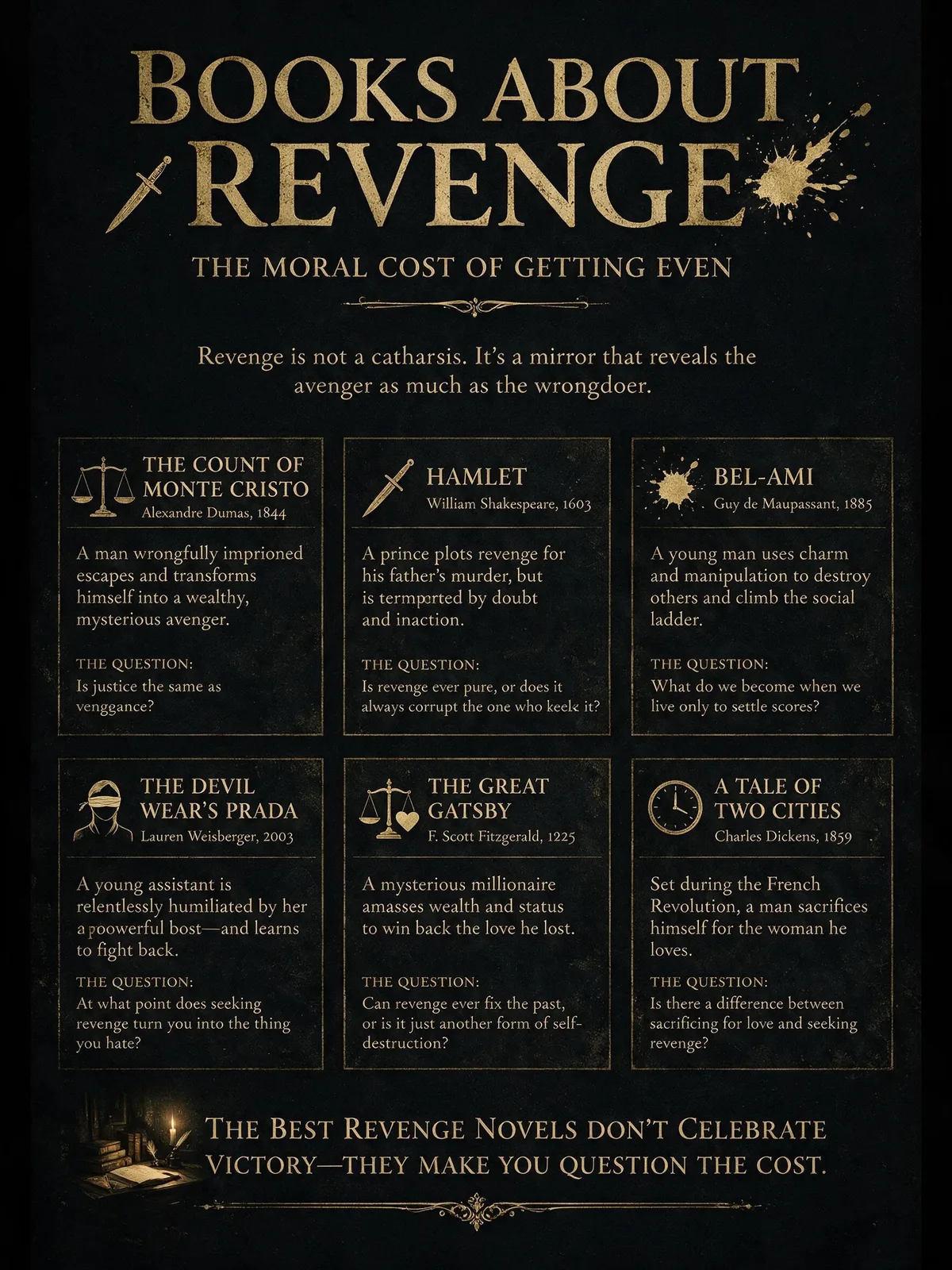
The Count of Monte Cristo, Alexandre Dumas. Remains one of literature's most influential revenge narratives, built around genuinely patient, meticulous planning rather than impulsive violence, following its protagonist across years of careful, calculated preparation.
Hamlet, William Shakespeare. A genuinely foundational exploration of revenge's psychological toll and moral hesitation, its protagonist's famous indecision itself becoming the play's central dramatic engine.
If you want a novel exploring revenge with genuine moral complexity
Gone Girl, Gillian Flynn. Uses a genuinely twisted revenge plot within a marriage to explore deception and complicity with real psychological sophistication, refusing to make either central character purely sympathetic or purely villainous.
The Girl with the Dragon Tattoo, Stieg Larsson. Explores genuine revenge and justice for real historical abuse and corruption, treating its protagonist's specific methods of retribution as morally complicated rather than straightforwardly heroic.
If you want a novel exploring revenge across generational or historical time
Beloved, Toni Morrison, while broader in theme, touches on genuine themes of reckoning and consequence tied to historical injustice.
If you want a novel exploring revenge with genuine restraint and psychological depth
Wuthering Heights, Emily Brontë. A genuinely dark exploration of how consuming, generational revenge can become, following Heathcliff's obsessive pursuit of retribution across an entire lifetime and into a second generation.
If you want a novel exploring revenge through genuine class or social injustice
Les Misérables, Victor Hugo, in Javert's relentless pursuit of Valjean, explores genuine questions about justice, law, and whether pursuit of retribution can ever be truly satisfied, ultimately destroying the pursuer as much as it was meant to punish the pursued.
If you want a more contemporary revenge thriller
You, Caroline Kepnes. Uses a genuinely unsettling unreliable narrator to explore obsession and retribution from a disturbing internal perspective, forcing readers into uncomfortable proximity with a genuinely dangerous mindset.
If you want a novel exploring revenge tied specifically to inherited family conflict
East of Eden, John Steinbeck, mentioned in our sibling-focused guide too, uses genuine biblical themes of rivalry and retribution to explore whether people are doomed to repeat destructive patterns across generations.
My honest opinion on why Wuthering Heights remains such a genuinely unsettling exploration of revenge
I think it's because Brontë shows how Heathcliff's consuming need for retribution doesn't just harm his intended targets, it genuinely corrodes his own capacity for happiness or peace across an entire lifetime, extending its damage into a second generation who had nothing to do with the original wrong.
Do revenge novels need to end with the protagonist achieving satisfaction, or can they complicate that outcome?
Genuinely varies, and the more thoughtful examples often deliberately withhold that satisfaction, using the protagonist's hollow or complicated feelings after achieving vengeance as the novel's actual final point rather than a straightforward triumphant conclusion.
Frequently asked questions
What's considered a foundational classic revenge narrative? The Count of Monte Cristo remains widely cited for its patient, meticulously planned approach to vengeance.
Is Hamlet considered a revenge story? Yes, genuinely, exploring revenge's psychological toll and moral hesitation as its central theme.
What's a novel exploring revenge within a marriage? Gone Girl uses a twisted revenge plot to explore deception and complicity with real psychological sophistication.
Does Wuthering Heights explore revenge across generations? Yes, genuinely, showing how Heathcliff's retribution extends its damage into a second generation.
Is Les Misérables considered a novel about revenge? In part, yes, particularly through Javert's relentless pursuit exploring justice and whether retribution can ever be satisfied.
Do revenge novels always end with the protagonist feeling satisfied? Not necessarily, some of the strongest examples deliberately withhold that satisfaction for a more honest conclusion.
What's a contemporary revenge thriller with an unreliable narrator? You by Caroline Kepnes explores obsession and retribution from a disturbing internal perspective.
Why do the best revenge novels complicate the pursuit of getting even? Pure catharsis feels hollow, while examining revenge's real psychological cost gives the novel lasting weight.
Does Javert's pursuit ultimately destroy him as much as Valjean? Yes, genuinely, his relentless pursuit of justice ultimately corrodes and destroys his own sense of meaning.
Is East of Eden considered relevant to revenge themes? Yes, genuinely, using biblical rivalry themes to explore whether destructive patterns repeat across generations.
Does The Girl with the Dragon Tattoo present its protagonist's revenge methods as straightforwardly heroic? No, genuinely, treating her specific methods of retribution as morally complicated rather than simply admirable.
Why is Hamlet's central indecision significant to the revenge genre? It becomes the entire play's dramatic engine, exploring genuine psychological hesitation about pursuing vengeance.
Want to discover your next read?
Our book recommendation quiz can help you find something new that fits your mood.