Best Multigenerational Family Saga Novels
TL;DR — A genuinely great multigenerational saga does more than track a family across decades, it shows how specific patterns, trauma, ambition, love, actually repeat and mutate as they pass down through generations. Here's a list sorted by what kind of family story each one is actually telling, plus my honest take on why the format rewards genuine patience more than almost any other.
Get book picks based on this article
Want to track how patterns repeat and mutate across generations? Skip the list and jump straight to book picks built for that patience.
Get book picksTell us your mood. We'll do the picking.
8 quick questions. Real book picks from real catalogs — not ads. Free, no sign-up.
Take the quizWhy does tracking a family across generations require a genuinely different kind of patience from readers?
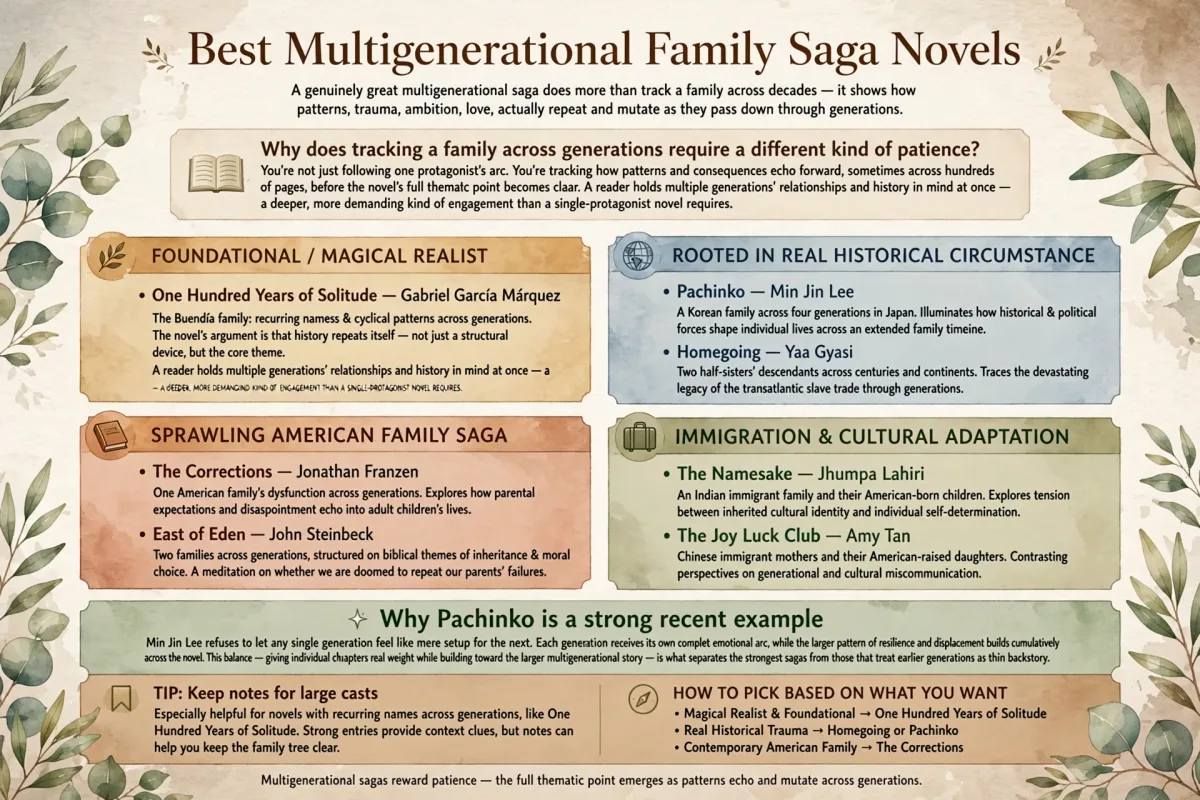
Because you're not just following one protagonist's arc, you're tracking how patterns and consequences echo forward, sometimes across hundreds of pages, before a novel's full thematic point becomes clear. A reader needs to hold multiple generations' worth of relationships and history in mind simultaneously, which is a genuinely different, more demanding kind of engagement than a single-protagonist novel requires.
If you want a genuinely foundational example of the genre
One Hundred Years of Solitude, Gabriel García Márquez. The Buendía family's recurring names and cyclical patterns across generations function as the novel's actual thematic argument about history repeating itself, not just a structural device.
Pachinko, Min Jin Lee. Following a Korean family across four generations in Japan, this genuinely illuminates how historical and political forces shape individual lives across an extended family timeline.
If you want something rooted in real, specific historical circumstance
The Kite Runner, Khaled Hosseini, while centered more on one central relationship than a full multigenerational sweep, uses father-son dynamics across time to explore guilt and redemption within Afghanistan's turbulent modern history.
Homegoing, Yaa Gyasi. Tracks two half-sisters' descendants across centuries and continents, following the specific, devastating consequences of the transatlantic slave trade across an entire family tree.
If you want a genuinely sprawling American family saga
The Corrections, Jonathan Franzen. A genuinely sharp, occasionally uncomfortable look at one American family's dysfunction across generations, exploring how parental expectations and disappointment echo into adult children's own lives.
East of Eden, John Steinbeck. Explicitly structured around biblical themes of inheritance and moral choice, following two families across generations as a genuinely ambitious meditation on whether people are doomed to repeat their parents' failures.
If you want a story built around immigration and cultural adaptation across generations
The Namesake, Jhumpa Lahiri. Following an Indian immigrant family and their American-born children, exploring genuine tension between inherited cultural identity and individual self-determination.
The Joy Luck Club, Amy Tan. Follows Chinese immigrant mothers and their American-raised daughters, using their contrasting perspectives to explore real generational and cultural miscommunication.
My honest opinion on why Pachinko is such a strong recent example of this genre
I think it's because Lee refuses to let any single generation's story feel like mere setup for the next, each generation genuinely gets its own complete emotional arc, even as the larger multigenerational pattern of resilience and displacement accumulates across the full novel. That balance, giving individual chapters real weight while still building toward a larger, cumulative family story, is exactly what distinguishes the strongest examples of this genre from ones that treat earlier generations as thin backstory.
Does a multigenerational saga require you to keep detailed track of a large cast of characters?
Often, yes, and I'd recommend keeping informal notes if you're prone to losing track, particularly for novels with recurring names across generations, like One Hundred Years of Solitude. That said, the strongest entries on this list generally provide enough context clues that careful, attentive reading alone should keep you oriented without needing external notes.
How should you pick from this list based on what you're actually looking for?
If you want a genuinely foundational, magical realist approach, start with One Hundred Years of Solitude. If you want something rooted in specific, real historical trauma, Homegoing or Pachinko deliver that with real emotional weight. If you want a more contained, contemporary American family dynamic, The Corrections is the strongest pick.
Frequently asked questions
What's considered the foundational multigenerational family saga novel? One Hundred Years of Solitude by Gabriel García Márquez, whose cyclical family patterns function as the novel's central thematic argument.
What's a multigenerational novel about immigration specifically? The Namesake and The Joy Luck Club both explore generational tension around inherited cultural identity within immigrant families.
Is Pachinko a good starting point for this genre? Yes, genuinely, since it gives each generation real, complete emotional weight while still building toward a larger cumulative family story.
Do I need to keep track of a large cast of characters in these novels? Often, yes, particularly for novels with recurring names across generations, though the strongest examples provide enough context to stay oriented with attentive reading.
Want to discover your next great family saga?
Our book recommendation quiz can help you find something new that fits your mood.