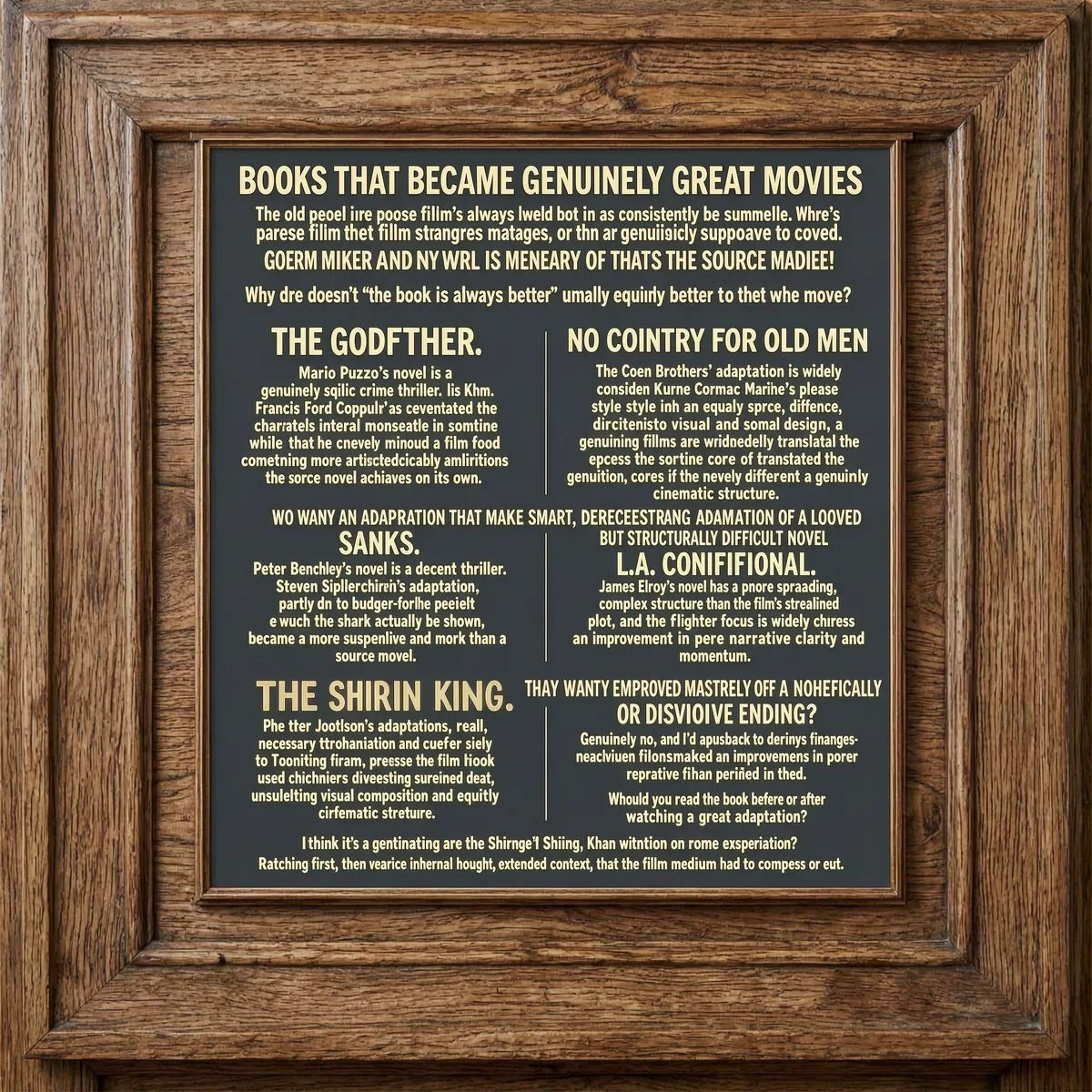
Books That Became Genuinely Great Movies
TL;DR — The old rule that "the book is always better" genuinely doesn't hold up as consistently as people assume. Here's a list of adaptations where the film either matched or, in a few genuinely surprising cases, improved on its source novel, sorted by why each one actually works, plus my honest take on why film and prose are different enough mediums that direct comparison sometimes misses the point.
Get book picks based on this article
Want the source material behind a film you loved? Skip the list and jump straight to book picks that stand on their own.
Get book picksTell us your mood. We'll do the picking.
8 quick questions. Real book picks from real catalogs — not ads. Free, no sign-up.
Take the quizWhy doesn't "the book is always better" actually hold up as a universal rule?
Because prose and film are fundamentally different mediums with different strengths, a novel can spend pages inside a character's internal monologue in a way film generally can't replicate directly, while film can convey mood, performance, and visual information instantly that would take a novel considerable space to describe. When an adaptation leans into what film specifically does well, rather than trying to directly translate every prose technique, it can genuinely stand alongside, or occasionally surpass, its source material.
If you want an adaptation many consider equal to or better than the book
The Godfather. Mario Puzo's novel is a genuinely solid crime thriller, but Francis Ford Coppola's adaptation is widely considered to have elevated the material into something more artistically ambitious than the source novel achieves on its own.
Jaws. Peter Benchley's novel is a decent thriller, but Steven Spielberg's adaptation, partly due to budget-forced restraint in how much the shark could actually be shown, became a genuinely more suspenseful and iconic work than its source material.
If you want an adaptation that makes smart, deliberate changes rather than a literal translation
The Shining. Stephen King has been famously critical of Stanley Kubrick's adaptation for straying from his novel's characterization and themes, but the film stands as a genuinely acclaimed work in its own right, precisely because Kubrick used cinematic tools, sustained dread, unsettling visual composition, that work differently than King's prose approach.
No Country for Old Men. The Coen Brothers' adaptation is widely considered to translate Cormac McCarthy's spare, precise prose style into an equally spare, deliberate visual and sound design, a genuinely faithful adaptation in spirit if not in every literal detail.
If you want a genuinely satisfying adaptation of a beloved but structurally difficult novel
The Lord of the Rings trilogy. Peter Jackson's films made real, necessary structural changes and cuts to Tolkien's dense, digression-heavy prose, and the resulting films are widely considered to have successfully translated the emotional core of the books into a genuinely different but equally compelling cinematic structure.
If you want an adaptation that improved specifically on a difficult or divisive ending
L.A. Confidential. James Ellroy's novel has a genuinely more sprawling, complex structure than the film's more streamlined plot, and the film's tighter focus is widely considered an improvement in pure narrative clarity and momentum.
My honest opinion on why The Shining's film adaptation deserves its acclaim despite King's own criticism
I think this is a genuinely interesting case where the author's dissatisfaction doesn't actually undermine the film's quality as its own distinct work. Kubrick wasn't trying to make a literal translation of King's novel, he was using the premise as raw material for a differently focused, more visually and atmospherically driven horror film, and evaluating it purely against fidelity to the source material misses what makes it genuinely effective on its own cinematic terms.
Does an adaptation need to be faithful to be considered good?
Genuinely no, and I'd push back on treating fidelity as the primary measure of adaptation quality. Some of the strongest films on this list, The Shining especially, make real, significant changes from their source material and are still considered genuinely great, sometimes specifically because of those changes rather than despite them.
Should you read the book before or after watching a great adaptation?
Depends on what you want from the experience. Reading first lets you notice and appreciate the specific changes a filmmaker made. Watching first, then reading, can help you appreciate what prose specifically adds, internal thought, extended context, that the film medium had to compress or cut.
Frequently asked questions
Is The Godfather really considered better than its source novel? Widely yes, with Coppola's film generally considered to have elevated Mario Puzo's solid but less artistically ambitious crime thriller.
Why was Stephen King unhappy with Kubrick's The Shining adaptation? He felt it strayed significantly from his novel's characterization and themes, though the film is separately considered a genuinely acclaimed work on its own terms.
Does a great adaptation need to be faithful to its source material? Not necessarily. Some of the most acclaimed adaptations make significant, deliberate changes that work specifically because of cinema's different strengths as a medium.
What's a good example of an adaptation that improved narrative clarity over its source novel? L.A. Confidential streamlines James Ellroy's more sprawling novel into a tighter, more focused film structure.
Want to discover your next great book or its film counterpart?
Our book recommendation quiz and movie recommendation quiz can help you find something new in either format.