Best Epistolary Novels Worth Reading
TL;DR — Telling a story entirely through letters, diary entries, or other documents is a genuinely distinct structural choice, one that creates intimacy and immediacy a traditional third-person narrative usually can't match as directly. Here's a list of epistolary novels that use the format especially well, sorted by how the device shapes the story itself, plus my honest take on why this structure has made a real comeback in modern fiction.
Get book picks based on this article
Drawn to stories told through someone else's own words? Skip the list and jump straight to book picks in that same intimate register.
Get book picksTell us your mood. We'll do the picking.
8 quick questions. Real book picks from real catalogs — not ads. Free, no sign-up.
Take the quizWhy does the epistolary format create such a different reading experience?
Because it puts you directly inside a character's own unfiltered account of events, with all the gaps, biases, and selective omissions that come with any individual telling their own story. Unlike a traditional narrator who might have some claim to objectivity, epistolary novels are explicitly, structurally limited to what one character chooses to write down, which creates a genuine intimacy but also a built-in unreliability worth staying alert to.
If you want a genuinely classic, foundational example
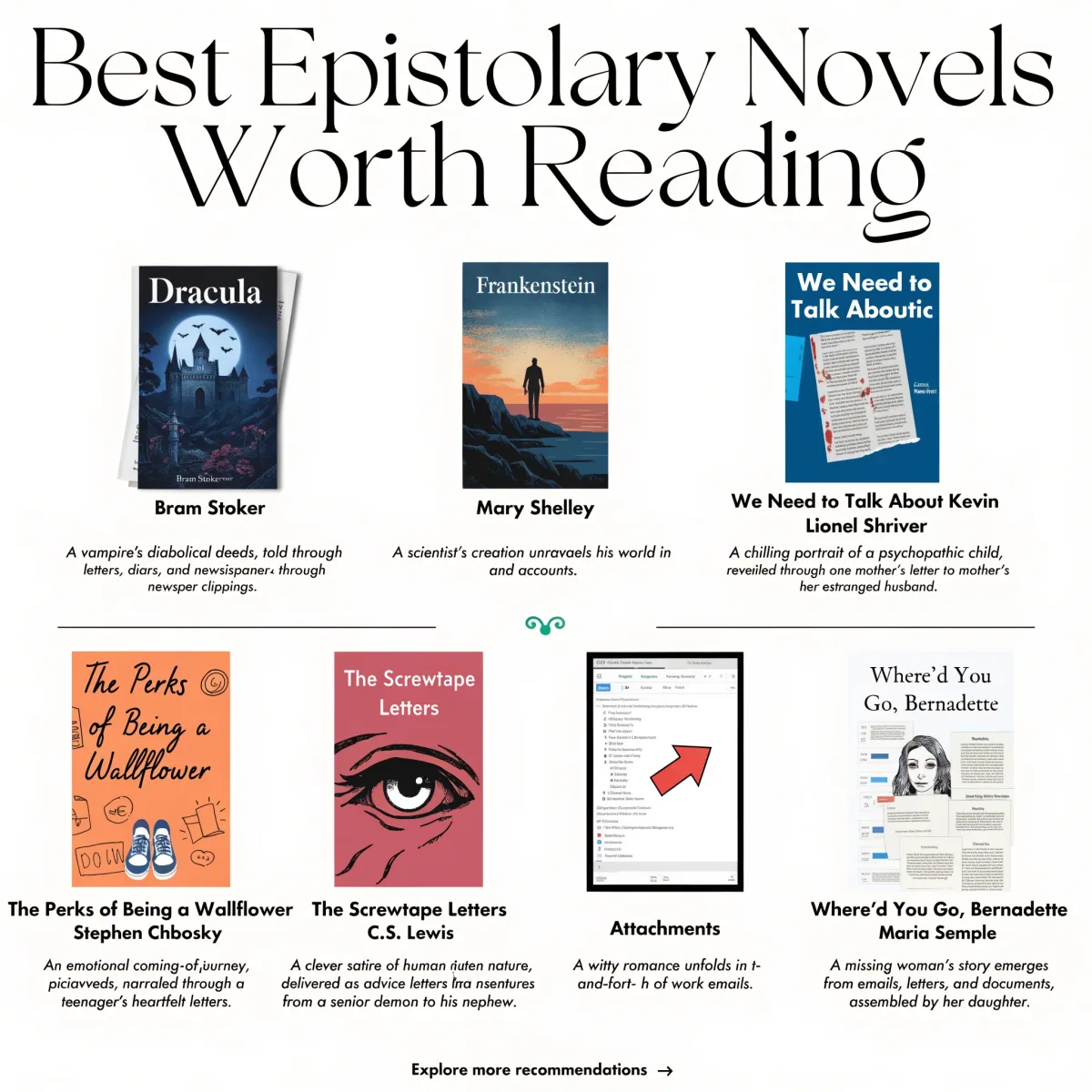
Dracula, Bram Stoker. Told entirely through letters, diary entries, and newspaper clippings, the format itself builds real suspense, since the reader often knows more, or less, than any single character piecing together the horror from their own limited documents.
Frankenstein, Mary Shelley. Structured as nested letters and accounts, using that layered structure to genuinely complicate questions of sympathy and reliability across multiple narrators recounting the same events from different vantage points.
If you want something more contemporary and emotionally intimate
We Need to Talk About Kevin, Lionel Shriver. Told entirely through one mother's letters to her estranged husband, using the format's inherent one-sidedness to build genuine tension around how much of her account can actually be trusted.
The Perks of Being a Wallflower, Stephen Chbosky. Written as a series of letters from an anonymous teenage narrator, using that intimate, confessional format to build real emotional closeness with a genuinely vulnerable protagonist.
If you want a genuinely funny or satirical use of the format
The Screwtape Letters, C.S. Lewis. A genuinely inventive use of the epistolary form, written as advice letters from a senior demon to his nephew, using the one-sided correspondence to explore moral and spiritual themes through dark comedic irony.
Attachments, Rainbow Rowell. Uses workplace emails as its epistolary device, giving the format a genuinely modern, comedic romantic-comedy spin rather than the more gothic or literary uses common in classic examples.
If you want a genuinely ambitious, modern epistolary structure
Where'd You Go, Bernadette, Maria Semple. Assembles its story through emails, letters, and documents pieced together by the missing woman's daughter, using the format for genuine comedic momentum alongside real emotional stakes underneath.
My honest opinion on why the epistolary format has made a real comeback in contemporary fiction
I think modern communication, texts, emails, social media posts, has given contemporary authors a genuinely natural, updated version of the classic letter-based structure, one that feels less like an old-fashioned literary device and more like an accurate reflection of how people actually communicate now. Where'd You Go, Bernadette and Attachments both use this updated version of the format to real comedic and emotional effect, proving the structure still has genuine life well beyond its Victorian-era origins.
Does the epistolary format make a book harder to follow than traditional narration?
Sometimes, since you're often piecing together a fuller picture from fragmented documents rather than following a single continuous narrative thread. But that same quality is often exactly the point, several books on this list, Dracula especially, use that fragmentation deliberately to build suspense and withhold information in a way straightforward narration couldn't replicate as effectively.
Should you read epistolary novels differently than traditional ones?
I'd suggest paying closer attention to who is writing each specific document and why, since the format's built-in unreliability depends on you actively tracking whose perspective you're getting at any given moment, rather than assuming a single, consistent narrative voice throughout.
Frequently asked questions
What's considered a foundational epistolary novel? Dracula, told entirely through letters, diary entries, and newspaper clippings, using that format to build genuine suspense.
Is We Need to Talk About Kevin a good modern epistolary example? Yes, its structure as one-sided letters creates real tension around how much of the narrator's account can be trusted.
Why has the epistolary format made a comeback recently? Modern communication formats, emails and texts, give contemporary authors a natural, updated version of the classic letter structure.
Is the epistolary format harder to follow than traditional narration? Sometimes, since it requires piecing together a fuller picture from fragmented documents, though that fragmentation is often deliberate and adds real suspense.
Want something else matched to your mood?
Our book recommendation quiz can help you find your next read, whether that's more of this format or something else entirely.