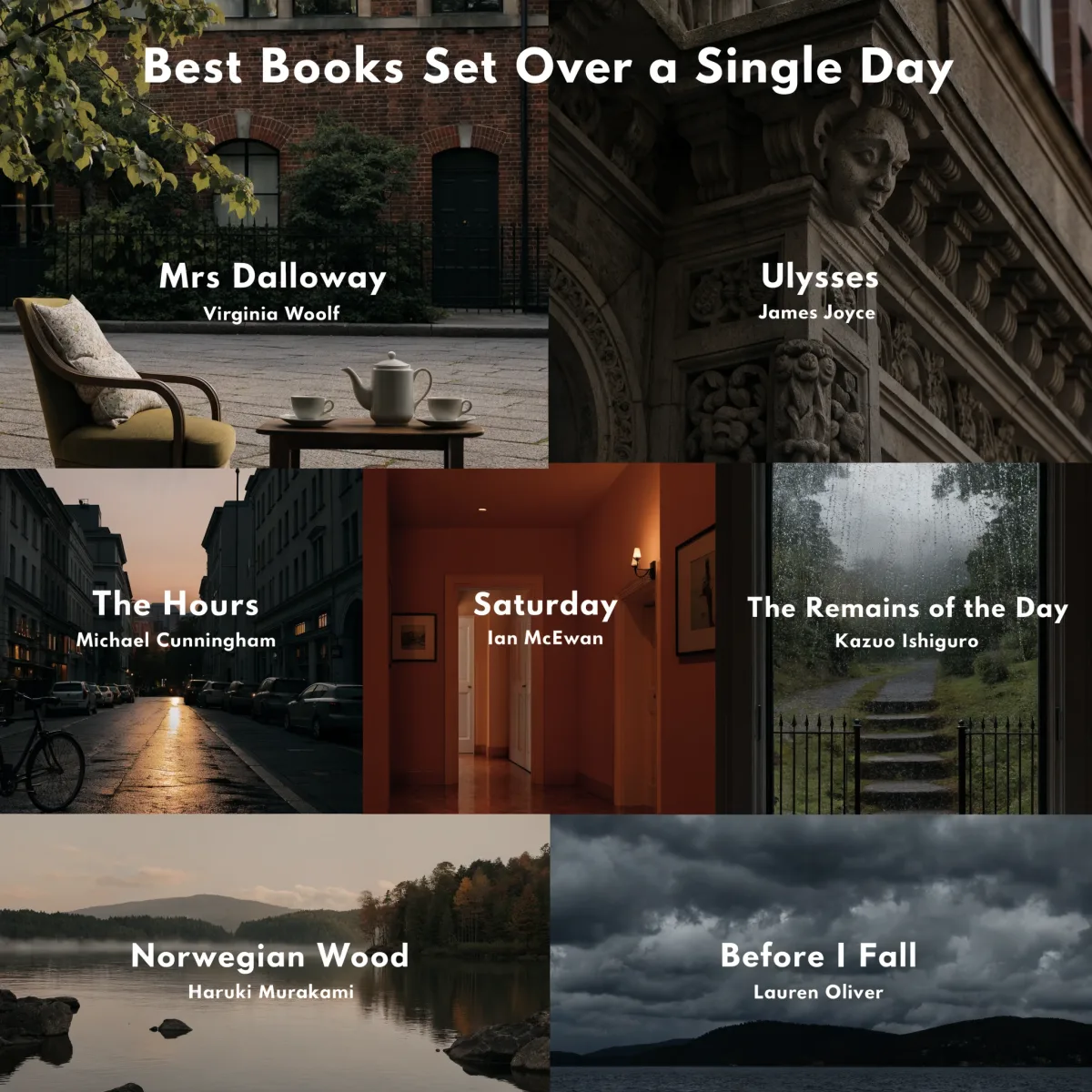
Best Books Set Over a Single Day
TL;DR — Compressing an entire novel into a single day is a genuine structural challenge, no time jumps to skip past slower stretches, no easy shortcuts around a character's internal life. Here's a list of books that turn that constraint into a real strength, sorted by tone, plus my honest take on why this format tends to produce unusually intimate, detail-rich fiction.
Get book picks based on this article
Want a book that slows all the way down into a single day? Skip the list and jump straight to picks built for close, patient attention.
Get book picksTell us your mood. We'll do the picking.
8 quick questions. Real book picks from real catalogs — not ads. Free, no sign-up.
Take the quizWhy does the single-day structure work so well for certain kinds of stories?
Because it forces a genuine focus on interiority and small, granular detail rather than large-scale plot movement. Without room for big time jumps, authors working within a single day have to generate meaning through a character's internal experience of ordinary moments, memory, perception, small decisions, which tends to produce genuinely intimate, closely observed fiction rather than sweeping, plot-heavy narratives.
If you want a genuinely foundational example of the format
Mrs Dalloway, Virginia Woolf. The single most influential single-day novel in modern literature, following Clarissa Dalloway through one ordinary day in London while moving fluidly through memory and interior consciousness in a way that expanded what a novel could actually do with time.
Ulysses, James Joyce. An even more ambitious, sprawling example, using a single day in Dublin as scaffolding for a genuinely massive, formally inventive exploration of consciousness and language.
If you want something more contemporary and accessible
The Hours, Michael Cunningham. A genuinely clever structural response to Mrs Dalloway itself, following three women across three different eras, each living out their own single day, in direct conversation with Woolf's original novel.
Saturday, Ian McEwan. Follows a neurosurgeon through one day in London, using the format to explore genuine anxiety and vulnerability against a backdrop of larger political tension.
If you want a single day used for real emotional weight rather than pure formal experimentation
The Remains of the Day, Kazuo Ishiguro. While structured around a longer road trip, its emotional core hinges on a single, pivotal day the narrator keeps circling back to, using that specific day's memory as the book's genuine emotional center.
Norwegian Wood, Haruki Murakami, while not strictly a single-day novel, uses similarly compressed, intensely detailed stretches of time to build real emotional intimacy, worth mentioning for readers drawn to this format's specific intimacy even outside a literal 24-hour structure.
If you want genre fiction using this same compressed structure
Before I Fall, Lauren Oliver. A young adult novel that uses a single day, repeated across multiple iterations, to explore genuine moral growth and consequence, adapting the single-day format into a genuinely different, more speculative structure.
My honest opinion on why Mrs Dalloway remains the reference point for this entire format
I think it's because Woolf demonstrated, genuinely for the first time at this level of ambition, that an ordinary day could carry as much narrative weight as a sprawling, plot-heavy epic, if you're willing to trust interior consciousness and memory to do the actual narrative work. Every subsequent single-day novel on this list, whether directly in conversation with Woolf like The Hours or simply working in the same tradition, owes a real debt to that foundational demonstration.
Is a single-day novel harder to read than a longer, more plot-driven book?
Genuinely can be, in a different way than length usually implies difficulty. These books often ask you to slow down and pay attention to small, granular detail rather than tracking a fast-moving plot, which can feel demanding if you're used to books built around constant forward momentum. But that same quality is exactly what makes the format rewarding for readers who enjoy close, careful attention to interior experience.
Should you read Mrs Dalloway before The Hours, or does it matter?
I'd genuinely recommend reading Mrs Dalloway first if you can. The Hours is written in direct, deliberate conversation with Woolf's novel, and you'll catch far more of what Cunningham is doing structurally and thematically if you already know the original text it's responding to.
Frequently asked questions
What's considered the most influential single-day novel? Virginia Woolf's Mrs Dalloway, which expanded what a novel could do with time and interior consciousness.
Should I read Mrs Dalloway before The Hours? Yes, ideally, since The Hours is written in direct conversation with Woolf's original novel.
Is Ulysses a good starting point for this genre? It's genuinely ambitious and formally demanding, better suited as a later stop once you're already comfortable with the format rather than a first entry point.
Are single-day novels harder to read than plot-driven books? Often in a different way, demanding close attention to interior detail rather than tracking fast plot movement.
Want something else matched to your mood?
Our book recommendation quiz can help you find your next read, whether that's more of this intimate, compressed format or something entirely different.