Best Nonfiction Books That Read Like a Novel
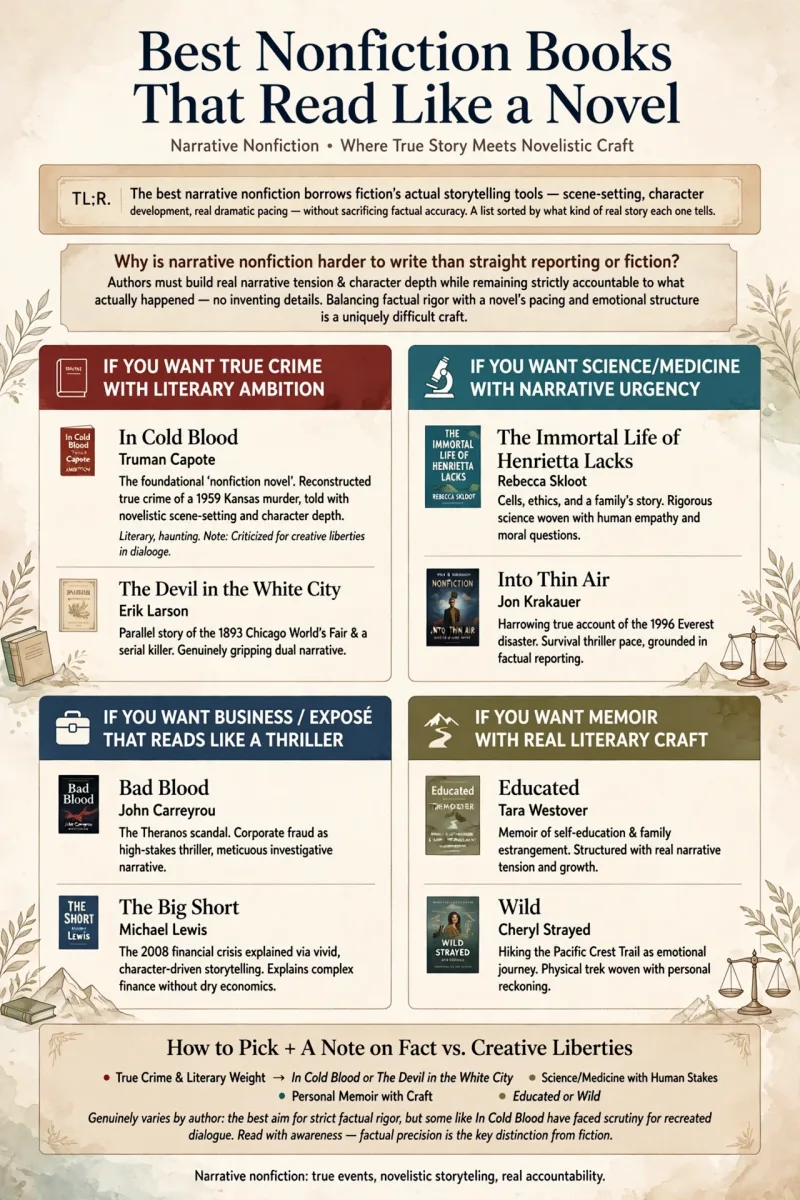
TL;DR — The best narrative nonfiction borrows fiction's actual storytelling tools, scene-setting, character development, real dramatic pacing, without sacrificing factual accuracy. Here's a list sorted by what kind of real story each one tells, plus my honest take on why this genre is genuinely harder to write well than either straight journalism or pure fiction.
Get book picks based on this article
Want a true story told with real dramatic pacing? Skip the list and jump straight to book picks built for exactly that.
Get book picksTell us your mood. We'll do the picking.
8 quick questions. Real book picks from real catalogs — not ads. Free, no sign-up.
Take the quizWhy is narrative nonfiction genuinely more difficult to execute well than either straight reporting or fiction alone?
Because the author has to build genuine narrative tension and character depth while remaining strictly accountable to what actually happened, without the freedom fiction has to invent whatever serves the story best. Getting real events to read with a novel's pacing and emotional structure, without distorting the actual facts to fit a cleaner narrative arc, requires a genuinely difficult balance most writers never fully master.
If you want a true crime story with real literary ambition
In Cold Blood, Truman Capote. Widely credited as one of the foundational works of the "nonfiction novel" form, using genuine novelistic technique, scene reconstruction, internal characterization, to tell the real story of a multiple murder with a literary depth true crime reporting rarely achieves.
The Devil in the White City, Erik Larson. Weaves together the true story of a serial killer and the 1893 Chicago World's Fair with genuinely gripping, parallel narrative structure.
If you want real science or medicine told with narrative urgency
The Immortal Life of Henrietta Lacks, Rebecca Skloot. Combines rigorous scientific reporting with a genuinely compelling personal and family story, exploring the real ethical questions around a woman whose cells were used without consent for decades of medical research.
Into Thin Air, Jon Krakauer. A genuinely harrowing, real account of a disastrous Everest expedition, told with the pacing and tension of a survival thriller while remaining grounded in factual reporting.
If you want a business or true-story exposé that reads like a thriller
Bad Blood, John Carreyrou. The real story of Theranos and Elizabeth Holmes, told with genuine narrative momentum and character development that makes corporate fraud reporting feel as gripping as fiction.
The Big Short, Michael Lewis. Genuinely explains complex financial mechanisms behind the 2008 financial crisis through vivid, character-driven storytelling rather than dry economic analysis.
If you want a memoir with real literary craft, not just personal account
Educated, Tara Westover. A genuinely gripping personal narrative about self-education and family estrangement, structured with real narrative tension despite being a factual memoir.
Wild, Cheryl Strayed. Uses the structure of a physical journey, hiking the Pacific Crest Trail, to give real narrative shape to a genuinely emotional personal reckoning.
My honest opinion on why In Cold Blood remains controversial despite its literary influence
I think it's a genuinely important tension worth knowing about going in, Capote has been criticized by some scholars for taking creative liberties with certain details and dialogue attributed to real people, raising real questions about where narrative nonfiction's fictional techniques should draw an ethical line. That controversy doesn't erase the book's genuine influence on the genre, but it's worth reading with awareness that even acclaimed narrative nonfiction can blur factual precision in service of a cleaner story.
Is narrative nonfiction always completely factually accurate, or does it sometimes take creative liberties?
Genuinely varies by author and book, and it's worth approaching each with some awareness of this tension. The strongest, most respected examples strive for real factual rigor even while using novelistic techniques, but some, In Cold Blood being a notable example, have faced real scrutiny over specific details and reconstructed dialogue.
How should you pick from this list based on what actually interests you?
If you want true crime with real literary weight, In Cold Blood or The Devil in the White City are strong picks. If you want science or medicine with genuine human stakes, The Immortal Life of Henrietta Lacks delivers that. If you want a personal memoir with real narrative craft, Educated or Wild are excellent choices.
Frequently asked questions
What's considered a foundational work of narrative nonfiction? In Cold Blood by Truman Capote, widely credited with pioneering the "nonfiction novel" form, though it's also faced scrutiny over factual accuracy in some details.
Is Bad Blood a good introduction to narrative nonfiction? Yes, it combines rigorous reporting on the Theranos scandal with genuinely gripping narrative momentum.
Does narrative nonfiction always stay completely factually accurate? Generally yes, though some acclaimed examples, particularly In Cold Blood, have faced real scrutiny over specific creative liberties taken.
What's a good memoir with real literary craft, not just a personal account? Educated by Tara Westover and Wild by Cheryl Strayed both use real narrative structure to shape their personal stories.
Want to discover your next great read?
Our book recommendation quiz can help you find something new that fits your mood, fiction or otherwise.