Guide·Updated August 31, 2026·5 min read·By Harshit Chawla

Grand Blue: Is It Worth Watching?

TL;DR — Grand Blue follows Iori Kitahara, a college freshman who moves to a beachside town intending to focus seriously on his studies, only to be immediately swept into his uncle's chaotic diving shop and its equally chaotic community of scuba diving enthusiasts and habitual drinkers. One 12-episode season exists. Here's what makes this genuinely uproarious college comedy such a beloved cult favorite, and why its specific brand of chaos rewards patient, willing viewers.

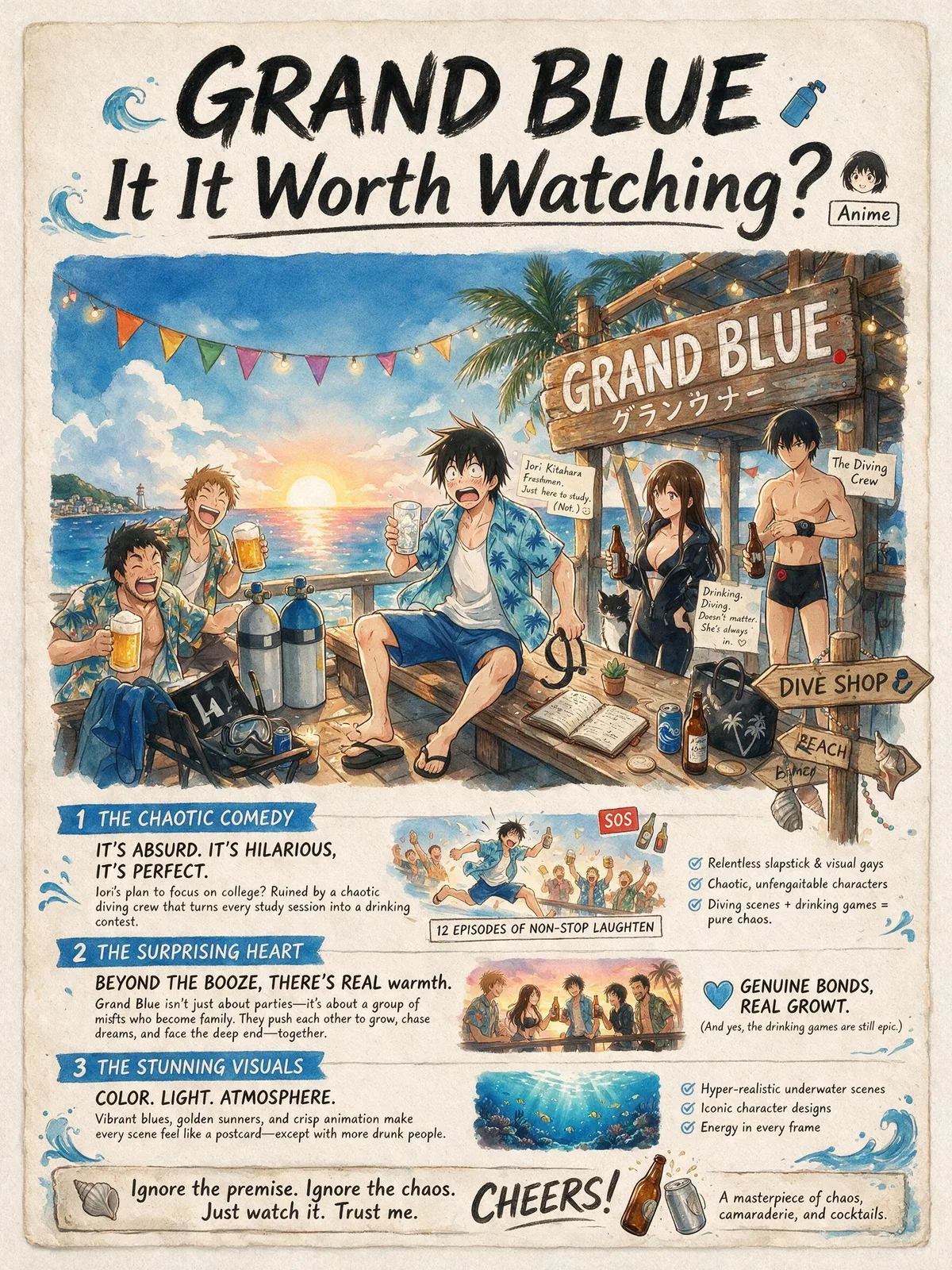
Grand Blue cover art of Iori and the diving crew drinking beer at sunset on a beachside deck, titled Is It Worth Watching.
Chaos, drinking games, and a diving shop that barely dives.

What's the actual premise?

Iori Kitahara arrives at his new college town with genuine, serious intentions to focus on his studies, but quickly gets pulled into the orbit of his uncle's scuba diving shop, populated by a genuinely unhinged cast of upperclassmen who spend far more time drinking and causing chaos than actually diving. Despite his initial reluctance, Iori gradually becomes fully absorbed into this chaotic community and its escalating misadventures.

Who are the key recurring characters that drive the show's specific brand of chaos?

Kohei and Aoi, two upperclassmen at the diving club, function as the show's primary chaos agents, constantly dragging Iori into escalating drinking games and social disasters with genuinely relentless energy. Their specific dynamic with Iori, alternately mentoring and tormenting him, gives the show a consistent comedic engine beyond just random chaos for its own sake.

Why is this show specifically praised for its comedic timing and animation?

Because it uses genuinely exaggerated, high-energy animation and expression work to heighten its already absurd comedic scenarios, treating relatively mundane college social situations, drinking games, awkward encounters, with an intensity and visual inventiveness that elevates simple premises into genuinely memorable comedic set pieces. Character reactions are drawn with genuinely extreme, almost grotesque exaggeration during peak comedic moments, a stylistic choice that's become one of the show's signature qualities.

Does the show actually involve much scuba diving, given its premise?

Genuinely less than the premise might suggest, the diving shop setting mostly serves as a backdrop for the characters' social chaos and drinking-fueled misadventures, rather than the show being substantively about the sport of diving itself. Viewers expecting a genuine diving-focused anime based on the title and setting should adjust expectations accordingly.

Is the content in this show appropriate for younger viewers?

No, genuinely not, given its heavy focus on drinking culture and occasional crude humor, this is clearly intended for a mature audience despite its otherwise lighthearted tone.

Is the humor genuinely funny, or does it rely too heavily on repetitive gags?

Widely considered genuinely funny by fans specifically for its commitment to escalating absurdity within recurring situations, though some repetitive elements, particularly around drinking-related humor, are a real, consistent throughline rather than a flaw some viewers might expect to diminish over time. The show's willingness to fully commit to its chosen comedic register without holding back is precisely what fans cite as its strongest quality.

Is the ensemble cast well developed beyond just being comedic vehicles?

Reasonably, the show gives its main recurring characters genuine, if broad, personality traits and running gags that build real familiarity and affection across the season, even if character development isn't the show's primary focus compared to pure comedic execution. Iori's own growth from reluctant, studious newcomer to genuine, willing member of the chaotic community provides a real, if lighthearted, throughline across the season.

Is this a good anime for someone who wants pure comedy without any heavier themes?

Yes, genuinely one of the stronger picks for that specific mood, delivering sustained, high-energy humor without requiring investment in dramatic plot or heavier emotional material.

How does Grand Blue compare to other college or slice-of-life comedy anime?

Its specific willingness to commit fully to genuinely raucous, drinking-focused chaos distinguishes it from gentler, more slice-of-life-oriented college comedies, giving it a distinct, more unapologetically rowdy identity within that broader category.

Frequently asked questions

How many episodes is Grand Blue? 12 episodes, forming one complete comedy season.

Does Grand Blue actually focus much on scuba diving? Genuinely less than the premise suggests, the diving shop mostly serves as a backdrop for social chaos rather than the sport itself.

Is Grand Blue appropriate for younger viewers? No, given its heavy focus on drinking culture and occasional crude humor, it's intended for mature audiences.

Is the humor genuinely funny throughout? Widely considered so by fans, particularly for its commitment to escalating absurdity within recurring situations.

Is the ensemble cast well developed? Reasonably, with genuine broad personality traits and running gags, though character depth isn't the primary focus.

Is this a good pick for pure comedy without heavier themes? Yes, genuinely one of the stronger options for that specific mood.

What's the source material for Grand Blue? A manga by Kenji Inoue and Kimitake Yoshioka.

Does the show rely too heavily on repetitive gags? Some repetitive elements, particularly drinking-related humor, are a consistent throughline that most fans embrace rather than find tiresome.

Who are the key characters driving the show's chaos? Kohei and Aoi, two upperclassmen who constantly drag Iori into escalating social disasters.

Does Iori's character actually grow across the season? Yes, genuinely, from a reluctant, studious newcomer to a willing member of the chaotic community.

How does the animation style contribute to the comedy? Character expressions are drawn with genuinely extreme exaggeration during peak comedic moments, a signature stylistic choice.

How does Grand Blue differ from gentler slice-of-life college comedies? Its full commitment to raucous, drinking-focused chaos gives it a distinctly rowdier identity within the broader genre.

Want something else with this kind of high-energy comedy?

Our anime recommendation quiz can help you find something similar.

Related essays from the Journal

Anime vs Western Cartoons: DifferencesJuly 12, 2026Why is isekai anime so popular?July 12, 2026

More guides like this

Frieren: Beyond Journey's End, Is It Worth the Hype?August 12, 2026Spy x Family: Where to Start and What to Know Going InAugust 13, 2026