JoJo's Bizarre Adventure Watch Order Explained
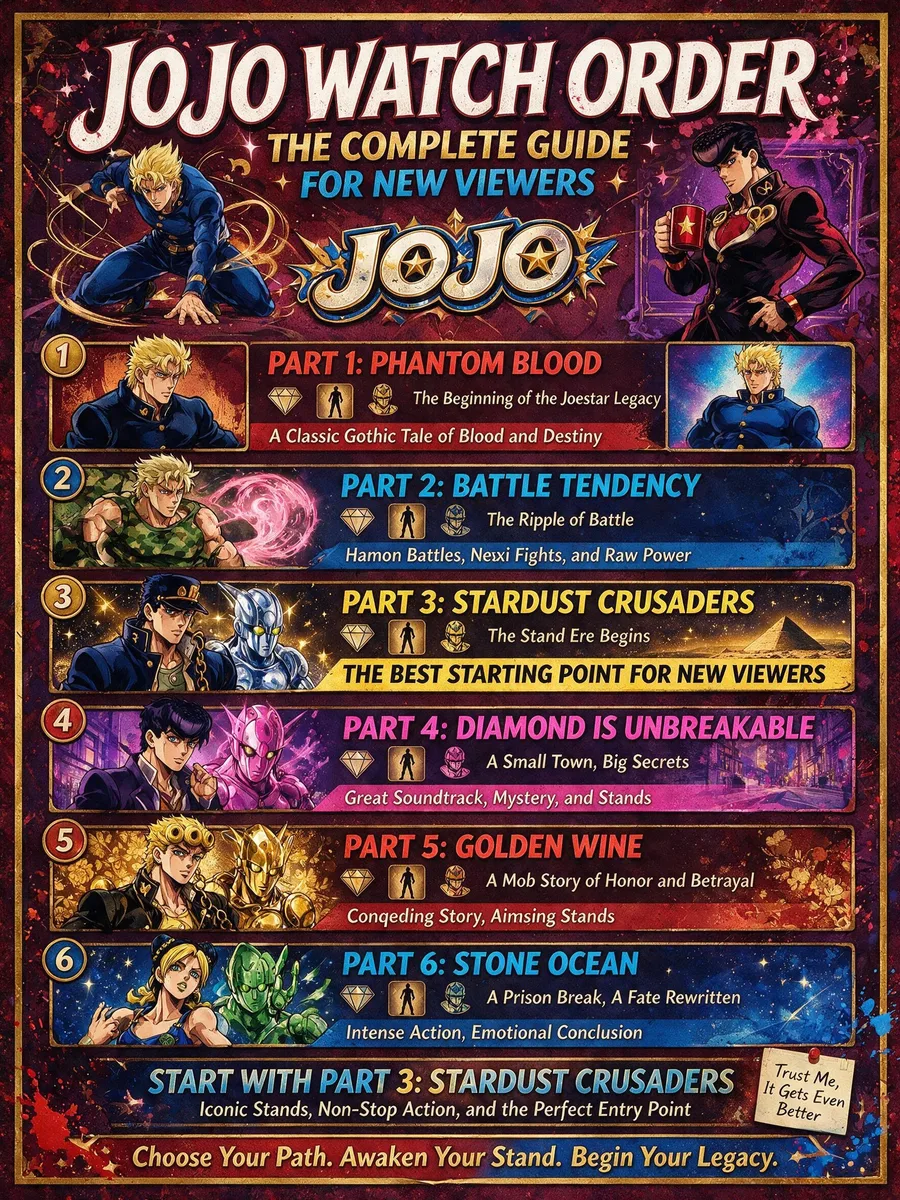
TL;DR — Watch JoJo's Bizarre Adventure by Part, in release order: Phantom Blood, Battle Tendency, Stardust Crusaders, Diamond Is Unbreakable, Golden Wind, Stone Ocean, then Steel Ball Run. That's 190 episodes before Part 7. Each Part follows a new Joestar with a new cast, so if Parts 1 and 2 feel slow, starting at Part 3 is a common and reasonable shortcut.
Get anime picks based on this article
Want something with this kind of over-the-top energy? Get picks matched to it.
Get anime picksTell us your mood. We'll do the picking.
8 quick questions. Real anime picks from real catalogs — not ads. Free, no sign-up.
Take the quizThe watch order
JoJo is split into Parts. Each one follows a different member of the Joestar family, in a different decade, with a new cast. Watch them in release order:
- Phantom Blood (2012): 9 episodes. Victorian England, Jonathan Joestar and Dio Brando.
- Battle Tendency (2012-2013): 17 episodes. Jonathan's grandson Joseph, 1938.
- Stardust Crusaders (2014-2015): 48 episodes, split into two seasons. Jotaro Kujo travels to Egypt to find Dio.
- Diamond Is Unbreakable (2016): 39 episodes. Josuke Higashikata in the Japanese town of Morioh, 1999.
- Golden Wind (2018-2019): 39 episodes. Giorno Giovanna in the Italian mafia, 2001.
- Stone Ocean (2021-2022): 38 episodes, released in three batches on Netflix. Jolyne Cujoh in a Florida prison, 2011.
- Steel Ball Run (2026, airing): a 47-minute first episode on March 19, then 11 weekly episodes from September 25 to December 4, 2026.
Parts 1 and 2 were broadcast together as one 26-episode season, so on most services they appear under a single "Season 1." Part 8, JoJolion, has no anime announced.
How long it takes
Parts 1 to 6 add up to 190 episodes of about 24 minutes, roughly 75 hours. The two big commitments are Stardust Crusaders (about 19 hours) and the three 38 to 39-episode Parts after it (15 to 16 hours each). Phantom Blood alone is under four hours.
Part 1 or Part 3: where should you start?
Start at Part 1 if you like knowing the whole story and don't mind an older style. Phantom Blood is short, Battle Tendency is one of the funniest Parts, and together they set up Dio, the villain of Part 3.
Start at Part 3 if you want the version of JoJo people usually mean. Stardust Crusaders introduces Stands, the visible fighting spirits that every later Part is built on. The story explains the family history you skipped, and you can go back to Parts 1 and 2 afterwards.
Our verdict: if you've tried Phantom Blood and it isn't clicking by episode 4 or 5, jump to Part 3 rather than quitting. The series changes a lot.
How the Parts differ
- Stardust Crusaders is a road trip with a Stand battle in nearly every stop, which some viewers find repetitive in the middle stretch.
- Diamond Is Unbreakable stays in one town and slowly turns into a hunt for a hidden killer. It's the most down-to-earth Part.
- Golden Wind is a gang story with a tight team and some of the series' most inventive fights.
- Stone Ocean is darker and more complicated, with the series' first female lead.
- Steel Ball Run restarts the universe. Johnny Joestar and Gyro Zeppeli race across 1890s America, so it's the one Part you can start cold.
Where to stream each Part
Parts 1 to 5 are on Crunchyroll and, in many regions, Netflix. Stone Ocean and Steel Ball Run are Netflix exclusives, so if you only have Crunchyroll you'll need to switch for the last two. Catalogs differ by country, so check your region before planning a marathon.
Frequently asked questions
Do I need to watch Parts 1 to 6 before Steel Ball Run? No. Part 7 is set in a separate universe with new characters, so it works as a starting point. Earlier Parts make some names and motifs more meaningful.
Is JoJo a good first anime? It can be, but its loud style, poses and long fights are an acquired taste. If you're new to anime, a shorter series first is an easier way in.
Want something else with this energy?
Our anime quiz can match something to the mood you're in, with episode counts and ratings for each pick.