Oshi no Ko: What to Know Before You Start
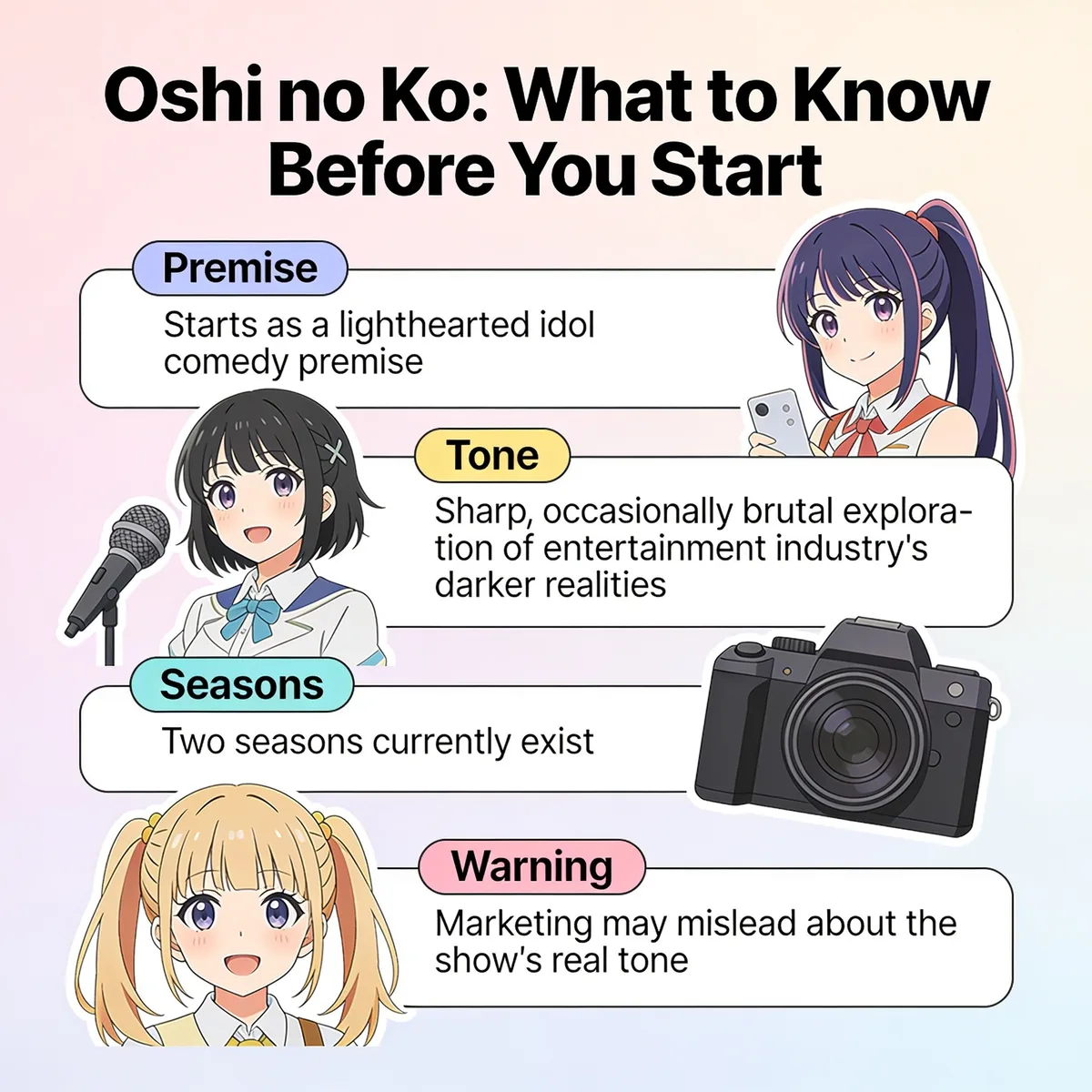
TL;DR — Oshi no Ko is one of the more genuinely surprising anime of the past few years, starting with a premise that sounds like a lighthearted idol comedy and rapidly becoming a sharp, occasionally brutal exploration of the entertainment industry's darker realities. Two seasons currently exist. Here's what to actually expect, since the marketing can be genuinely misleading about the show's real tone, and why its central twist reshapes everything that follows.
Get anime picks based on this article
Want a sharp, critical take on the entertainment industry? Skip the guide and jump straight to picks built for that.
Get anime picksTell us your mood. We'll do the picking.
8 quick questions. Real anime picks from real catalogs — not ads. Free, no sign-up.
Take the quizWhat's the actual premise?
A country doctor who idolizes a young, rising pop star ends up reincarnated as one of her newborn twins after a genuinely shocking early plot twist, retaining memories of his past life. Growing up immersed in the entertainment industry from a genuine insider's perspective, the twins navigate the harsh realities of idol culture, acting, and fame, including exploitation, manufactured personas, obsessive fandom, and real professional cruelty behind the industry's polished public image.
Why do people warn newcomers so specifically about the show's tonal shift?
Because the premise and early marketing suggest a cute, colorful idol-focused comedy or drama, when the actual show is considerably darker, dealing directly with industry exploitation, obsessive and dangerous fandom, and a genuinely shocking early plot development within the first episode that completely reframes the entire story going forward. Going in expecting light idol fluff will genuinely catch you off guard, and I'd recommend knowing that going in rather than being blindsided.
Is this show critical of the entertainment industry, or does it ultimately celebrate it?
Genuinely critical, and specifically, pointedly so. The show uses its idol and acting industry backdrop to examine real, uncomfortable dynamics: how young performers get manufactured into marketable, often dishonest personas, how fans can develop genuinely unhealthy, even dangerous obsessions with the performers they idolize, and how the industry's glossy surface often conceals real exploitation and cynicism underneath, from producers, from media outlets, and sometimes from the performers themselves.
How does the show's reincarnation premise actually function within the larger story?
It's less a fantastical gimmick and more a structural device that gives the protagonist genuine insider knowledge and adult perspective within a child's body, letting the show explore the entertainment industry from a uniquely double vantage point, innocent enough to be genuinely affected by it, knowledgeable enough to see through its more manipulative aspects immediately.
How many seasons are there, and how much of the manga do they cover?
Two seasons currently, adapting a substantial early portion of Aka Akasaka and Mengo Yokoyari's ongoing manga. The story continues well beyond where the anime currently stands, with real plot developments still ahead in the source material.
Is the content in this show appropriate for younger viewers, given the idol premise?
No, genuinely not, despite the surface-level idol aesthetic that might suggest otherwise to someone judging purely by marketing or character designs. The show deals with mature themes including exploitation, manipulation, obsessive stalking behavior, and disturbing plot developments that make it a clearly adult-oriented series regardless of its colorful, idol-culture presentation.
Is this a good anime for someone interested in the entertainment industry specifically?
Genuinely yes, if you want a fictionalized but pointed examination of how the entertainment industry actually operates behind its polished public image. Few anime commit this thoroughly to depicting the darker mechanics of fame, manufactured stardom, and the specific pressures placed on young performers.
Is the animation and production quality notable?
Yes, genuinely. Studio Doga Kobo handles the production with real visual polish, and the opening sequence in particular became a genuine cultural phenomenon on its own, praised for its stylistic ambition well beyond a typical anime intro.
Frequently asked questions
Is Oshi no Ko really a cute idol anime? Not really, despite the marketing. It's a considerably darker exploration of entertainment industry exploitation wrapped in an idol premise.
How many seasons of Oshi no Ko are there? Two seasons currently, adapting an early portion of the still-ongoing manga.
Is Oshi no Ko appropriate for younger viewers? No, it deals with mature, disturbing themes despite its colorful surface aesthetic.
Is Oshi no Ko critical of the entertainment industry? Yes, genuinely and pointedly, examining exploitation and manufactured stardom rather than celebrating idol culture uncritically.
Does the reincarnation premise feel like a gimmick, or does it serve the story? It genuinely serves the story, giving the protagonist a dual insider-outsider perspective on the industry.
Is the animation quality notable? Yes, Studio Doga Kobo's production has real visual polish, and its opening sequence became a genuine cultural moment on its own.
Want something else with this level of sharp social commentary?
Our anime recommendation quiz can help you find something similar.