Sci-Fi Series for People Who Don't Usually Like Sci-Fi
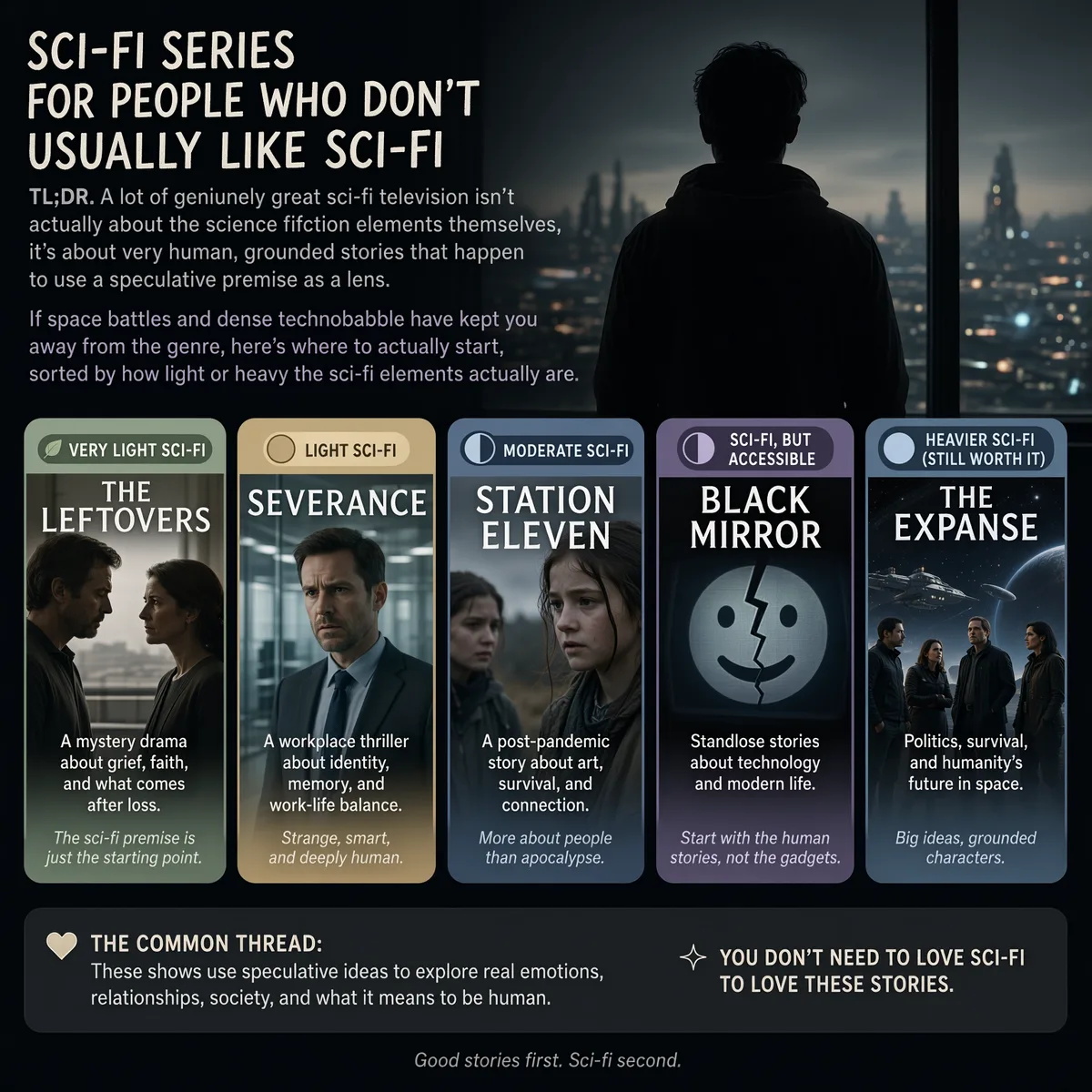
TL;DR — A lot of genuinely great sci-fi television isn't actually about the science fiction elements themselves, it's about very human, grounded stories that happen to use a speculative premise as a lens. If space battles and dense technobabble have kept you away from the genre, here's where to actually start, sorted by how light or heavy the sci-fi elements actually are.
Skip ahead
Get series recommendations based on this article
Sci-fi premise, human story — want more like it? Skip the list and jump straight to picks built around real emotional stakes.
Get series picksSkips the quiz — takes you straight to a real shortlist.Or take the quiz
Tell us your mood. We'll do the picking.
8 quick questions. Real series picks from real catalogs — not ads. Free, no sign-up.
Take the quizWhy do so many non-sci-fi fans assume they'll hate the genre?
Because the genre's most visible, marketed entries, big space operas with heavy mythology and technical jargon, aren't actually representative of everything sci-fi as a category can do. A huge amount of the genre's best recent television work uses its speculative premise almost entirely in service of character drama, using the "what if" as a way into very human questions rather than as the actual point of the show.
If you want almost no actual sci-fi trappings
Severance. The premise, employees who surgically split their consciousness between work and home life, is genuinely science fiction, but the show barely feels like it. It's much closer to a workplace mystery and psychological drama that happens to use a single, tightly contained sci-fi conceit as its engine.
Black Mirror, at least its more grounded episodes. Some installments lean into heavier sci-fi concepts, but plenty are closer to near-future extrapolations of technology we already have, making them feel more like unsettling social commentary than traditional science fiction.
If you want a light sci-fi premise wrapped around real emotional stakes
Station Eleven. Technically post-apocalyptic, but the show is much more interested in art, memory, and human connection after catastrophe than in worldbuilding the mechanics of its pandemic. It's one of the more literary, emotionally focused pieces of speculative fiction made for television in recent years.
The Leftovers. Not strictly sci-fi in the traditional sense, its central premise, a small percentage of the world's population inexplicably vanishing, is never explained or resolved, and the show has zero interest in doing so. It's really a show about grief and faith that uses an unexplained speculative event as its starting point.
If you want a genuinely gentle entry point into harder sci-fi concepts
For All Mankind. An alternate history where the Space Race never ended, this show uses its central conceit primarily to explore character relationships and political drama across decades, with the actual space technology serving the story rather than dominating it.
Silo. A dystopian premise, but the show functions largely as political and social drama within a contained underground setting, closer to a locked-room mystery than a sprawling sci-fi epic.
My honest opinion on why these shows work for skeptical viewers
I think the common thread across every show on this list is that none of them ask you to care about the science itself. Severance doesn't explain the surgical procedure in detail. The Leftovers never explains the disappearance. Station Eleven isn't interested in virology. What they all share is using a speculative premise as a genuinely efficient way to isolate a human question, grief, identity, connection, that would take much longer to get to in a purely realistic drama.
How should you actually pick where to start?
If you want almost zero traditional sci-fi feel, start with Severance. If you want something with real emotional weight built around an unexplained speculative event, The Leftovers or Station Eleven are strong picks. If you want to ease into harder sci-fi concepts gradually, For All Mankind or Silo give you a gentler on-ramp than jumping straight into more traditionally dense science fiction.
Frequently asked questions
What's a good sci-fi show for someone who doesn't like traditional science fiction? Severance is a strong starting point, since its premise is speculative but the show functions much more like a workplace mystery.
Is The Leftovers considered science fiction? Loosely, its central unexplained event is speculative, but the show is much more focused on grief and faith than traditional sci-fi worldbuilding.
What's a gentler entry point into harder science fiction? For All Mankind eases you in gradually, since its alternate-history space race premise mainly serves character and political drama.
Does Silo require understanding a lot of sci-fi worldbuilding? Not really. It functions largely as a contained political and social drama despite its dystopian setting.
Want something matched more specifically to your mood?
Our series recommendation quiz can help point you toward something in this register if none of these feel like quite the right fit tonight.