Guide·Updated August 25, 2026·6 min read·By Harshit Chawla

Sword Art Online: Is It Worth Watching, and Where Should You Start?

TL;DR — Sword Art Online is arguably the single anime most responsible for turning trapped-in-a-video-game isekai into a mainstream genre, and it remains genuinely worth watching for its first arc, even though the show's reputation gets more divisive the further it goes. Four seasons currently exist, plus multiple films. Here's what to actually expect from each stretch of the show, and why I'd manage your expectations very differently depending on which arc you're watching.

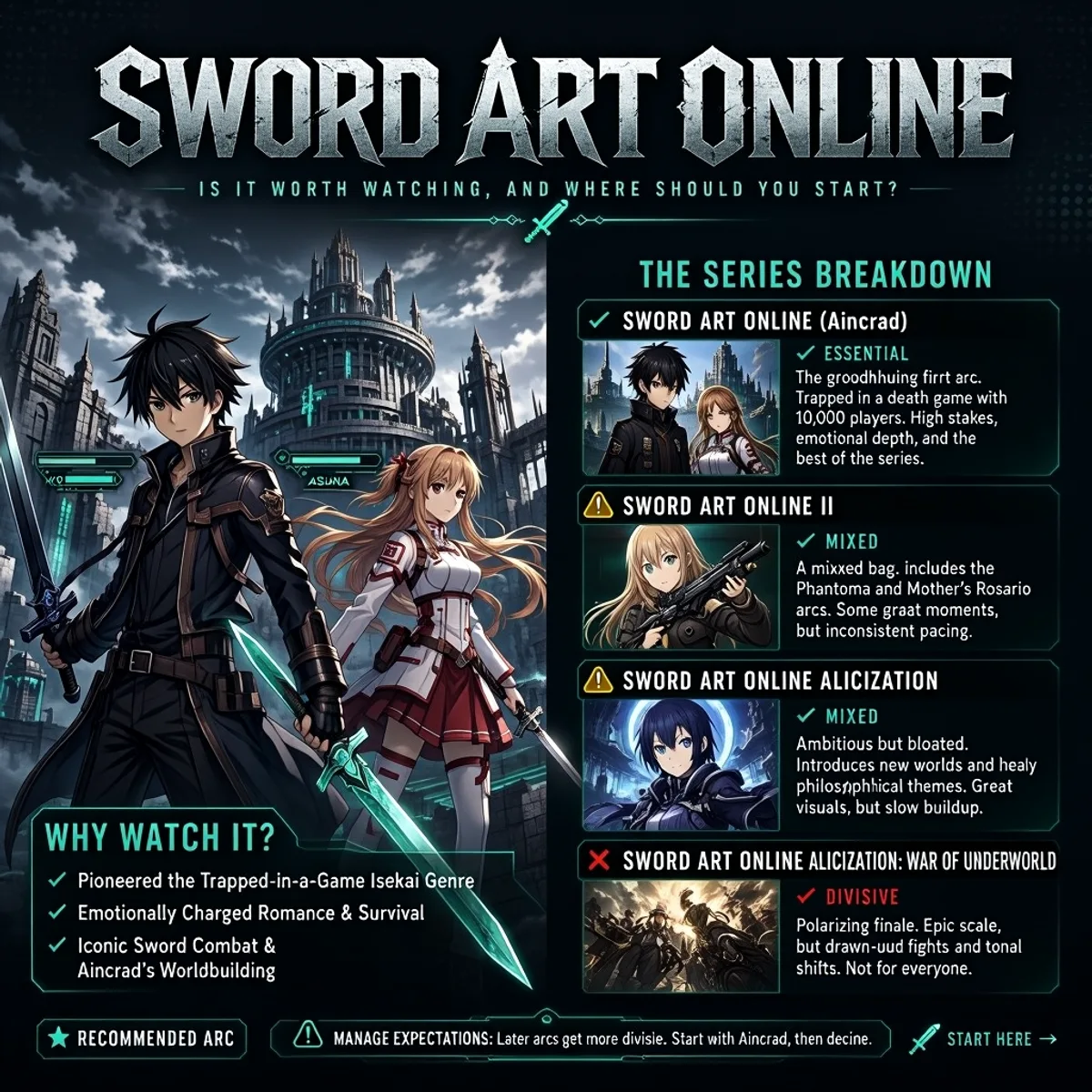
Sword Art Online infographic featuring Kirito and Asuna with swords drawn, alongside a season-by-season breakdown recommending starting with the Aincrad arc.
Start with Aincrad, then decide.

What's the actual premise?

Ten thousand players log into Sword Art Online, a groundbreaking new virtual reality MMORPG, only to discover the game's creator has trapped them inside with no way to log out. The catch is genuinely brutal: dying in the game means dying in real life, and the only way anyone escapes is by clearing all 100 floors of the game's massive tower, Aincrad. Kirito, one of the more skilled beta testers turned full players, has to survive not just the game's monsters and floor bosses, but the psychological toll of a world where every death is permanent and irreversible.

Why did this specific premise become so influential?

Because it arrived at almost exactly the right cultural moment, as online gaming culture was becoming mainstream, and it packaged a genuinely high-concept premise, real stakes inside a fictional game world, into an accessible action-adventure format. Its success is a big part of why "trapped in a game" and "reincarnated into a fantasy world" isekai exploded into one of anime's dominant genres over the following decade, for better and for worse depending on who you ask.

Why does this show get such mixed reactions online, more than most long-running anime?

Because its quality is genuinely inconsistent across arcs in a way that goes beyond typical show-to-show variation. The first arc, Aincrad, is widely praised, even by people who dislike the franchise's later direction, for its genuinely tense stakes, careful world-building, and real exploration of how ordinary people cope when trapped in mortal danger for years at a time. Later arcs have drawn real, sustained criticism for leaning harder into fan service, romantic harem dynamics around Kirito, and giving him increasingly overpowered abilities that undercut the careful tension the first arc built so deliberately.

Is the first season worth watching on its own, even if I never continue?

Genuinely yes, and if you only watch one arc of this franchise, make it this one. Aincrad's central premise, real death for in-game failure, gives every decision genuine weight that later, safer arcs simply don't replicate. The show's exploration of how thousands of trapped players build makeshift societies, form alliances, and cope with genuine, sustained psychological pressure over roughly two years of in-game time is its strongest, most thoughtful material by a clear margin. Kirito's own arc from a somewhat cold loner to someone who builds real, meaningful relationships under impossible circumstances lands with genuine weight here specifically.

What actually happens in the arcs after Aincrad, and why do people criticize them?

Season 2 moves into Alfheim Online and later Gun Gale Online, introducing new game worlds, new stakes, and a broader cast. Criticism generally centers on a few recurring issues: Kirito becomes progressively more overpowered with fewer genuine setbacks, the show leans increasingly into a harem dynamic where multiple female characters are romantically drawn to him without much narrative justification, and some later arcs feel more interested in spectacle and fan service than the careful stakes-building that made Aincrad work. That said, individual arcs vary in quality, and dismissing everything after Season 1 uniformly isn't entirely fair either.

Should I keep watching after Season 1 if I genuinely liked it?

Depends on your tolerance for that tonal shift. Season 2 and beyond introduce new game worlds and story arcs that some fans enjoy for expanding the universe and giving side characters more spotlight, while others feel they dilute what made the first arc distinct and tense. My honest recommendation is to try Season 2 yourself and decide based on your own reaction rather than assuming it'll disappoint you purely based on online discourse, since plenty of viewers do genuinely enjoy the later material on its own terms.

How many seasons and movies are there in total, and which are essential?

Four TV seasons plus several films, including Sword Art Online: Ordinal Scale, a movie-original story, and the more recent Progressive movie series, which specifically retells the Aincrad arc in significantly more depth and detail than the original TV adaptation had room for. If you loved Season 1 and want more of that specific arc rather than moving into the more divisive later seasons, the Progressive films are genuinely worth seeking out as a deeper, more fleshed-out version of that same story rather than new content.

Is this a good pick for someone who's tired of typical isekai tropes?

Only partially, and it's worth being honest about this rather than oversell the show. SAO is one of the genre's foundational, most influential entries, but it also popularized several tropes, including an overpowered male lead surrounded by an adoring harem of female characters, that isekai fatigue is often specifically a reaction against. If those particular tropes bother you in other shows, they're present here too, just with genuine historical significance attached to where they originated. Watching SAO with that context in mind, as the franchise that set the template rather than expecting it to have transcended the template, is probably the healthiest way to approach it.

Is the animation quality consistent across all four seasons?

Reasonably, though production values have generally improved as the franchise's budget grew with its commercial success. Studio A-1 Pictures has handled the series throughout, and later seasons and films generally look more polished than the earlier TV episodes, even if some fans feel the visual improvement hasn't been matched by consistent narrative quality.

Frequently asked questions

Is Sword Art Online worth watching just for Season 1? Yes, genuinely. The Aincrad arc stands as a strong, complete story even if you never continue further into the franchise.

Why do people criticize the later Sword Art Online seasons? Mainly for leaning into fan service and harem dynamics, and for giving Kirito increasingly overpowered abilities that reduce narrative tension compared to the first arc.

Should I watch the Progressive movies instead of Season 1? They're a more detailed retelling of the same arc, worth watching either alongside or instead of the TV version if you specifically want more depth on that story.

Is Sword Art Online a good anime for isekai beginners? Yes, it's historically very influential, though it also includes tropes that isekai-fatigued viewers specifically tend to dislike, so go in with that context.

Do the later seasons ever recapture the tension of the first arc? Occasionally, in stretches, though general critical consensus is that nothing quite matches Aincrad's sustained stakes.

Is the animation quality consistent throughout the franchise? Generally improving over time as the franchise's budget grew, though narrative consistency hasn't necessarily kept pace.

Want something else in this genre?

Our anime recommendation quiz can help you find something similar, or something that avoids SAO's more divisive tropes entirely.

Related essays from the Journal

Sub vs dub: which is better?July 12, 2026How Anime Recommendation Engines WorkJune 29, 2026

More guides like this

Anime Suggestions for Beginners: 10 PicksJune 29, 2026Best Short Anime Series: Top 10 ShowsJune 29, 2026