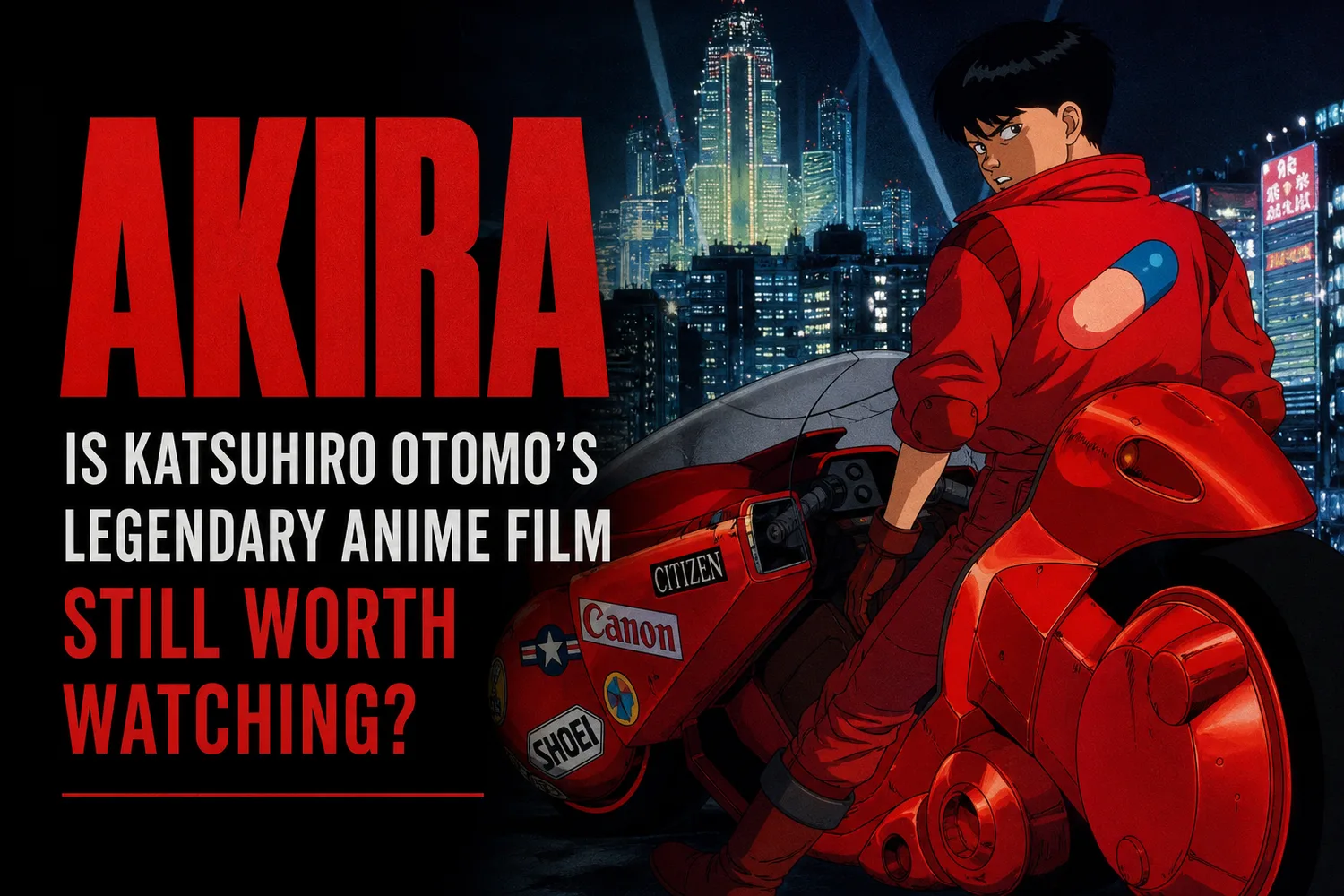
Akira: Is Katsuhiro Otomo's Legendary Anime Film Still Worth Watching?
TL;DR — Akira, director Katsuhiro Otomo's 1988 adaptation of his own manga, remains one of the most influential animated films ever made, a sprawling, visually staggering cyberpunk epic set in Neo-Tokyo, following biker gang member Tetsuo Shima after a motorcycle accident triggers a terrifying, escalating psychic power inside him that threatens to unleash the same catastrophic event that destroyed the original Tokyo decades earlier. Decades after its release, Akira's fingerprints are visible across countless subsequent films, anime, and broader pop culture. Here's everything worth knowing about the film, plus my honest opinion on why it remains essential viewing even now.
Get anime picks based on this article
Want another genre-defining, visually groundbreaking anime film? Skip the search and jump straight to picks built for that.
Get anime picksTell us your mood. We'll do the picking.
8 quick questions. Real anime picks from real catalogs — not ads. Free, no sign-up.
Take the quizWhat is Akira about?
Set in 1988, err, more precisely set in 2019 Neo-Tokyo, a city rebuilt after Tokyo's destruction decades earlier in a mysterious explosion widely believed to have triggered World War III, Akira follows Tetsuo Shima and Shotaro Kaneda, members of a biker gang navigating a decaying, socially fractured city on the edge of open revolt. When Tetsuo crashes his motorcycle after encountering a strange, psychically gifted child who's escaped from a secretive government research facility, he's taken into military custody, where doctors discover he's developing terrifying, rapidly escalating psychic abilities of his own.
As Tetsuo's powers grow increasingly uncontrollable and destructive, Kaneda, government and military officials, and a group of similarly psychic children connected to a mysterious figure named Akira, whose own catastrophic power was apparently responsible for the original Tokyo's destruction, race to understand and contain the threat Tetsuo now represents before his abilities spiral entirely out of control and history repeats itself on an even larger scale.
Who's behind the film?
Katsuhiro Otomo wrote and directed the film, adapting his own sprawling manga series of the same name, which he'd been serializing since 1982 and which continued publication for several years after the film's release, meaning the movie necessarily condenses and diverges from the manga's considerably longer, more expansive narrative in order to fit a feature-length runtime. The film was produced through a dedicated production committee, the Akira Committee, formed specifically to finance the project given its considerable ambition and budget for an animated film of its era.
Why is Akira considered so visually and technically groundbreaking?
This is worth examining in real depth, because it's central to the film's enduring reputation. Akira was produced with an extraordinarily large budget and painstaking level of animation detail for its time, reportedly using considerably more individual animation cels than was standard for feature films of its era, allowing for a level of fluid, detailed movement and visual complexity that was unprecedented in animated filmmaking at the time of its release. The film's depiction of Neo-Tokyo, its neon-drenched, densely detailed urban environments, and its increasingly surreal, body-horror-inflected depiction of Tetsuo's psychic transformation, set new benchmarks for what theatrical animation was visually capable of achieving.
That technical ambition wasn't purely for its own sake; it served the film's broader thematic interests in bodily transformation, loss of control, and societal collapse, giving Akira's most visually extreme, surreal sequences genuine narrative and thematic weight rather than functioning as spectacle detached from the story's deeper concerns.
How influential has Akira been on subsequent media?
Extraordinarily. Akira is widely credited with playing a significant role in introducing anime to considerably broader international audiences beyond Japan's existing anime fanbase, and its specific visual and thematic influence, dystopian, neon-lit cyberpunk cityscapes, themes of bodily transformation and loss of control, government conspiracy and psychic power, can be traced across an enormous range of subsequent films, anime, video games, and broader visual culture. Its influence is frequently cited in discussions of numerous major science fiction and animated works produced in the decades since its release, cementing its status as a foundational text within both anime specifically and broader global science fiction cinema.
My honest take on Akira
I think this remains one of the most essential, important pieces of animated filmmaking ever produced, and its continued cultural relevance decades after release is entirely earned rather than simply a product of historical nostalgia or its role as an early anime gateway film for international audiences. What makes Akira so remarkable isn't purely its groundbreaking technical achievement, though that remains staggering to witness even now, but its willingness to use that technical ambition in service of unsettling, thematically rich material about bodily autonomy, uncontrolled power, institutional failure, and societal collapse.
Tetsuo's arc specifically remains one of the most memorable, disturbing depictions of body horror and loss of self-control in animated cinema; watching his psychic abilities consume and transform him, both literally and psychologically, carries real, sustained dread precisely because the film commits so fully to depicting that transformation's visual and emotional horror without softening or simplifying it for easier audience consumption. That commitment to uncomfortable, ambiguous storytelling, rather than a more conventional, tidily resolved narrative arc, is exactly what's kept the film feeling vital and unsettling rather than simply a dated genre curiosity.
The film's Neo-Tokyo setting also remains striking; its specific vision of dystopian urban decay, social unrest, and government overreach has aged remarkably well, feeling less like a dated 1980s vision of "the future" and more like a prescient, still-relevant exploration of societal fragility and institutional failure that continues resonating with contemporary audiences.
I do think it's worth acknowledging the film's narrative can feel dense and occasionally rushed for newcomers, a natural consequence of condensing a considerably longer, more expansive manga into a single feature runtime, and some viewers may find certain plot and character motivations somewhat opaque on a first viewing without additional context. That's a fair, worthwhile caveat, but it doesn't meaningfully diminish the film's overall power or its status as essential viewing for anyone interested in animation, science fiction, or the broader history of anime as a global cultural force.
Given its extraordinary technical achievement, rich thematic ambition, and enormous, still-visible influence across subsequent decades of film, anime, and popular culture, I'd call this unreservedly essential viewing, one of the true landmark achievements in the entire history of animated filmmaking.
Do you need to have read the manga first?
No, the film works as a standalone experience, though it does compress and diverge meaningfully from the original manga's fuller, considerably longer narrative; readers who've experienced both often note the manga offers a more expansive, differently resolved version of the story.
Frequently asked questions
When was Akira released? 1988, in Japan.
Who directed Akira? Katsuhiro Otomo, adapting his own manga.
What is the plot about? A biker gang member develops uncontrollable psychic powers in a dystopian, rebuilt Tokyo, echoing an earlier catastrophic event that destroyed the original city.
Is Akira based on a manga? Yes, Otomo's own manga, which he was still serializing at the time of the film's release.
Why is Akira considered so influential? Its groundbreaking animation technique and its widespread influence on subsequent science fiction and animated media internationally.
Is Akira appropriate for all audiences? No, it contains intense violence and disturbing body-horror imagery; it's best suited for mature audiences.
Do I need to have seen other anime first? No, though it's often considered one of the most significant entry points into anime for newcomers.
Where can I watch Akira? Availability varies by region and streaming service; check current listings.
Is the manga different from the film? Yes, the manga is considerably longer and more expansive, with some narrative differences from the film's more condensed story.
What is Akira's cultural legacy? It's widely regarded as one of the most influential animated films ever made, helping introduce anime to global audiences.
Looking for your next mind-bending anime classic?
If genre-defining, visually groundbreaking anime is your thing, our anime recommendation quiz can help you find your next watch.