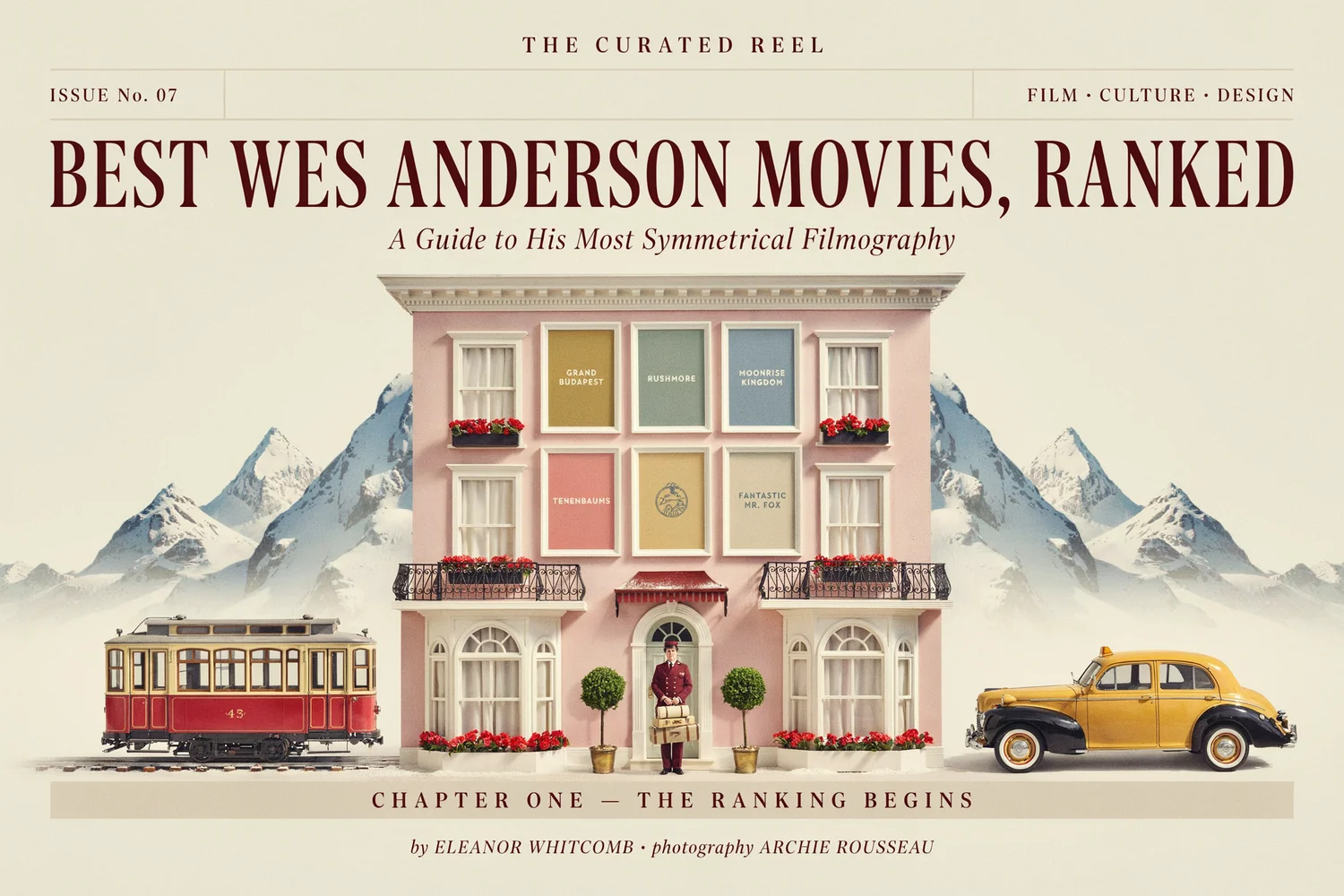
Best Wes Anderson Movies, Ranked: A Guide to His Most Symmetrical Filmography
TL;DR — Wes Anderson has built one of the most instantly recognizable visual styles in modern film, symmetrical framing, meticulously curated color palettes, deadpan line readings, and miniature diorama production design, across more than two decades of work. His essentials are The Grand Budapest Hotel, Moonrise Kingdom, Rushmore, and Fantastic Mr. Fox, with The Royal Tenenbaums as the film that first proved his style could carry genuine emotional weight rather than just visual novelty. Here's a ranked, opinionated guide to his filmography, and an honest take on why his critics' biggest complaint, that his films are all style and no substance, has always missed what he's actually doing.
Get movie picks based on this article
Anderson's filmography rewards close attention. Get a pick for tonight while you decide where to start.
Get movie picksTell us your mood. We'll do the picking.
8 quick questions. Real movie picks from real catalogs — not ads. Free, no sign-up.
Take the quizWhy rank Wes Anderson's films at all?
Wes Anderson is one of those directors whose stylistic consistency is so total that newcomers to his work often assume, not unreasonably, that if you've seen one of his films you've basically seen all of them. That assumption undersells him considerably. While the visual grammar, symmetrical compositions, whip pans, chapter book title cards, is remarkably stable across his filmography, the emotional register and thematic concerns underneath that grammar shift a lot more than his detractors tend to give him credit for. Ranking his films is really an exercise in figuring out which of his recurring obsessions, absent or emotionally unavailable parents, grief processed through elaborate ritual, found family assembled from misfits, land with the most force in any given film.
The best Wes Anderson movies, ranked
1. The Grand Budapest Hotel (2014)
Anderson's most fully realized film, and the one where his stylistic precision and his genuine emotional and political concerns finally lock together perfectly. Ralph Fiennes gives a career best comic performance as Gustave H., a hotel concierge whose fussy, old world elegance becomes a genuinely moving stand in for an entire vanished European culture, one the film's nested framing device makes clear is being actively erased by encroaching fascism even as the story stays mostly comedic on its surface. It's the funniest film in his filmography and one of his saddest, often within the same scene.
2. Moonrise Kingdom (2012)
A genuinely tender, deeply felt story about two twelve year olds running away together, told with all of Anderson's usual formal control but without a trace of the archness that sometimes gets leveled as a criticism at his other work. Jared Gilman and Kara Hayward's lead performances are remarkable for how straight faced and sincere they play material that could easily tip into cutesy in lesser hands, and the adult ensemble around them, Bruce Willis, Edward Norton, Bill Murray, Frances McDormand, gives the film real emotional ballast.
3. Rushmore (1998)
Anderson's second film and the one where his voice fully arrived. Jason Schwartzman's Max Fischer, an overachieving, delusional private school student who falls for a teacher and wages a petty war against Bill Murray's disillusioned industrialist, remains one of the great comedic character studies of the era. It's rawer and less visually controlled than his later work, but that rawness gives it an energy his more polished films sometimes trade away.
4. Fantastic Mr. Fox (2009)
Anderson's stop motion adaptation of Roald Dahl's novel shouldn't work as well as it does, translating his extremely specific live action visual language into animation, and specifically into a genre aimed partly at children, could have been a disaster. Instead it's one of his most purely fun films, funny, warm, and visually inventive in ways his live action work can't quite replicate, while still smuggling in his usual preoccupations with fatherhood, legacy, and reckless self destructive pride.
5. The Royal Tenenbaums (2001)
The film that proved Anderson's aesthetic could support genuinely heavy material, depression, attempted suicide, familial resentment carried for decades, without the visual whimsy undercutting the emotional stakes. Gene Hackman's performance as the family's absent, manipulative patriarch is the film's engine, and the extended Tenenbaum family, Ben Stiller, Gwyneth Paltrow, Luke Wilson, Owen Wilson, remains one of the most fully drawn ensembles Anderson has ever assembled.
6. Asteroid City (2023)
Anderson at his most formally ambitious and, for a lot of viewers, his most opaque, a play within a film within a television broadcast about grief, performance, and the search for meaning at a 1950s junior stargazer convention interrupted by an alien encounter. It rewards patience and multiple viewings more than almost anything else in his filmography, and it contains some of his most direct meditations yet on grief and the inadequacy of language to process it.
7. The Life Aquatic with Steve Zissou (2004)
A genuinely underrated entry that gets overshadowed by the films on either side of it in his filmography. Bill Murray's washed up oceanographer, chasing the shark that killed his partner while navigating a possible estranged son and a documentary crew recording his decline, is one of Murray's best performances in Anderson's ensemble, and the film's melancholy undertow deserves more credit than it usually gets.
8. The Darjeeling Limited (2007)
Three estranged brothers, played by Owen Wilson, Adrien Brody, and Jason Schwartzman, attempt to reconnect on a train journey across India in the wake of their father's death. It's a smaller, more intimate film than a lot of his other work, genuinely funny and occasionally quite moving, even as some of its treatment of India as a backdrop for the brothers' personal growth has drawn fair criticism over the years.
9. The French Dispatch (2021)
An anthology structure built around a fictional magazine's final issue, adapting three separate stories into one film. It's Anderson operating at his most maximalist and formally dense, and while individual segments, particularly the one starring Benicio del Toro as an imprisoned artist, land beautifully, the anthology format keeps the film from building the same sustained emotional momentum as his single narrative work.
10. Isle of Dogs (2018)
A stop motion film set in a near future Japan where all dogs have been exiled to a trash island, following a boy's journey to find his own banished pet. Visually stunning and genuinely inventive, though its use of a Japanese setting without a Japanese protagonist at its center drew real, fair critical debate about whose story it actually is.
11. The Phoenician Scheme (2025)
Anderson's most recent film, a globe trotting espionage adjacent comedy centered on a wealthy, morally compromised businessman reassessing his legacy through his estranged daughter, played opposite Benicio del Toro in the lead role. It's a lighter, more genre playful entry than his most acclaimed work, but it continues his recent run of interrogating fatherhood and inherited moral rot with real specificity.
12. Bottle Rocket (1996)
Anderson's debut feature, a shaggier, much lower budget heist comedy starring Owen and Luke Wilson that lacks the visual polish of everything that came after. It's genuinely charming and worth seeing for completists and for how clearly you can already spot the deadpan comic rhythms that would define his entire career, but it's fair to call it his least essential feature.
Where should a Wes Anderson newcomer actually start?
If his aesthetic intimidates you, or you've bounced off one of his films before and assumed the whole filmography would be more of the same, start with The Grand Budapest Hotel. It's his most purely entertaining film on a scene by scene basis, funny enough to work even if you're skeptical of the visual style, and it's structured as a genuine adventure comedy rather than something more meditative, which makes it the easiest entry point by a wide margin. From there, Moonrise Kingdom and Fantastic Mr. Fox are the next logical stops, both accessible and emotionally direct in ways that ease you into his more formally demanding later work.
My honest take on Wes Anderson as a filmmaker
The most common criticism of Anderson, that his films are all meticulous surface and no real substance underneath, has always struck me as fundamentally backward. His visual precision isn't a substitute for emotional content, it's the delivery mechanism for it. Anderson's characters are, almost without exception, people who've built elaborate, controlled systems, a scout troop, a hotel, a magazine, a family estate, specifically because the actual emotional lives underneath those systems are messy, painful, and largely unmanageable. The symmetry and the color coding aren't decoration, they're a formal expression of characters desperately trying to impose order on grief and disappointment they can't otherwise process. Once you see the films that way, the stylization stops looking like distance from real feeling and starts looking like the exact shape that feeling takes for these specific characters.
I also think his filmography has aged into something genuinely rare, a director whose voice has only gotten more distinct and more personal over three decades, even as the industry around him has pushed harder and harder toward interchangeable, focus grouped visual style. Whatever you think of any individual Wes Anderson film, and I think even his weaker entries are more interesting than most directors' best work, there's real value in a filmmaker this committed to a singular, uncompromised vision across this many films.
If I had to pick one film that best represents why he matters, it would still be The Grand Budapest Hotel, because it's the film where his formal control, his political conscience, and his sense of genuine loss all arrive at exactly the same moment, and it never once feels like any of those elements is getting sacrificed for the others.
Frequently asked questions
What is Wes Anderson's best movie? The Grand Budapest Hotel is the most frequently cited answer among critics and fans, though Moonrise Kingdom and Rushmore both have passionate followings of their own.
What's the best Wes Anderson movie for a beginner? The Grand Budapest Hotel, since it's his most purely entertaining and accessible film on a first watch.
How many movies has Wes Anderson directed? Twelve feature films as of this writing, spanning from Bottle Rocket in 1996 to The Phoenician Scheme in 2025.
Which actors appear most often in Wes Anderson movies? Bill Murray, Owen Wilson, Jason Schwartzman, Adrien Brody, and Willem Dafoe are among his most frequent recurring collaborators.
Are Wes Anderson's animated movies as good as his live action films? Yes, Fantastic Mr. Fox and Isle of Dogs are both widely considered among his strongest work, not lesser side projects.
Why do Wes Anderson movies look so symmetrical? It's a deliberate, consistent formal choice across his career, tied to his broader interest in characters who impose visual and structural order on emotionally chaotic lives.
Is Wes Anderson's style considered style over substance? It's a common criticism, though many critics and fans argue his visual precision is directly tied to, rather than a substitute for, his films' emotional and thematic content.
What is Wes Anderson's most divisive movie? Asteroid City and The French Dispatch tend to split audiences the most, due to their dense, formally experimental structures.
Does Wes Anderson write his own films? Yes, he's written or co-written every film in his filmography, frequently collaborating with writers like Owen Wilson, Roman Coppola, and Noah Baumbach.
What is Wes Anderson's most recent movie? The Phoenician Scheme, released in 2025, starring Benicio del Toro.
Looking for your next movie night pick?
Take our mood based quiz at https://www.suggestionlabs.com/quiz/movies and let us do the deciding for you.