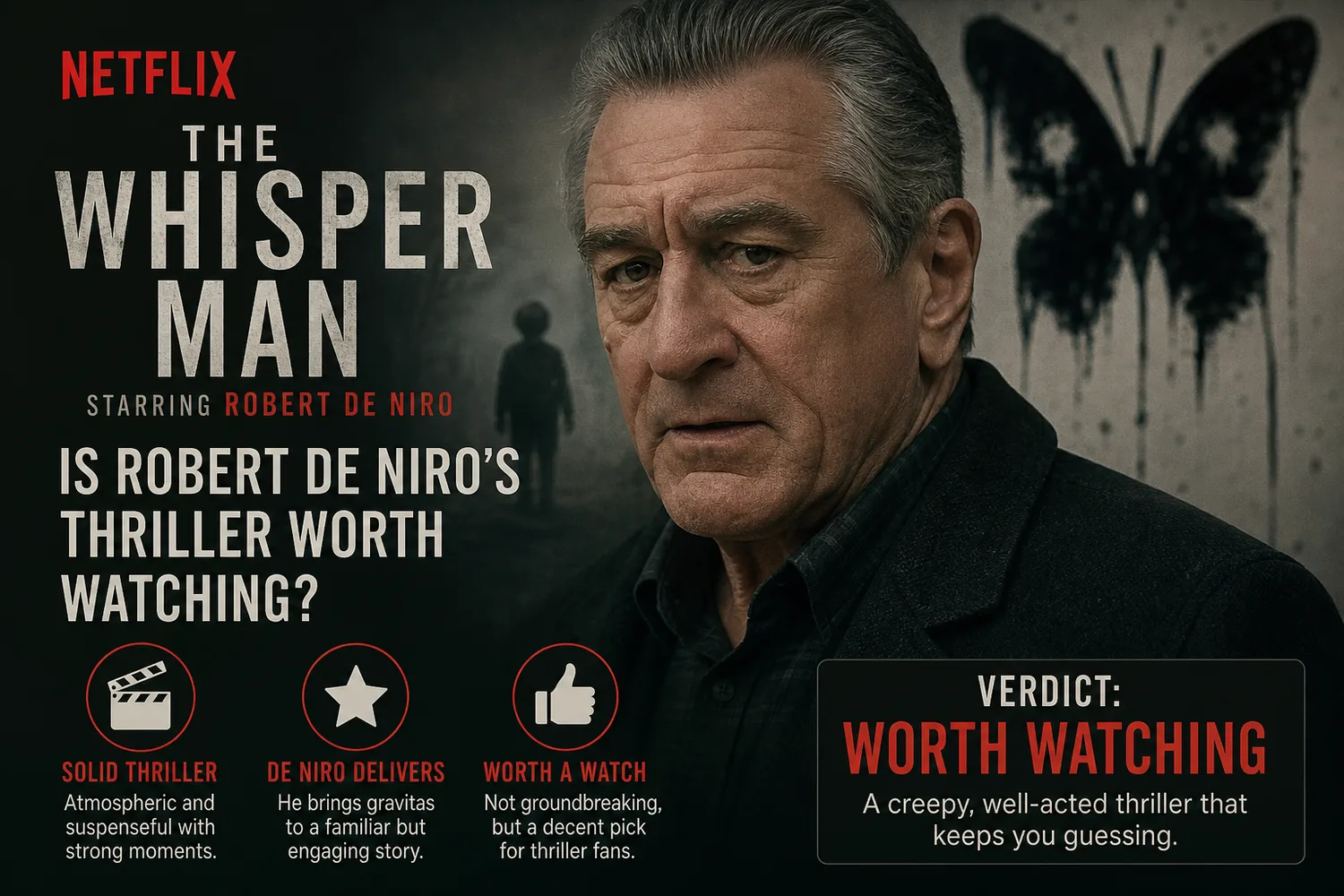
The Whisper Man on Netflix: Is Robert De Niro's Thriller Worth Watching?
TL;DR — The Whisper Man hit Netflix on August 28, 2026, adapting Alex North's New York Times bestselling novel with a stacked cast: Robert De Niro as a retired detective, Michelle Monaghan, and Adam Scott as a widowed crime writer whose young son disappears. Directed by James Ashcroft and produced through the Russo brothers' AGBO, it centers on a chilling playground rhyme and a serial killer case that refuses to stay buried. Here's everything confirmed, plus my honest opinion on how this stacks up against the wave of literary thriller adaptations currently flooding streaming platforms.
Get movie picks based on this article
Want another atmospheric thriller built around a haunting central mystery? Skip the search and jump straight to picks built for that.
Get movie picksTell us your mood. We'll do the picking.
8 quick questions. Real movie picks from real catalogs — not ads. Free, no sign-up.
Take the quizWhat is The Whisper Man about?
The story follows a widowed crime author whose young son goes missing, a nightmare scenario that forces him to reach out to his estranged father, a retired police detective, for help finding the boy. Their investigation together uncovers a disturbing connection to a case from decades earlier: a serial killer known as "The Whisper Man," whose crimes centered around a haunting playground rhyme that's become the film's central, unsettling refrain: "If you leave a door half open, soon you'll hear the whispers spoken."
That rhyme is doing a lot of narrative and atmospheric work here, functioning as both a literal plot device (tied to the killer's methodology and victims) and a piece of effective horror-thriller marketing, the kind of creepy, repeatable phrase that's designed to lodge itself in your head the way the best horror mythology often does.
Who's in the cast?
This is a strong ensemble, and De Niro's presence specifically carries real weight for a project like this. He's an actor whose career has spanned everything from genre-defining crime dramas to, in recent years, a real willingness to lend his gravitas to prestige streaming projects, and casting him as a retired detective drawn back into the exact kind of dark, obsessive investigation that's defined so much of his filmography feels like smart, deliberate casting rather than just a recognizable name attached for marketing purposes.
Adam Scott, meanwhile, continues a run of dramatic work that's steadily distanced him from the comedic roles (Parks and Recreation, most notably) that first made him a household name. Playing a grieving, desperate father searching for his missing son is a significant tonal departure, and it's part of a broader pattern of comedic actors using prestige streaming thrillers to demonstrate real dramatic range.
- Robert De Niro as the retired detective
- Michelle Monaghan
- Adam Scott as the crime writer whose son disappears
- Hamish Linklater
- Owen Teague
- Acston Luca Porto
- Will Brill
Who directs, and who wrote the screenplay?
James Ashcroft directs, with a screenplay from Ben Jacoby and Chase Palmer. Chase Palmer's name will be familiar to horror fans specifically: he co-wrote the 2017 adaptation of Stephen King's It, one of the most successful horror films of the past decade, which gives real credibility to how this project approaches adapting a beloved, atmospheric horror-thriller novel for the screen.
What's the connection to the Russo brothers?
The film is Netflix's sixth collaboration with AGBO, the production company founded by Anthony and Joe Russo, the directing duo behind several of the biggest Avengers films as well as a growing slate of non-Marvel projects across film and television. AGBO has increasingly positioned itself as a serious player in prestige genre content beyond the Russos' blockbuster action pedigree, and The Whisper Man fits into that broader strategy of backing distinctive, book-adapted thrillers with real directorial and screenwriting talent attached.
How closely does the film follow Alex North's novel?
Based on reporting specifically dedicated to tracking the book-to-film changes, there are meaningful differences between North's original novel and this adaptation, enough that outlets have published entire pieces breaking down what changed and why. North himself has reportedly weighed in publicly on his reaction to the changes made in translating his book to the screen, which is a notable and relatively rare level of author engagement with an adaptation of their own work. That kind of direct author commentary tends to signal either genuine enthusiasm for how the adaptation reshaped the material, or at minimum, a level of involvement that suggests the production cared about getting his perspective on record.
For readers of the original novel, going in aware that meaningful changes exist is worth keeping in mind, since a film that diverges significantly from beloved source material can either enhance a story by tightening its structure for a visual medium, or frustrate readers attached to specific details, character beats, or the novel's particular pacing.
What inspired Alex North to write the original novel?
According to reporting around the film's release, North has discussed an unsettling real-life moment involving his own young son saying something creepy that helped inspire the novel's premise, the kind of small, uncanny parenting moment that horror writers are particularly good at turning into fully realized fictional dread. That personal genesis point gives the story's central conceit, a rhyme, a whisper, a child's vulnerability to something unseen, a grounding in genuine, relatable parental anxiety that elevates it above a purely mechanical genre premise.
My honest take on The Whisper Man
I think this is a smart, well-assembled entry in what's become an increasingly crowded field: prestige literary thriller adaptations built around a missing child, a haunted past, and a grizzled investigator (retired or otherwise) drawn back into a case they thought was closed. That's a well-worn structure at this point, but well-worn doesn't mean exhausted, and the specific elements here, De Niro's casting, the playground-rhyme mythology, and a screenwriter with real horror credibility in Chase Palmer, suggest a production that understood exactly which levers to pull to make a familiar structure feel fresh.
What excites me is the casting logic. De Niro playing a retired detective isn't just stunt casting; it's leaning into decades of accumulated audience trust in his ability to convey weary, hard-won moral authority, the sense of a man who's seen the absolute worst of humanity and carries that weight visibly. That's exactly the emotional register this story needs from its central investigator figure, and it's the kind of casting decision that elevates genre material by bringing genuine dramatic gravitas rather than just star power for marketing purposes.
I'm also drawn to the specific choice of central horror device here: a rhyme. Horror has a long, well-earned tradition of using children's rhymes, songs, and games as vessels for dread (think of how effectively "one, two, Freddy's coming for you" works in the Nightmare on Elm Street franchise, or the various creepy nursery-rhyme conceits that have anchored horror properties for decades). There's something specifically unsettling about corrupting the innocent, repetitive structure of a children's rhyme into something menacing, because it plays on the same uncanny-valley instinct that makes corrupted childhood imagery so effective across horror more broadly (see also: this same batch of trending searches includes Buddy, a film built on an almost identical instinct applied to children's television instead of playground rhymes).
My one real question mark, without having seen the film myself, is how it handles the tonal balance between grounded, character-driven grief (a father searching for his missing son, a family confronting an estranged relationship) and the more genre-driven serial-killer mystery elements. Films built around a missing child premise carry real emotional stakes that need careful handling; done well, that grief gives the mystery genuine weight and urgency. Done clumsily, it can feel like the emotional material is being used cynically, purely as a mechanism to generate audience anxiety rather than being honored as a real, serious subject in its own right. Given the pedigree involved here, De Niro, Adam Scott, a screenwriter with real horror craft, and a director bringing his own specific sensibility, I'd bet on this being handled with real care, but it's worth going in aware of that tension.
Overall, this looks like one of the stronger literary-thriller adaptations to hit streaming this year, built on an effective piece of horror mythology and anchored by a cast that brings real dramatic credibility to material that could easily have been generic in less careful hands.
Do you need to have read the novel first?
No, the film is designed to work as a standalone adaptation, and given the reported changes from the source material, going in without pre-existing expectations from the book might actually be the smoother viewing experience for most people. If you're curious about the differences afterward, there's substantial reporting available comparing the book and film versions in detail.
Frequently asked questions
When did The Whisper Man release on Netflix? August 28, 2026.
Who stars in The Whisper Man? Robert De Niro, Michelle Monaghan, Adam Scott, Hamish Linklater, Owen Teague, Acston Luca Porto, and Will Brill.
What book is The Whisper Man based on? Alex North's New York Times bestselling novel of the same name.
Who directs the film? James Ashcroft.
Who wrote the screenplay? Ben Jacoby and Chase Palmer, the latter known for co-writing 2017's It.
What is the film's runtime and rating? 1 hour 54 minutes, rated R.
Is this connected to the Russo brothers? Yes, it's the sixth Netflix collaboration with the Russos' production company, AGBO.
Does the film follow the novel closely? No, there are meaningful changes from the source material, which have been publicly discussed and documented.
What inspired the original novel? Author Alex North has said a creepy comment from his own young son helped inspire the story's premise.
Is The Whisper Man more of a mystery or a horror film? Both, blending a missing-child mystery investigation with genuine horror atmosphere built around its central rhyme mythology.
Looking for your next atmospheric thriller?
If missing-persons mysteries and slow-burn dread are your thing, our movie recommendation quiz can help you find your next watch tonight.