Baccano!: Is It Worth Watching?
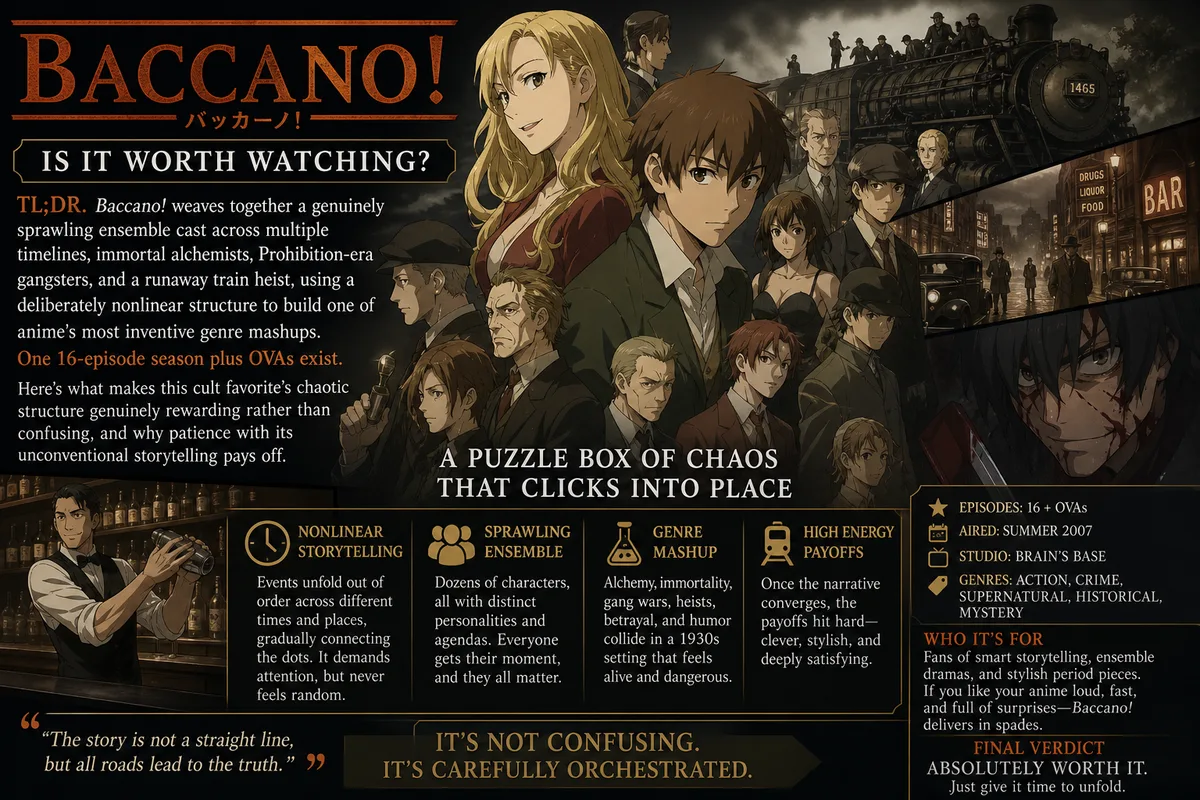
TL;DR — Baccano! weaves together a genuinely sprawling ensemble cast across multiple timelines, immortal alchemists, Prohibition-era gangsters, and a runaway train heist, using a deliberately nonlinear structure to build one of anime's most inventive genre mashups. One 16-episode season plus OVAs exist. Here's what makes this cult favorite's chaotic structure genuinely rewarding rather than confusing, and why patience with its unconventional storytelling pays off.
Get anime picks based on this article
Want a puzzle-box structure that actually rewards patience? Skip the guide and jump straight to picks built for that.
Get anime picksTell us your mood. We'll do the picking.
8 quick questions. Real anime picks from real catalogs — not ads. Free, no sign-up.
Take the quizWhat's the actual premise?
Set primarily in 1930s America, Baccano! follows a genuinely massive ensemble cast, including immortal alchemists seeking eternal life, Prohibition-era gangsters, and a diverse cast of thieves and con artists, whose separate storylines intersect around a legendary train heist and the secret of immortality itself. The narrative deliberately jumps between different time periods and characters' perspectives, gradually revealing how seemingly disconnected events actually connect.
What is the actual "secret of immortality" the story revolves around, without spoiling too much?
A group of alchemists discovered a way to achieve genuine immortality generations before the story's main events, and the consequences and fallout from that discovery ripple forward through decades, connecting characters who initially seem to have nothing to do with each other. This backstory element gives the show a genuine mythological backbone beneath its more immediate gangster and heist plotting.
Why does this show's nonlinear structure work despite being genuinely confusing at first?
Because the eventual payoff of seeing how disparate storylines and time periods connect rewards patient viewers with real, satisfying revelations, using its deliberately scrambled structure specifically to create suspense and surprise that a linear telling couldn't achieve as effectively. Information withheld early on becomes genuinely rewarding once later episodes recontextualize earlier scenes with new understanding.
Is the large ensemble cast actually well developed, or does the show struggle to give everyone real depth?
Genuinely well developed for most major characters, despite the large cast, giving distinct personalities and real character arcs to its many players, though some more minor characters inevitably receive less attention within the show's relatively compact episode count. Characters like Isaac and Miria, a comedic pair of small-time thieves, become genuine fan favorites specifically because of how consistently and specifically their personalities come through despite limited individual screen time relative to the whole ensemble.
Does the show balance its comedic and violent elements well?
Yes, genuinely, blending genuinely dark, violent content with real comedic timing and charm, creating a distinctive tonal balance that's become one of the show's most distinguishing, beloved qualities among fans. Scenes of genuine brutal violence sit comfortably alongside broad comedic beats without either undercutting the other, a genuinely difficult tonal balance to strike consistently.
Is this a good anime for someone who wants a genuinely unconventional structural experience?
Yes, genuinely one of the better picks for that specific interest, its deliberately scrambled nonlinear storytelling rewards attentive, patient viewers specifically drawn to structurally inventive narratives. If you enjoyed the puzzle-piece satisfaction of properly nonlinear films like Pulp Fiction, this scratches a genuinely similar itch within an anime format.
How does the show's setting, 1930s Prohibition-era America, affect its identity?
Genuinely significantly, giving the story a distinctive period atmosphere and genre blend, mixing gangster crime drama conventions with genuinely fantastical elements like immortality in a way that few other anime attempt with this specific historical backdrop. The production makes real effort to capture period-appropriate visual details, adding genuine texture to the setting.
Should newcomers watch the episodes in broadcast order, or is there a recommended alternate viewing order?
Most fans recommend watching in the original broadcast order specifically, since the deliberate scrambling of chronology is part of the intended viewing experience, and reordering episodes chronologically would undermine the show's carefully constructed reveals and structure. Some more dedicated fans do eventually rewatch in chronological order after finishing, as a genuinely different way to appreciate the same story once all the pieces are known.
Is the OVA content essential, or purely optional bonus material?
Generally considered optional bonus content, expanding on side stories and characters rather than continuing the main plot in an essential way, making the core 16-episode season the actual complete story. Fans who particularly enjoyed specific characters may find the OVAs genuinely rewarding as extra time with those characters, even without essential new plot content.
Frequently asked questions
How many episodes is Baccano!? 16 episodes, forming one complete season, plus additional OVA content.
Should I watch Baccano! in broadcast order or chronological order? Broadcast order, since the deliberate scrambling of chronology is part of the intended viewing experience.
Is the large ensemble cast well developed? Yes, genuinely, most major characters receive distinct personalities and real arcs despite the show's compact length.
Does the nonlinear structure make the show hard to follow? Initially somewhat, though the eventual payoff of seeing connections rewards patient viewers.
Is the OVA content essential to the main story? No, generally considered optional bonus material expanding on side stories rather than continuing the main plot.
Does the show balance comedy and violence well? Yes, genuinely, this distinctive tonal balance has become one of its most beloved qualities.
What's the historical setting of Baccano!? Primarily 1930s Prohibition-era America, blending gangster crime drama with fantastical elements.
Is this a good pick for someone who wants structurally inventive storytelling? Yes, genuinely one of the stronger anime for that specific interest.
What's the "secret of immortality" the story revolves around? A group of alchemists discovered genuine immortality generations before the main events, with consequences rippling forward through decades.
Are there fan-favorite characters despite the show's large ensemble? Yes, Isaac and Miria, a comedic pair of thieves, become genuine favorites through consistent, specific characterization.
Should I rewatch the show in chronological order after finishing? Some dedicated fans do, finding it a genuinely different way to appreciate the same story once all pieces are known.
Does the production capture period-appropriate visual detail? Yes, genuinely, making real effort to add authentic texture to its 1930s setting.
Want something else with this kind of inventive structure?
Our anime recommendation quiz can help you find something similar.