Best Books With Twist Endings
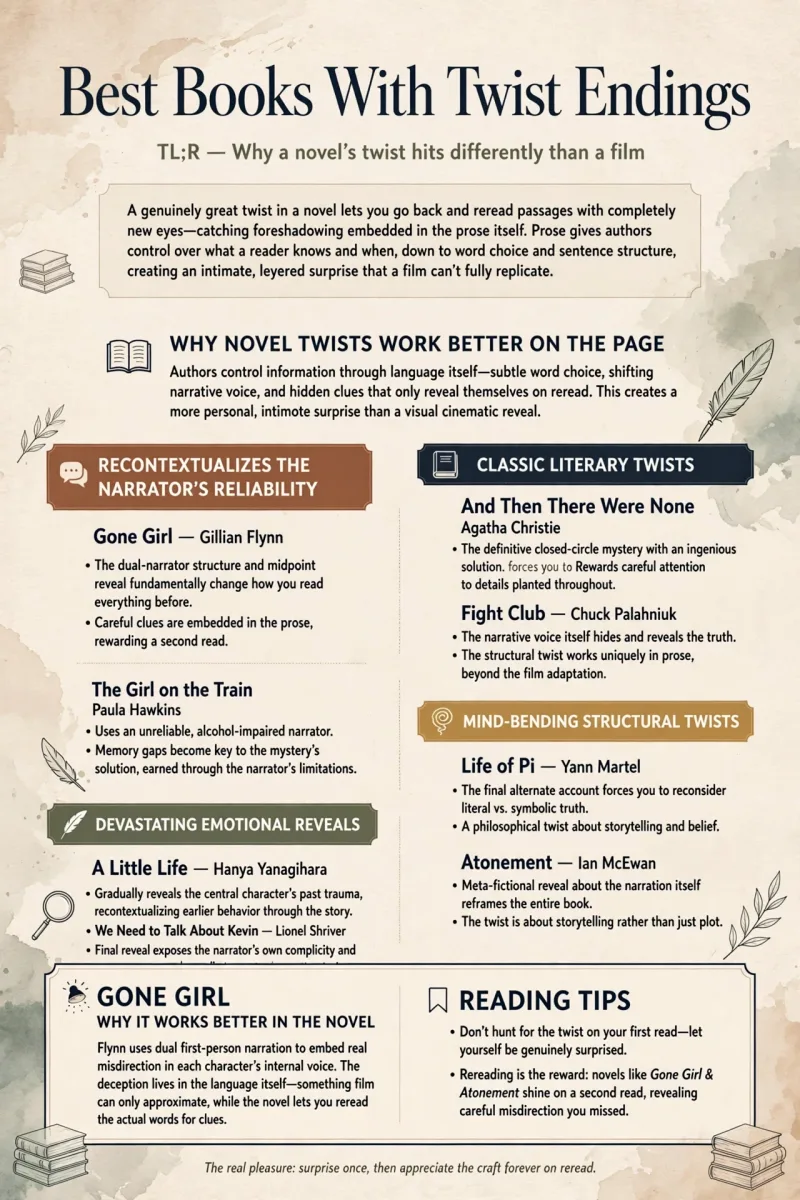
TL;DR — A genuinely great twist ending in a novel does something a film twist often can't quite match, it lets you go back and reread specific passages with completely new eyes, catching foreshadowing embedded directly in the prose itself. Here's a list sorted by how the twist actually functions, plus my honest take on why some literary twists work better on the page than they ever could on screen.
Get book picks based on this article
Want a twist embedded directly in the prose itself? Skip the list and jump straight to book picks built around real, careful misdirection.
Get book picksTell us your mood. We'll do the picking.
8 quick questions. Real book picks from real catalogs — not ads. Free, no sign-up.
Take the quizWhy can a novel's twist sometimes work better than a film's equivalent?
Because prose gives an author direct control over exactly what a reader knows and when, down to individual word choices and sentence structure, in a way that's harder to replicate visually. A skilled author can plant a twist's clues in language itself, a particular word choice, a subtle shift in narrative voice, that only becomes visible in hindsight, creating a genuinely different, more intimate kind of surprise than a purely visual reveal can achieve.
If you want a twist that recontextualizes an entire narrator's reliability
Gone Girl, Gillian Flynn. The dual-narrator structure and midpoint reveal fundamentally change how you read everything that came before, and the novel plants real, careful clues in its prose that a second read reveals more clearly.
The Girl on the Train, Paula Hawkins. Uses an unreliable, alcohol-impaired narrator whose gaps in memory become directly relevant to the mystery's actual solution, making the twist feel earned through the narrator's specific limitations rather than arbitrary.
If you want a genuinely classic literary twist
And Then There Were None, Agatha Christie. Still one of the most influential mystery structures ever written, with a genuinely ingenious solution that rewards careful attention to detail throughout.
Fight Club, Chuck Palahniuk. The novel's structural twist works slightly differently in prose than the film adaptation, with narrative voice itself doing real work to both hide and eventually reveal the truth.
If you want a twist built around a genuinely devastating emotional reveal, not just plot mechanics
A Little Life, Hanya Yanagihara, while not built around a single twist in the traditional sense, reveals its central character's past trauma gradually in a way that recontextualizes his behavior throughout the earlier portions of the novel.
We Need to Talk About Kevin, Lionel Shriver. The final reveal about the narrator's own complicity and self-deception changes how every prior letter in the novel should be read.
If you want a genuinely mind-bending structural twist
Life of Pi, Yann Martel. The novel's final alternate account of events forces you to reconsider the entire preceding narrative's literal versus symbolic truth, a genuinely philosophical rather than purely plot-driven twist.
Atonement, Ian McEwan. The novel's meta-fictional reveal about its own narration recontextualizes the entire book's structure, a twist about storytelling itself rather than just plot events.
My honest opinion on why Gone Girl's twist works better in the novel than in some comparable film thrillers
I think it's because Flynn uses the dual first-person narration to embed real, careful misdirection directly in each character's internal voice, something a film, however well adapted, can only approximate through editing and performance rather than literal narrative control over what you're told and how. The prose format lets the deception live in the actual language itself.
Should you try to spot the twist while reading, or just let the story unfold?
I'd genuinely recommend against actively hunting for the twist on a first read. Part of what makes these novels rewarding is the specific experience of being genuinely surprised, then rereading key passages afterward to appreciate exactly how the author planted the clues you missed the first time.
Is it worth rereading a novel once you know its twist?
Absolutely, and I'd consider it one of the real pleasures of this specific genre. Novels like Gone Girl and Atonement genuinely reward a second read, letting you appreciate the careful, deliberate construction of misdirection that a plot-focused first read tends to miss.
Frequently asked questions
What's a classic novel with a genuinely influential twist ending? And Then There Were None by Agatha Christie remains one of the most influential mystery structures ever written.
Does Gone Girl's twist work better in the book or the movie? Many readers feel the novel's dual first-person narration allows for more precise, embedded misdirection than the film adaptation can fully replicate.
Is Life of Pi's twist a plot twist or something more philosophical? More philosophical, forcing you to reconsider the entire narrative's literal versus symbolic truth rather than simply revealing a hidden plot fact.
Is it worth rereading a novel after learning its twist? Yes, genuinely, several novels on this list specifically reward a second read that reveals carefully planted clues missed the first time.
Want to discover your next great twist-filled read?
Our book recommendation quiz can help you find something new that fits your mood.