Bunny Girl Senpai: Is It Worth Watching?
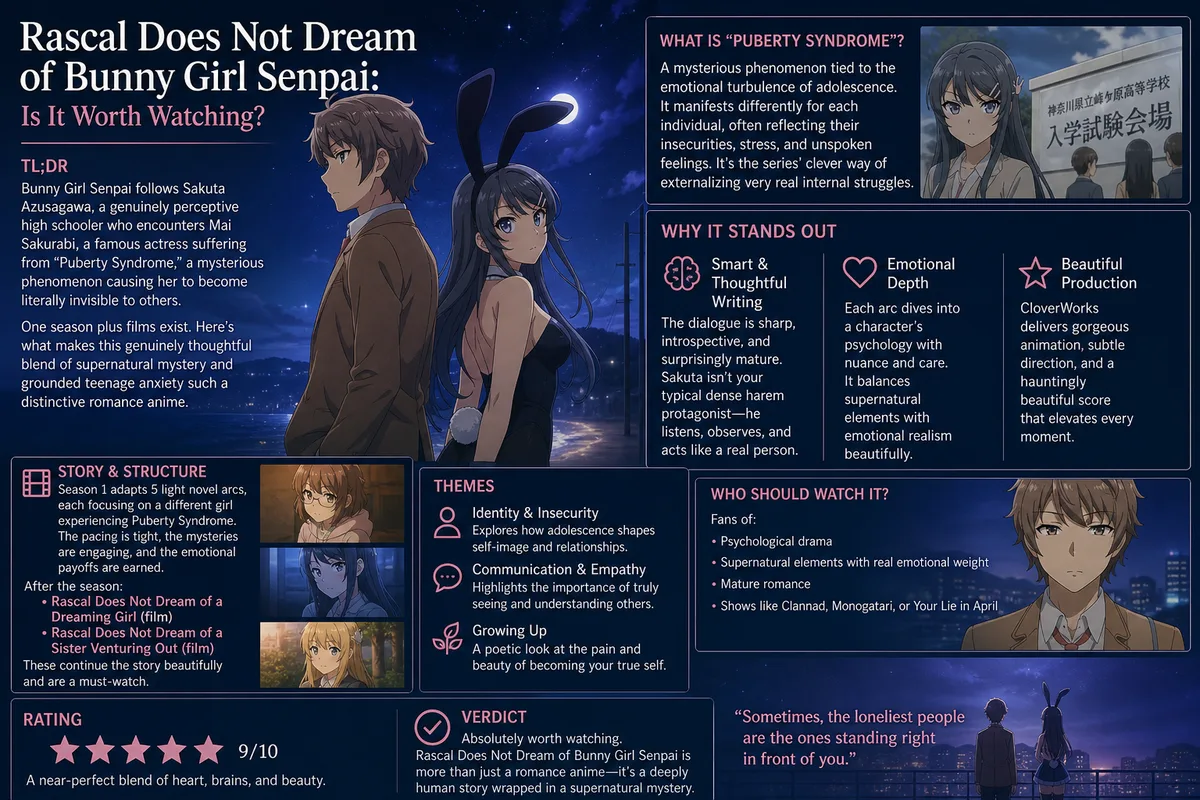
TL;DR — Bunny Girl Senpai follows Sakuta Azusagawa, a genuinely perceptive high schooler who encounters Mai Sakurabi, a famous actress suffering from "Puberty Syndrome," a mysterious phenomenon causing her to become literally invisible to others. One season plus films exist. Here's what makes this genuinely thoughtful blend of supernatural mystery and grounded teenage anxiety such a distinctive romance anime.
Get anime picks based on this article
Want romance with genuine psychological substance? Skip the guide and jump straight to picks built for that.
Get anime picksTell us your mood. We'll do the picking.
8 quick questions. Real anime picks from real catalogs — not ads. Free, no sign-up.
Take the quizWhat's the actual premise?
Sakuta encounters Mai Sakurabi, dressed as a bunny girl in a public library despite being a famous actress who should be recognized everywhere, and discovers she's affected by "Puberty Syndrome," a mysterious condition causing people to gradually become invisible or otherwise afflicted based on genuine, specific adolescent anxieties and insecurities. As Sakuta helps Mai and later other affected classmates, the show explores each character's specific psychological struggle through its supernatural conceit.
What does "Puberty Syndrome" actually represent within the show's themes?
A genuinely clever narrative device for literalizing real adolescent anxieties, fear of being forgotten, pressure to conform, feeling unseen or unheard, giving the show's supernatural elements genuine emotional and thematic weight rather than existing as disconnected fantasy spectacle.
Is the relationship between Sakuta and Mai handled with real depth?
Yes, genuinely, their romance develops through genuine mutual understanding and support during Mai's specific crisis, giving the central relationship real emotional foundation beyond typical romantic comedy convention.
Does the show explore other characters' specific Puberty Syndrome cases with the same depth as Mai's?
Yes, genuinely, subsequent arcs give real, individual attention to other characters' specific psychological struggles, each Puberty Syndrome manifestation tied to a genuinely different, specific adolescent anxiety, giving the show's ensemble cast real depth beyond the central couple.
Is the show's tone more comedic or genuinely emotionally serious?
Genuinely both, blending real comedic banter, particularly between Sakuta and Mai, with genuinely serious emotional stakes tied to each character's specific crisis, giving the show a well-balanced tonal register.
Is the content in this show appropriate for general audiences?
Largely accessible for older teen and adult audiences, dealing with genuine psychological and social anxiety themes without extreme graphic content, making it more broadly watchable than some other entries on this list.
How many seasons and films exist, and does the story feel complete?
One season plus two films, together adapting a substantial, largely complete portion of the ongoing light novel series, giving the anime adaptation a genuinely satisfying overall arc even with source material still continuing.
Is this a good anime for someone who wants romance with genuine psychological substance?
Yes, genuinely, one of the stronger recent examples of using a supernatural or fantastical conceit to explore real emotional and psychological territory within a romance framework.
Frequently asked questions
What's the actual premise of Bunny Girl Senpai? A student helps a famous actress affected by "Puberty Syndrome," a condition making her literally invisible to others.
What does Puberty Syndrome actually represent in the show? A narrative device literalizing real adolescent anxieties like fear of being forgotten or unseen.
Is the central romance handled with real depth? Yes, genuinely, developing through mutual understanding and support during Mai's specific crisis.
Do other characters get their own Puberty Syndrome storylines? Yes, genuinely, each tied to a different specific adolescent anxiety with real individual attention.
Is the show more comedic or emotionally serious? Genuinely both, balancing comedic banter with genuinely serious emotional stakes.
Is Bunny Girl Senpai appropriate for general audiences? Largely accessible for older teens and adults without extreme graphic content.
How many seasons and films exist? One season plus two films, adapting a substantial, largely complete portion of the light novels.
Is this a good pick for romance with psychological substance? Yes, genuinely, using its supernatural conceit to explore real emotional territory.