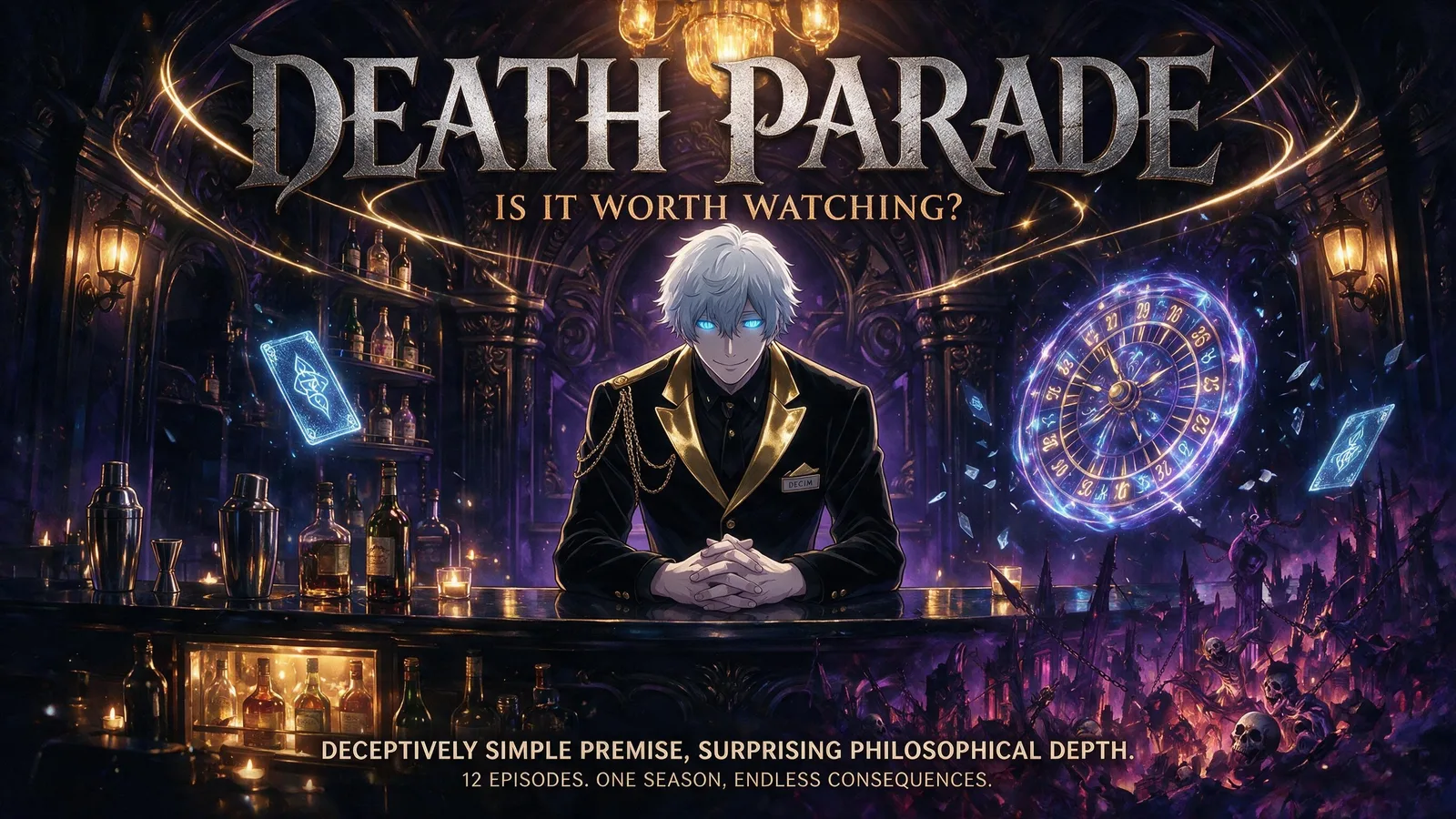
Death Parade: Is It Worth Watching?
TL;DR — Death Parade follows Decim, an arbiter who judges recently deceased souls by forcing them to play genuinely high-stakes games that reveal their true character, deciding whether they're reincarnated or sent to the void. One 12-episode season exists. Here's what makes this genuinely inventive, philosophically ambitious show work, and why its deceptively simple premise leads somewhere unexpectedly profound.

Get anime picks based on this article
Want a deceptively simple premise with real philosophical depth? Skip the guide and jump straight to picks built for that.
Get anime picksTell us your mood. We'll do the picking.
8 quick questions. Real anime picks from real catalogs — not ads. Free, no sign-up.
Take the quizWhat's the actual premise?
When two people die simultaneously, they arrive at Quindecim, a mysterious bar existing between life and death, where the arbiter Decim forces them to play a seemingly ordinary game, darts, bowling, or similar, with genuinely dark stakes attached, revealing their true character under pressure. Based on how they behave during the game, Decim judges whether their souls are reincarnated or sent into an endless void, all while a mysterious woman with no memory of her own death begins to change his own understanding of judgment and humanity.
How does the show's premise actually generate different stories episode to episode?
Genuinely effectively, each new pair of deceased characters arrives with their own specific relationship history and hidden secrets, meaning the games themselves function as a genuine revealing mechanism for whatever particular dynamic, a troubled marriage, a hidden betrayal, unresolved guilt, defines that episode's specific pair, giving the show real narrative variety within its consistent structural conceit.
Why does this show's premise work so effectively as a vehicle for psychological drama?
Because the game structure creates a genuinely controlled, high-pressure environment that reveals characters' true nature in ways ordinary circumstances might not, using the games' escalating stakes to strip away social performance and expose real motivations, fears, and regrets. The specific games chosen, often deceptively simple, become genuine psychological pressure cookers once real, dark stakes are attached to them.
Is this show more episodic or does it build toward a larger, overarching story?
Genuinely both, with each episode largely functioning as a self-contained exploration of two new deceased characters and their specific judgment, while a slower, more sustained narrative about Decim himself and the mysterious woman, later revealed to have real significance to his own understanding of judgment, develops across the full season.
Does the show maintain a consistent emotional register, or does it vary considerably episode to episode?
It varies genuinely significantly, some episodes lean into real, devastating tragedy, exploring genuine grief and moral complexity with real weight, while others carry darkly comedic or even mysteriously unsettling tones, giving the show a genuinely wide emotional range within its shared central premise. This variation keeps the format from feeling repetitive despite its consistent structural conceit.
Is the show's philosophical inquiry into judgment and humanity handled with real depth?
Yes, genuinely, the show asks real, substantive questions about how fairly anyone, human or otherwise, can judge another person's entire character based on limited information or specific moments of pressure, without offering easy or comforting answers. Decim's own arc, gradually questioning the fairness of his role as arbiter, gives this philosophical inquiry real narrative stakes rather than existing as abstract theme alone.
Is the content in this show appropriate for all audiences?
No, genuinely not, several episodes involve real, difficult depictions of trauma, death, and psychological distress that make this a mature series despite its stylish, often deceptively lighthearted bar setting. The tonal contrast between Quindecim's polished, almost glamorous presentation and the genuinely dark subject matter it houses is deliberate and part of the show's overall effect.
Is 12 episodes enough to fully explore this show's premise, or does it feel incomplete?
Genuinely enough for a complete, satisfying arc, though the show's structure, largely episodic character studies with a slower-building central mystery, means it prioritizes thematic exploration over a tightly plot-driven conclusion. Some viewers wish for more episodes exploring additional pairs of characters, though the existing length keeps the format from overstaying its welcome.
How does the show's visual style contribute to its overall effect?
Genuinely significantly, using a distinctive, stylish visual aesthetic for Quindecim itself that creates real tonal contrast against the darker content revealed through its games, a deliberate juxtaposition that heightens the unsettling effect of watching genuine human tragedy unfold within such a polished, almost glamorous setting.
Frequently asked questions
How many episodes is Death Parade? 12 episodes, forming one complete season.
Is Death Parade more episodic or does it build toward one larger story? Genuinely both, blending largely self-contained character studies with a slower, more sustained overarching narrative.
Is the show's tone consistent throughout? No, it varies significantly, ranging from real tragedy to dark comedy to unsettling mystery across different episodes.
Is Death Parade appropriate for all audiences? No, several episodes involve difficult depictions of trauma and psychological distress intended for mature viewers.
Does the show offer clear answers about how fairly people can be judged? No, genuinely, it asks substantive philosophical questions without offering easy or comforting answers.
Is the games' structure just a gimmick, or does it serve the story? It genuinely serves the story, using controlled pressure to reveal characters' true nature and motivations.
Is this show appropriate for someone who wants deep, standalone character studies? Yes, genuinely, its episodic structure lends itself well to that specific viewing preference.
Is 12 episodes a satisfying length for this show's premise? Yes, genuinely, giving a complete arc while prioritizing thematic depth over a tightly plotted conclusion.
How does each episode generate a genuinely different story? Each new pair of characters arrives with their own specific relationship history and secrets, giving real narrative variety within the consistent format.
Does Decim himself have a real character arc? Yes, genuinely, gradually questioning the fairness of his role as arbiter across the season.
How does the show's visual style contribute to its effect? Its stylish, polished setting creates deliberate tonal contrast against the genuinely dark content revealed through its games.
Would more episodes have improved the show? Some viewers wish for additional character pairs, though the existing length keeps the format from feeling repetitive.
Want something else with this level of philosophical ambition?
Our anime recommendation quiz can help you find something similar.